
Canada Workers Benefit 2025: Filing Is How You Get Paid
- October 23, 2026
- Posted by: Taxmetic
- Category: Tax Planning
If you work but earn a modest income, the Canada Workers Benefit could put more than a thousand dollars back in your pocket. But there is a catch that trips up thousands of Ontario workers every year: the advance payments only flow if your tax return is filed. With the October 9, 2026 advance payment now issued, anyone who still has not filed a 2025 return should understand exactly what is at stake and what to do about it.
What the Canada Workers Benefit is
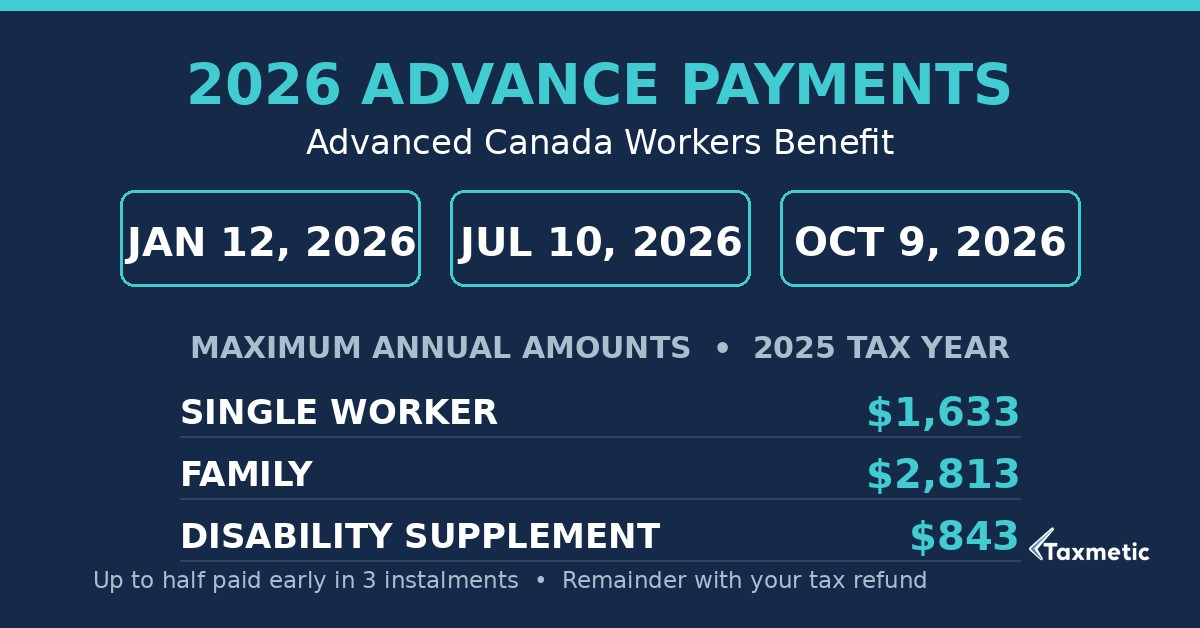
The Canada Workers Benefit is a refundable tax credit for people who work and do not earn much. Unlike a deduction that only reduces tax you owe, a refundable credit can generate a refund even if you owe no tax at all. For the 2025 tax year, a single worker can receive up to $1,633 and a family up to $2,813, with an additional disability supplement of up to $843 for those approved for the Disability Tax Credit.
The Advanced Canada Workers Benefit is the portion CRA pays you early. Instead of waiting until you file to receive the full credit, CRA estimates your entitlement and sends up to half of it in advance, spread across three payments. For 2026, those payments landed on January 12, July 10, and October 9. CRA’s advance payments page sets out how the program works.
You do not apply for the advance separately. There is no form to fill out and no separate enrollment. You claim the Canada Workers Benefit on your tax return by completing Schedule 6, and CRA determines your advance eligibility automatically from there.
Why filing your return is the whole game
Everything about this benefit runs through your tax return. CRA calculates your advance payments based on the return you filed. If you claimed the benefit last year, the advances arrive on their own. If you did not file, or did not claim it, there is nothing for CRA to base an advance on, and no advance payment comes.
This is where late filers get hurt. If you have not yet filed your 2025 return, you have already missed the January, July, and October 2026 advance payments. The money is not necessarily lost forever: you can still claim the full Canada Workers Benefit when you file, and any unpaid balance comes to you as part of your refund. But the point of the advance system is to get money to low-income workers during the year, when bills are due, not months later at tax time.
What is certain, from CRA’s own materials, is the mechanical reality: CRA calculates your advance payments from your filed return. No filed return means no calculated entitlement, and no calculated entitlement means no advance payments. Every week you delay filing is a week the system cannot pay you.
Who qualifies
The basic eligibility rules are straightforward. You must be a Canadian resident throughout the year and be at least 19 years old on December 31, unless you have a spouse, common-law partner, or dependent child. You must have working income, and your adjusted net income must fall below the phase-out thresholds. For the 2025 tax year, the basic benefit starts shrinking above $26,855 of adjusted net income for a single worker and $30,639 for a family, and disappears entirely above $37,742 and $49,393 respectively. Quebec, Alberta, and Nunavut use adjusted versions of the benefit with different limits.
Two details catch people out. First, your working income generally must exceed $3,000 to claim the basic benefit. Workers with very short or intermittent work periods sometimes fall below this line without realizing it. Second, you are not eligible if you were a full-time student for more than 13 weeks during the year (unless you had an eligible dependent), were incarcerated for 90 days or more, or hold diplomatic tax-exempt status.
For the disability supplement, you must also have an approved Disability Tax Credit on file with CRA. The supplement carries higher income limits and can be paid even when you no longer qualify for the base benefit, so it is worth checking even if your income has risen.
How to claim it correctly
• Complete Schedule 6. The benefit is claimed through Schedule 6 of your return, and the result flows to line 45300. Many people assume tax software handles it automatically. Usually it does, but confirm that Schedule 6 was actually generated before you file. A return filed without it claims nothing.
• Report any advances you received. If CRA sent you advance payments during the year, you will receive an RC210 slip. The total from box 10 goes on line 41500 of your return through Schedule 6. This reconciles what you already received against your final entitlement.
• Check your working income lines. Working income is not only hourly wages. It includes employment income, certain taxable scholarships and bursaries, and qualifying self-employment income. Income reported on the wrong line, or omitted entirely, can push your working income below the thresholds that unlock the benefit.
• File even if you expect no refund. Some low-income workers skip filing because they owe no tax. That is exactly backwards for this benefit. The Canada Workers Benefit is refundable, which means filing is how you get paid. No return, no benefit.
• Set up direct deposit. CRA deposits arrive fastest by direct deposit. Cheques add days or weeks of mail delay to every payment, including any catch-up amounts owed when you file late.
What to do right now
If you have not filed your 2025 return, file it. That single step preserves your full Canada Workers Benefit entitlement and gets any unpaid amounts moving toward you. If you have filed but are unsure whether Schedule 6 was completed, review your return or ask your preparer to confirm. If you received advance payments, make sure the RC210 amounts are correctly reported so you are not reassessed later for a mismatch.
For Ontario workers juggling gig income, part-time shifts, or seasonal work, the $3,000 working-income threshold deserves a second look before you file. Pull your slips, add up every source of working income, and make sure nothing was missed. A few hundred dollars of unreported self-employment income can be the difference between qualifying and not.
This content is for educational purposes only and must not be taken as professional advice.
Not sure you claimed everything you’re owed? Book a free consultation or call (437) 966-0033. Taxmetic helps Ontario workers file correctly and claim every credit available.
Related reading: Corporate Tax Filing Ontario: Deadlines, Rates, and Key Tips • Bookkeeping for Doctors Ontario: 6 Costly Mistakes to Fix