
Ontario Dividend Tax Credit Drops January 1, 2027: Should You Accelerate Dividends?
- October 27, 2026
- Posted by: Taxmetic
- Category: Corporate Tax
On January 1, 2027, a small number in Ontario’s tax system changes, and for owners of small corporations it changes the value of every non-eligible dividend they take. Ontario is cutting the non-eligible dividend tax credit from 2.9863 percent to 1.9863 percent. That is a one percentage point cut, and it is the direct consequence of a corporate tax cut that already took effect. The question owners are asking now is whether to take dividends in 2026, while the larger credit still applies, instead of waiting until 2027. The answer is not automatic. Acceleration helps in some situations and hurts in others, and the difference comes down to five factors this article works through.
Why the credit is changing at all
The change comes from Ontario’s 2026 Budget, tabled on March 26, 2026. The budget cut Ontario’s small business corporate income tax rate from 3.2 percent to 2.2 percent, effective July 1, 2026, with proration for taxation years that straddle that date. The combined federal and Ontario small business rate is now 11.2 percent on the first $500,000 of active business income earned by a Canadian-controlled private corporation, while the general combined rate in Ontario remains 26.5 percent.
Dividends are paid out of after tax corporate earnings, so the personal tax system gives shareholders a dividend tax credit that approximates the corporate tax already paid. When the corporate rate falls, the credit falls with it, or the same dollar would be undertaxed overall. That is the principle called integration: the system tries to make the total tax on corporate earnings roughly the same whether the income is earned directly by an individual or routed through a corporation. The credit cut is therefore not a standalone tax increase. It is the personal side of the corporate rate cut, and the two must always be read together.
How dividend taxation works in Canada
Canada taxes dividends in two steps. First, the cash dividend is grossed up, meaning a larger amount is added to income. Second, a dividend tax credit is applied against the tax on that larger amount. The size of the gross-up and the credit depends on which kind of dividend you receive.
Eligible dividends are generally paid out of income that was taxed at the general corporate rate, typically by large public companies. They carry a 38 percent gross-up and a federal credit of 15.0198 percent of the taxable amount, plus an Ontario credit of 10 percent of the taxable amount.
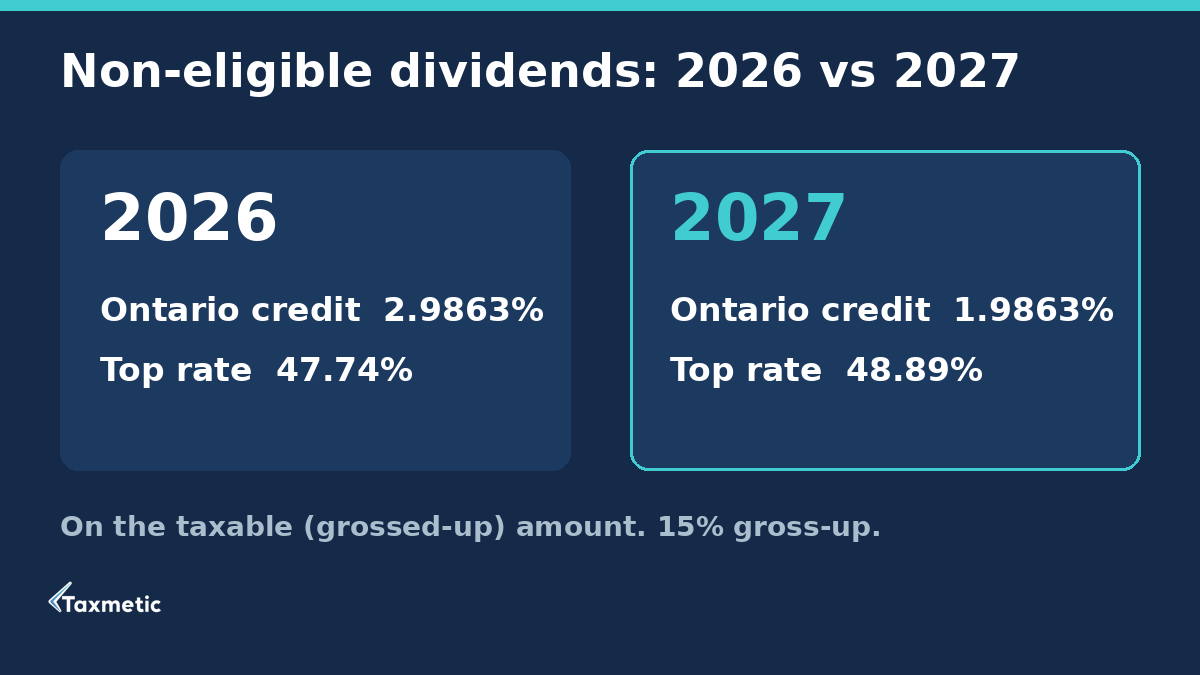
Non-eligible dividends, which the Canada Revenue Agency calls “other than eligible” dividends, are generally paid out of income that benefited from the small business deduction, which is the normal case for an owner-managed corporation. They carry a 15 percent gross-up and a federal credit of 9.0301 percent of the taxable amount, plus an Ontario credit that is 2.9863 percent of the taxable amount in 2026 and 1.9863 percent from January 1, 2027.
Your T5 slip reports each kind separately, so you do not have to guess which kind you received. At Ontario’s top marginal rate, the combined federal and Ontario personal rate on non-eligible dividends is 47.74 percent in 2026 and rises to 48.89 percent in 2027, assuming no other personal rate changes. Eligible dividends at the top rate sit at 39.34 percent. The gap between the two kinds is the reason the eligible versus non-eligible distinction matters so much in owner-manager planning.
What the cut is worth in dollars
Take a $100,000 non-eligible dividend. The 15 percent gross-up makes the taxable amount $115,000. Ontario’s credit on that amount is $3,434.25 at the 2026 rate of 2.9863 percent, and $2,284.25 at the 2027 rate of 1.9863 percent. The difference is $1,150, which is exactly one percent of the taxable amount. Scale that to a $250,000 dividend and the credit difference is $2,875. Scale it to $500,000 and it is $5,750.
That arithmetic is clean, and it is also incomplete. The credit difference is only one line in a larger calculation. Whether accelerating a dividend actually saves you money depends on the tax rate that applies to the dividend in each year, and that rate depends on your total income in each year. A dividend taken in a year when you are already at the top marginal rate is taxed very differently from the same dividend taken in a year when you have room in lower brackets.
The five factors that decide the acceleration question
First, compare your marginal rate in 2026 with your expected marginal rate in 2027. If 2026 is a lower income year for you, perhaps because of a sabbatical, a parental leave, a business loss year, or a planned retirement, taking the dividend in 2026 can win twice: you get the larger credit and the lower bracket. If 2026 is already a top bracket year and 2027 looks lighter, waiting can win even after giving up the one point of credit, because the bracket saving can be larger than the credit loss. Run both years side by side before deciding.
Second, check the corporation’s cash and retained earnings. A dividend can only be paid out of funds the corporation can spare. Draining operating cash to chase a tax saving is poor business, and a dividend that leaves the corporation short for payroll, suppliers, or a tax instalment has cost more than it saved. Confirm the corporation’s cash position after the dividend, not just before it.
Third, remember that a dividend is taxed in the year you receive it. Timing a dividend therefore means controlling both the declaration and the payment dates, and documenting them. A resolution passed in December with payment in January does not automatically land in the earlier year. Confirm the dates with your accountant before year end, and keep the directors’ resolution and the payment record together in the corporate minute book.
Fourth, account for the knock-on effects of extra income in 2026. The gross-up raises your net income, not just your tax. That can affect income tested benefits and credits, and it raises the base on which next year’s instalments are calculated. A large 2026 dividend can also create a personal tax balance due April 30, 2027, which needs cash set aside. The credit saving is real, but it is not free of side effects.
Fifth, redo the salary versus dividend comparison for 2027. Many owner-managers choose between salary and dividends each year, and the credit cut changes that comparison by one point on the taxable amount of non-eligible dividends. Salary carries Canada Pension Plan contributions and RRSP room, while dividends do not, so the comparison was never about the credit alone. Recompute it with the 2027 credit before locking in a 2027 compensation plan. Also note that dividends paid to family members can attract the tax on split income rules, so any plan that spreads dividends across family members needs its own review before it is implemented.
A practical year end sequence
Start with a two year income projection, 2026 and 2027, including salary, dividends, and any other income. Price the same dividend in both years using the 2026 credit and the 2027 credit, at your actual marginal rate in each year. Then test the corporation’s cash position after the dividend, confirm the declaration and payment dates, and set aside the personal tax the 2026 dividend will create. Only then decide how much, if anything, to accelerate. Owners who skip the projection step are guessing, and the credit cut rewards precision, not haste.
The broader point is worth stating plainly. The 2026 Budget gave small corporations a lower corporate rate and took back part of that benefit on the personal side. Owners who leave profits inside the corporation keep the full corporate saving. Owners who extract profits as non-eligible dividends face a slightly higher personal cost from 2027 onward. The system still integrates, just at a new level. Your job before December 31 is to decide which side of that line each dollar belongs on.
Book a free consultation
If you own an Ontario corporation and want the two year dividend comparison run on your actual numbers, Taxmetic can help. Taxmetic is based in Hamilton and serves clients across the GTA and Ontario. Book a free consultation at https://taxmetic.ca/contact/.
This content is for educational purposes only and must not be taken as professional advice.