
Year-End Salary vs. Dividends for Ontario Doctors and Dentists
- November 3, 2026
- Posted by: Taxmetic
- Category: Corporate Tax
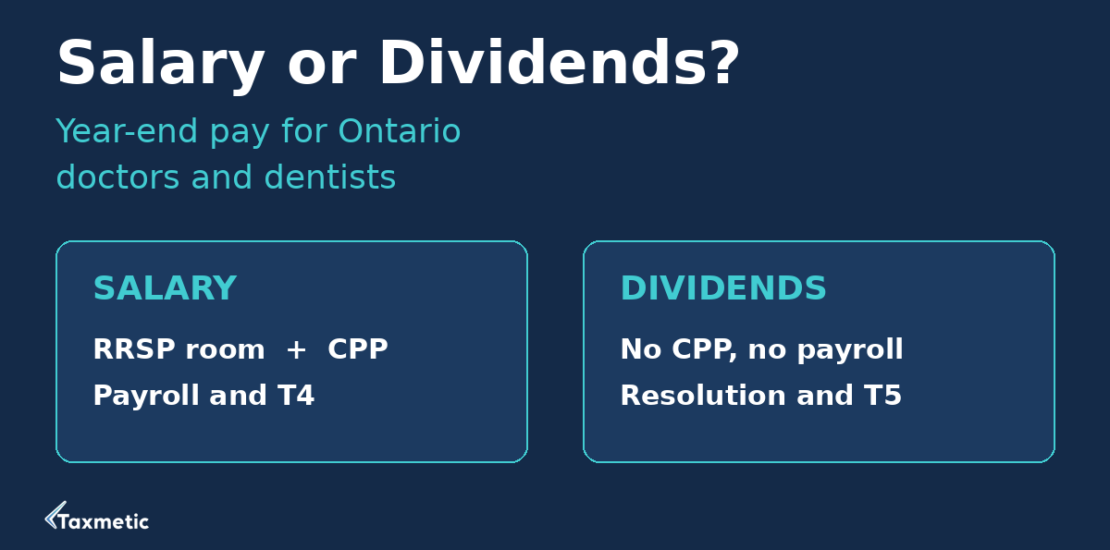
Every year-end, incorporated doctors and dentists in Ontario face the same question: should the professional corporation pay salary, dividends, or a mix of both? The question sounds like a tax question. In practice, it is a retirement, cash flow, and paperwork question as well, and the tax difference alone is smaller than most owners expect. Canada’s tax system is built around integration, the principle that total tax on corporate earnings should end up roughly the same whether income reaches you as salary or as a dividend. The system is not perfect, but it is close enough that the side effects of each choice often matter more than the headline tax rate.
This article works through the 2026 numbers and the five factors that should decide the mix before December 31. It is written for doctors and dentists who practise through an Ontario professional corporation. The rules for professional corporations are stricter than the rules for an ordinary corporation, and that matters for the dividend side of the choice.
How salary works
Salary is a deductible expense of the corporation. It reduces corporate taxable income dollar for dollar, then lands on your personal return as employment income, taxed at your marginal rate. It runs through payroll, so source deductions must be remitted and a T4 slip is issued at year-end.
Salary does two things dividends cannot do. First, it creates RRSP room. RRSP room is based on earned income, and salary counts as earned income while dividends do not. For 2026, the RRSP dollar limit is $33,810, and new room is generally 18 percent of the prior year’s earned income up to that limit, plus unused room carried forward and minus any pension adjustment. Second, salary is pensionable. It builds Canada Pension Plan entitlement, and the corporation funds both halves of the contribution through payroll.
For 2026, the Canada Pension Plan numbers are a first earnings ceiling of $74,600 and a second ceiling of $85,000, with a $3,500 basic exemption. The base contribution is $4,230.45 from each side at the first ceiling, and the second tier adds $416 from each side between the two ceilings. An owner-manager paying salary of $85,000 or more therefore funds about $9,292.90 in total CPP contributions across both halves. That is real money, and it is the main cash cost of choosing salary. What it buys is CPP entitlement and RRSP room, not a tax saving on its own.
How dividends work
Dividends are paid out of the corporation’s after-tax retained earnings. The corporation gets no deduction. On your personal return, the dividend is grossed up and a dividend tax credit is applied, a mechanism designed to credit you for the corporate tax already paid.
Non-eligible dividends, which are generally paid out of income that benefited from the small business deduction, carry a 15 percent gross-up and a federal credit of 9.0301 percent of the taxable amount, plus an Ontario credit of 2.9863 percent of the taxable amount in 2026. That Ontario credit falls to 1.9863 percent from January 1, 2027, following Ontario’s cut to the small business corporate rate from 3.2 percent to 2.2 percent effective July 1, 2026. The combined federal and Ontario small business corporate rate is now 11.2 percent on the first $500,000 of active business income of a Canadian-controlled private corporation, while the general combined rate in Ontario remains 26.5 percent.
Dividends skip CPP contributions and payroll remittances, and the paperwork is simpler: a directors’ resolution and a T5 slip rather than a payroll cycle. What dividends cost you is RRSP room and CPP entitlement. A year funded entirely by dividends builds no new RRSP room and no CPP pensionable earnings for that year, so retirement saving becomes entirely your own job, through corporate retained earnings or personal non-registered saving.
The professional corporation constraint
Ontario doctors and dentists practise through a medicine professional corporation or a dentistry professional corporation, governed by the Regulated Health Professions Act and by the College of Physicians and Surgeons of Ontario or the Royal College of Dental Surgeons of Ontario. The corporation must hold a certificate of authorization from its college, and it may carry on only the practice of the profession and activities related to it.
Share ownership is restricted. Voting shares must be held by members of the same profession. Non-voting shares may be held by certain family members, generally a spouse, child, or parent of the voting shareholder. That family share structure is what makes dividends to family members possible in form, but the tax on split income rules, in place since 2018, sharply restrict dividend splitting to family members. A dividend to a spouse or adult child is not automatically effective for tax purposes. It needs its own review before it is declared, and it should never be assumed to work because the share structure allows it.
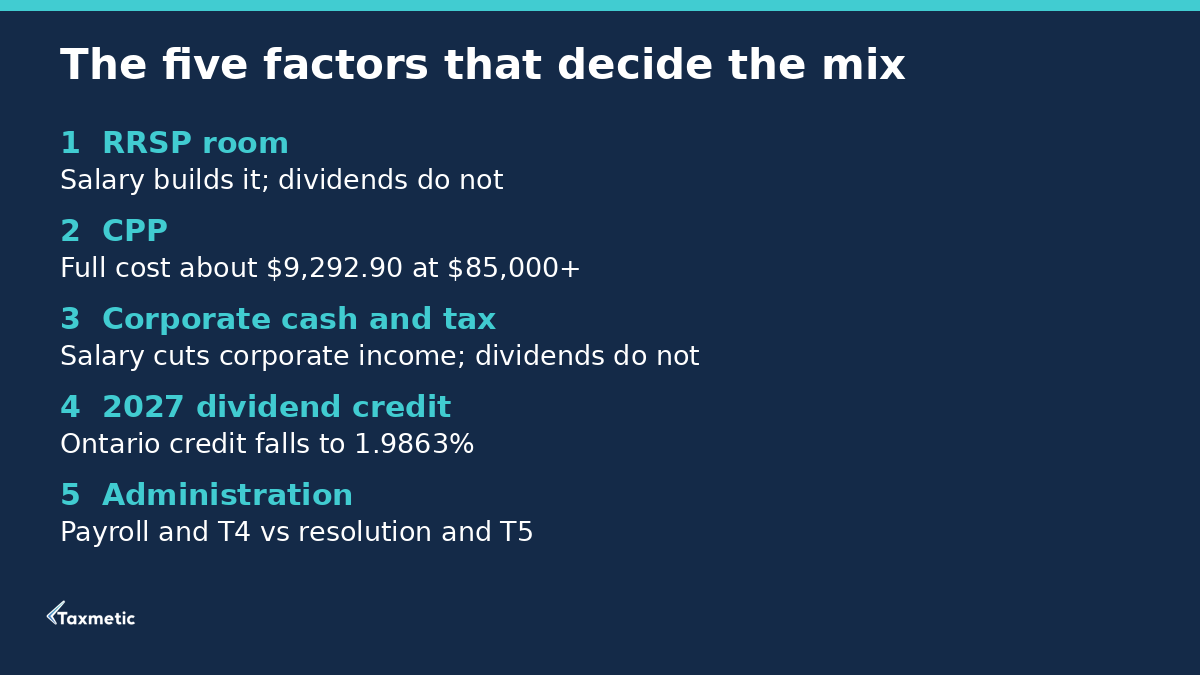
The five factors that decide the mix
First, decide how much RRSP room you want to build. If building RRSP room matters to you, you need salary, and you need enough of it. A small salary that generates only a little room while still triggering payroll administration may be the worst of both worlds. Many incorporated professionals therefore set salary at least high enough to generate meaningful RRSP room, then top up with dividends.
Second, decide deliberately about CPP. Paying the full CPP cost buys entitlement and a measure of forced retirement saving. Skipping CPP keeps about $9,292.90 in the corporation at maximum salary, to invest or retain instead. Neither choice is wrong, but drifting into one by default is the mistake. Make the choice on purpose, and revisit it as your retirement plan changes.
Third, look at the corporation’s cash and tax position together. Salary reduces corporate taxable income in the year it is paid or accrued, which can help keep the corporation within the small business limit. Dividends come from after-tax earnings, so they do not reduce corporate tax. If the corporation is close to the $500,000 small business limit, the salary versus dividend choice interacts with that limit, and the comparison should be run on the corporation and the individual together, not on either one alone.
Fourth, weigh the 2027 dividend credit change. The Ontario non-eligible dividend tax credit cut from 2027 onward makes dividends slightly more expensive personally from next year, by one percent of the taxable amount of the dividend. That change alone should not drive a large 2026 dividend, because a dividend is taxed in the year you receive it and the bracket that applies in each year matters more than the credit alone. It is, however, one more reason to recompute the salary versus dividend comparison for 2027 rather than rolling the 2026 mix forward unchanged.
Fifth, be honest about administration. Salary requires a payroll account, timely source deduction remittances, and a T4. Dividends require a resolution and a T5, but they also require the corporation to have retained earnings to pay them and the cash to fund the personal tax they create. If payroll remittances are a recurring struggle, that is a practical argument for a heavier dividend mix, provided the RRSP and CPP trade-offs are accepted consciously.
A practical year-end sequence
Start with the personal cash you need for the year, then set salary to cover the RRSP room and CPP entitlement you have decided to build. Top up with dividends to reach the total cash target, checking the corporation’s retained earnings and cash after the dividend. Confirm the declaration and payment dates for any dividend, since a dividend is taxed in the year it is received, and confirm that any bonus accrued at year-end will actually be paid within the statutory payment window so it stays deductible in the year it was accrued. Finally, run the 2027 comparison with the lower Ontario dividend credit before locking in next year’s mix.
The blend is the point. Very few incorporated doctors or dentists should be all salary or all dividends every year. The right mix changes as income, retirement goals, and corporate cash change, and year-end is the moment to reset it deliberately rather than repeat last year’s answer.
Related reading
• Self-Employed Tax Services in Ontario
• Corporate Tax Filing Ontario: Deadlines, Rates, and Key Tips
• Do I Need an Accountant for My Small Business?
Book a free consultation
If you practise through an Ontario professional corporation and want the salary versus dividend comparison run on your actual numbers for 2026 and 2027, Taxmetic can help. Taxmetic is based in Hamilton and serves clients across the GTA and Ontario. Book a free consultation at https://taxmetic.ca/contact/.
This content is for educational purposes only and must not be taken as professional advice.