
CRA 2-Year Audit Workplans: How Ontario Businesses Prepare
- October 21, 2026
- Posted by: Taxmetic
- Category: Corporate Tax
The Canada Revenue Agency has changed how it audits large businesses, and the shift matters for any Ontario company that could find itself under review. According to reporting by the tax law firm Millar Kreklewetz, CRA has advised at a major industry roundtable that its auditors may now adopt two-year audit workplans, requesting records from multiple taxation years at the very outset of an audit, rather than examining one year at a time. Here is what changed, why it matters, and how Ontario businesses should prepare.
What the CRA announced: two-year audit workplans
The announcement came through the CRA’s International and Large Business Directorate, the division responsible for auditing Canada’s largest corporate taxpayers. Beginning with the 2023 and 2024 taxation years, the directorate has implemented a two-year audit workplan for audit files where similar issues exist from year to year. Millar Kreklewetz sets out the announcement and its implications in its Tax Audit Series report on the new workplans.
In practical terms, this means that when CRA opens an audit, the auditor may now ask for documentation covering two years simultaneously from day one. The stated purpose is to help auditors identify recurring issues, patterns that repeat across taxation years, such as transfer pricing positions, intercompany transactions, or recurring deductions that look the same year after year.
Although the announcement was made in the income tax context, Millar Kreklewetz notes that the same administrative principles apply to GST and HST audits, excise duty, and other indirect tax audits, where recurring issues frequently span multiple reporting periods. A business that collects and remits HST, for example, faces the same multi-period logic: if the auditor questions how you treated a particular supply in 2023, they will want to see how you treated it in 2024 as well.
The structure of the directorate reinforces the approach. CRA’s own evaluation of its international and large business programs describes an integrated team model, in which domestic, international, and tax avoidance auditors work a file together under a case manager who acts as the single point of contact, an approach the agency summarizes as one team, one voice, one audit. A two-year workplan fits that model: one coordinated team examining connected years as a single file.
Why this is a bigger deal than it sounds
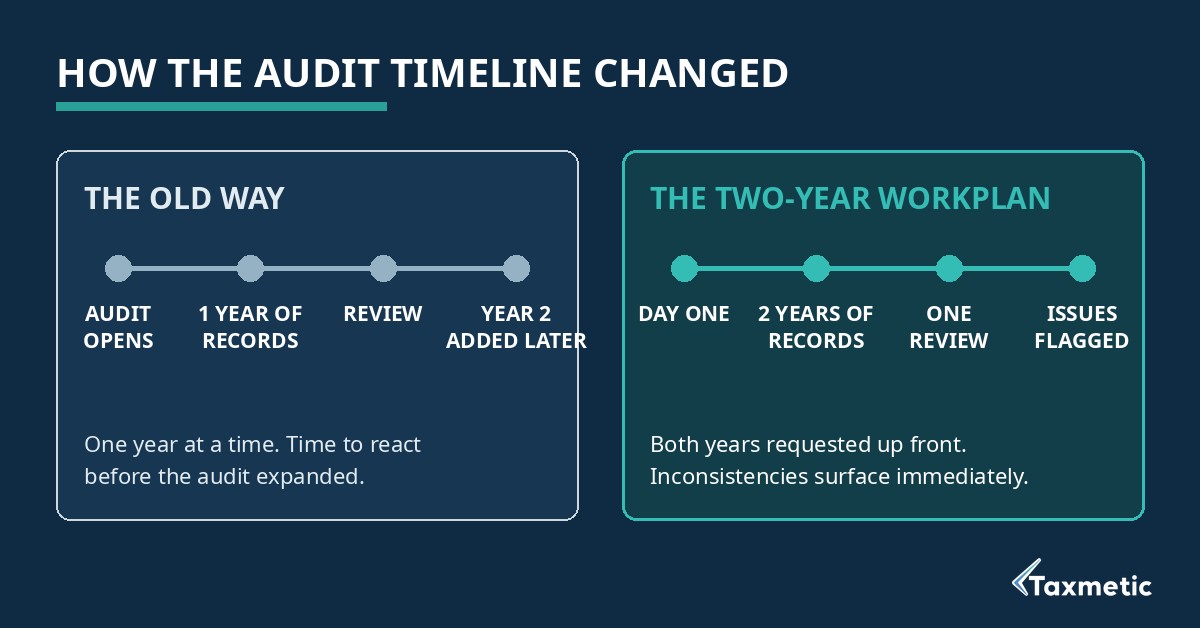
Under the old approach, an audit typically began with a records request focused on a single taxation year. The taxpayer produced that year’s books, the auditor reviewed them, and only if issues emerged did the audit expand. Businesses had time to understand the auditor’s concerns before the second year came into scope.
The two-year workplan compresses that timeline. From the first information request, you may need to produce complete, organized records for two full years. For a business with clean, consistent bookkeeping, this is manageable. For a business whose records are messier in one year than the other, or where a position taken in 2023 was quietly changed in 2024, the simultaneous request exposes inconsistencies immediately.
There is also a workload reality behind this change. CRA’s own published evaluation of its international and large business programs notes that the $250 million annual gross revenue threshold defining a large business has been in place for more than two decades without adjusting for inflation, while the population it covers has grown substantially. The agency is looking for efficiency. A two-year workplan lets one audit team cover more ground per file, which is good for CRA’s resource management and more demanding for the taxpayer on the receiving end.
How Ontario businesses should prepare
You do not need to be a $250 million enterprise to take the lesson here. CRA’s administrative habits tend to migrate across programs over time, and the discipline that a two-year workplan demands is simply good tax hygiene for any Ontario business. Here is what to do now, before any audit letter arrives.
Keep multi-year records consistent and complete. The core risk of a two-year workplan is inconsistency between years. Review how recurring transactions were treated in 2023 and 2024. If your treatment of owner draws, management fees, intercompany charges, or HST on particular supplies changed between years, make sure you can explain why, with documentation. An unexplained change across years is exactly the kind of recurring issue pattern the new workplans are designed to catch.
Organize records by issue, not just by year. Most businesses file records chronologically. Consider also maintaining issue-based summaries for material positions: transfer pricing documentation, scientific research and experimental development claims, and large capital asset additions. When an auditor asks for two years of records on a specific issue, handing over a coherent package beats handing over two years of unsorted ledgers.
Respond to the first request as if it covers everything. Under the old model, some taxpayers treated the initial records request as a fishing expedition and produced the minimum. Under a two-year workplan, the initial request is the main event. Incomplete or disorganized production at the outset does not buy time. It signals to the auditor that deeper digging is warranted.
Get professional help at the audit stage, not the objection stage. Tax practitioners consistently advise involving experienced counsel early, ideally when the auditor first makes contact. By the time a reassessment is issued and you are filing a notice of objection, the factual record is largely set. Early involvement lets you understand what the auditor is looking at, present your positions coherently across both years, and avoid creating new issues through casual answers to auditor questions.
Review your GST and HST positions with the same lens. Because the two-year logic extends naturally to indirect tax, Ontario businesses should apply the same multi-year consistency review to their HST filings. Common trouble spots include the treatment of management fees between related companies, place-of-supply determinations for services, and input tax credit claims on mixed-use expenses. If your HST position on any of these shifted between reporting periods, document the reason.
What has not changed
A change in audit administration is not a change in the law. Your rights as a taxpayer are the same: the right to be informed, the right to have the law applied consistently, and the normal reassessment time limits that protect closed years. Those limits are generally three years from the notice of assessment for individuals and Canadian-controlled private corporations, and four years for other corporations. A two-year workplan does not give CRA the power to audit years that are statute-barred. It simply means that for years already open to audit, the agency will look at two of them together from the start.
It is also worth keeping perspective. This announcement concerns the International and Large Business Directorate. Most small and medium Ontario businesses will never face an ILBD audit. But the direction of travel is clear: CRA is investing in data, analytics, and administrative efficiency across all its compliance programs. The businesses that fare best are the ones whose records would survive scrutiny in any year, examined alone or alongside the next.
The bottom line
CRA’s move to two-year audit workplans means broader initial records requests and less room to maneuver once an audit begins. For Ontario business owners, the preparation is unglamorous but effective: consistent multi-year records, issue-based organization, a serious response to the first request, and professional guidance from day one. An audit you are ready for is an audit you can manage.
This article is for informational purposes only and does not constitute professional tax or financial advice. Please consult a qualified accountant for advice specific to your situation.
Facing a CRA audit or want your records audit-ready? Book a free consultation or call (437) 966-0033. Taxmetic helps Ontario businesses stay compliant and prepared.
Related reading: Corporate Tax Filing Ontario: Deadlines, Rates, and Key Tips • Bookkeeping for Doctors Ontario: 6 Costly Mistakes to Fix
[…] CRA 2-Year Audit Workplans: How Ontario Businesses Prepare […]
[…] CRA Two-Year Audit Workplans: What Ontario Businesses Should Expect• December 15 Tax Instalment Deadline Ontario: What Business Owners Must […]