
CRA Enforcement Is Making Examples: What $1M Unreported Really Costs
- October 28, 2026
- Posted by: Taxmetic
- Category: Corporate Tax
The Canada Revenue Agency does not need to audit everyone to change behaviour. It needs the penalty structure to be expensive enough, and the detection net to be wide enough, that hiding income stops looking like a bargain. Both conditions now hold. Platform reporting, slip matching, bank deposit analysis, and industry benchmarking feed the same matching system, and the penalty ladder that applies once an omission is found stacks tax, interest, and penalties into a bill that can approach the size of the income itself. This article works through that ladder with real rules, then models it on an illustrative $1 million of unreported income so you can see the arithmetic instead of taking anyone’s word for it.
How the CRA finds unreported income
Start with the detection side, because it answers the most common objection, which is that small omissions go unnoticed. The CRA matches your return against slips issued in your name, including T4A slips from platforms and payers. Digital platform operators report seller earnings to the CRA under the digital platform reporting rules, so marketplace, rideshare, delivery, and freelance income arrives at the CRA with or without your return. Payment processor records and bank deposits are reviewed during audits, and returns are compared against industry patterns. None of this requires a full audit to trigger a letter. A mismatch between what third parties reported and what you filed is enough to start a review.
Time is also on the CRA’s side. The normal reassessment period for an individual is three years from the original assessment. But where the CRA can show a misrepresentation attributable to neglect, carelessness, wilful default, or fraud, that time limit does not apply. An omission from many years ago can still be reassessed. Unreported income does not age out of reach the way many people assume.
The penalty ladder, rung by rung
Once unreported income is established, the bill is built in layers. The tax itself comes first and is unavoidable. On top of it, the following layers can apply.
Arrears interest applies to any unpaid tax balance. For the fourth quarter of 2026, October 1 to December 31, the CRA’s prescribed rate on overdue taxes is 7 percent, compounded daily, and the rate resets every quarter. Interest runs from the original due date until the balance is paid, so a three year old omission has three years of compounding behind it.
The repeated failure to report income penalty applies when you leave $500 or more off your return and did the same in any of the three previous years. The penalty is the lesser of 10 percent of the unreported amount and 50 percent of the understated tax, net of tax already withheld, with a matching provincial penalty possible on top.
The gross negligence penalty applies where the CRA concludes you knowingly made a false statement or omission, or acted with gross negligence. Under subsection 163(2) of the Income Tax Act, the penalty is the greater of $100 and 50 percent of the understated tax or overstated credits. Where both the repeated failure penalty and the gross negligence penalty could apply to the same amount, the CRA applies one, not both. That single choice still leaves a very large number on the table.
Late filing penalties sit in a separate lane. Filing late with a balance owing costs 5 percent of the balance plus 1 percent for each full month late, up to 12 months. Repeat late filers can face 10 percent plus 2 percent per full month, up to 20 months.
Criminal prosecution is the top rung and it is not theoretical. The CRA publicizes criminal convictions, and under section 239 of the Income Tax Act, tax evasion on indictment carries fines of 50 percent to 200 percent of the tax evaded, plus up to five years in prison, on top of the taxes, interest, and civil penalties. Most files never reach that rung, but the rung exists, and its existence is part of the deterrent design.
An illustrative model: $1 million unreported
The scenario below is explicitly illustrative. It is not a real case, not a CRA example, and not a prediction about any taxpayer. Its purpose is to show how the layers add up under stated assumptions.
Assume an Ontario individual with $1 million of net business income left off a return, no credits or deductions applied against it, and the tax calculated at Ontario’s top marginal rate of 53.53 percent as a simplification. Assume the CRA characterizes the omission as gross negligence, and assume interest accrues at a constant 7 percent, compounded daily, for three years, with no payments made in the meantime. Real cases differ on every one of these points, and the characterization of an omission as gross negligence is fact specific and frequently contested.
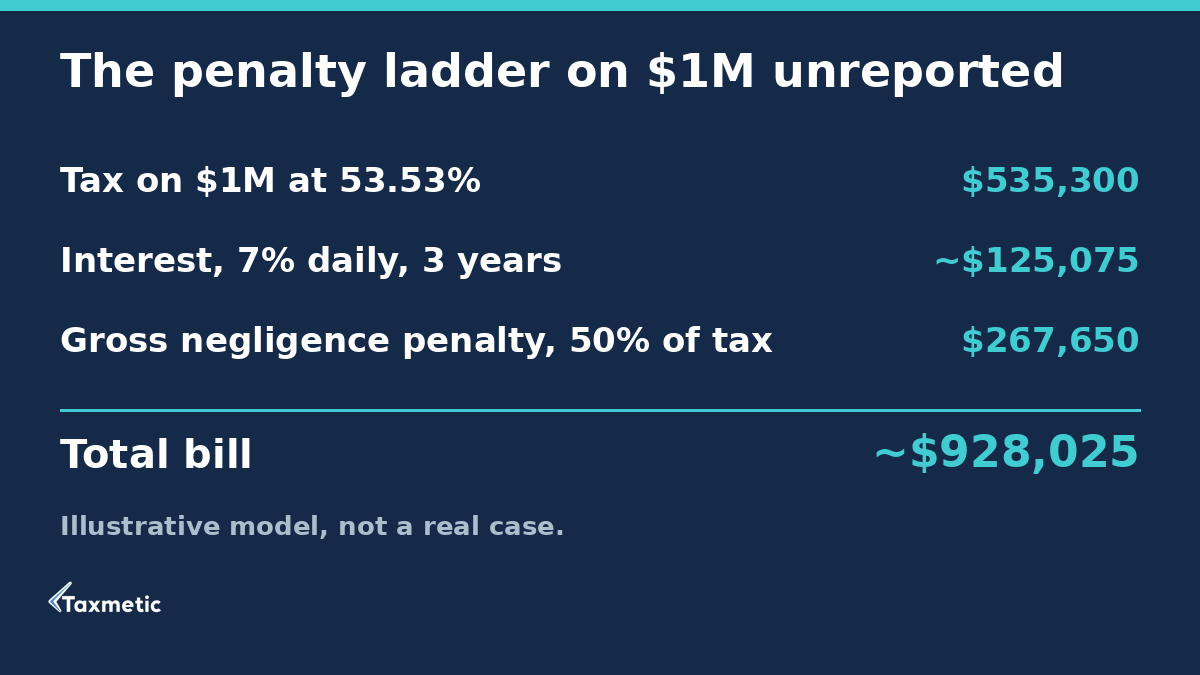
• Tax on the unreported income: $1,000,000 at 53.53 percent equals $535,300.
• Gross negligence penalty: 50 percent of the understated tax equals $267,650.
• Interest: 7 percent compounded daily over three years on $535,300 equals approximately $125,075.
• Total bill: approximately $928,025, of which about $392,725 is penalty and interest on top of the tax itself.
Now change one assumption. Suppose the omission is characterized as a repeated failure to report rather than gross negligence. The penalty is then the lesser of 10 percent of the unreported amount, which is $100,000, and 50 percent of the understated tax, which is $267,650, so the penalty is $100,000, plus a possible matching provincial penalty. The total bill in that version is roughly $760,375 including interest. Still far more than the tax alone, and still before any late filing penalty if the return itself was filed late.
Two lessons fall out of the model. First, the penalty is a percentage of the tax, so it scales with the omission. There is no dollar cap that makes a large omission cheap. Second, interest is the quiet compounder. At 7 percent compounded daily, a balance left alone for three years grows by more than 23 percent before any penalty is added, and the rate resets quarterly, so it can rise further while the file is open.
The way back: voluntary disclosure
The system also contains an exit, and it rewards using it early. The CRA’s Voluntary Disclosures Program, under information circular IC00-1R7 effective October 1, 2025, lets taxpayers come forward before the CRA contacts them. Applications are classified as unprompted, which can receive 100 percent penalty relief and 75 percent interest relief, or prompted, which can receive up to 100 percent penalty relief and 25 percent interest relief. Both streams can protect against criminal prosecution. The conditions are strict: the disclosure must be complete, covering all years and all accounts, and it must arrive before the CRA has already started asking questions about the same income. A partial disclosure that omits a year or an account does not qualify, and filing amended returns after the CRA has already written to you is not the same thing as a voluntary disclosure.
That timing rule is the practical heart of the article. The cheapest moment to fix unreported income is before the matching system flags it. Once a review letter arrives, penalty relief shrinks and prosecution protection narrows. Owners who know they have unreported years should map the full scope first, every year and every income source, and then choose the correction route with that complete picture in hand, rather than filing a single amended year and hoping the rest stays buried.
What this means for Ontario business owners
Compliance is not a moral lecture. It is arithmetic. The CRA’s detection net now includes platform data, slips, payment records, and deposits. The penalty ladder turns a tax debt into a tax debt plus a large percentage penalty plus daily compounding interest. Reassessment has no time limit where misrepresentation is shown. And the voluntary disclosure route rewards early, complete action while penalizing delay. If any part of that description matches your situation, the expensive move is waiting.
Related reading
• CRA Two-Year Audit Workplans: What Ontario Businesses Should Expect
• December 15 Tax Instalment Deadline Ontario: What Business Owners Must Pay
Book a free consultation
If you have unreported income, unfiled years, or a CRA letter you are unsure how to answer, Taxmetic can help you map the scope and the options. Taxmetic is based in Hamilton and serves clients across the GTA and Ontario. Book a free consultation at https://taxmetic.ca/contact/.
This content is for educational purposes only and must not be taken as professional advice.