
The CRA Already Has Your Uber Earnings: A Gig Worker’s Reporting Guide
- October 30, 2026
- Posted by: Taxmetic
- Category: Corporate Tax

If you drive, deliver, freelance, or sell through a platform, the CRA probably already has a record of your earnings before you file. Digital platform operators report seller earnings to the CRA under the digital platform reporting rules, transmitting gross earnings, transaction volumes, and identification details. Platform summaries, T4A slips, payment processor records, and bank deposits all feed the same matching system. That does not mean you are in trouble. It means the old idea that platform income is invisible is finished, and the smart move is to report it properly, claim everything you are entitled to deduct, and keep records that survive a review.
You are self-employed, even if the app feels like an employer
The first thing to settle is your status. The CRA treats gig workers as self-employed independent contractors, not employees. You do not receive a T4 slip. You report your income and expenses on Form T2125, Statement of Business or Professional Activities, as part of your personal tax return. No tax is withheld from your payouts, no employer remits Canada Pension Plan contributions on your behalf, and no one sets money aside for you. Every one of those jobs is yours.
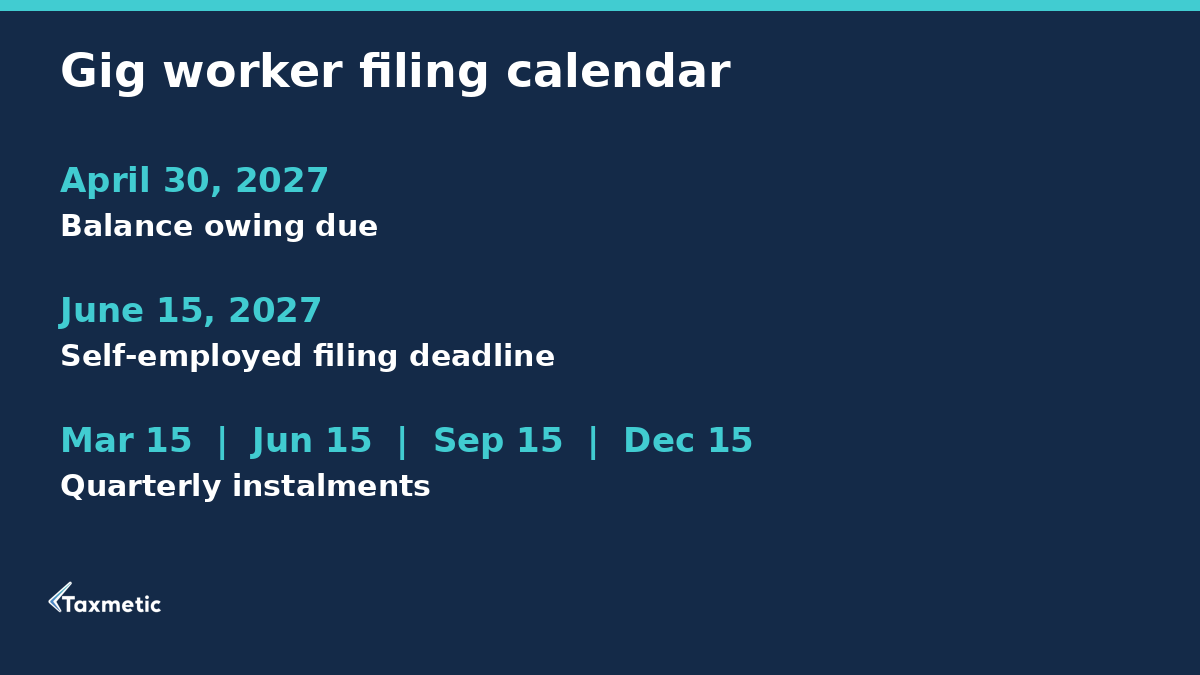
That status has three immediate consequences. First, you owe income tax on your net gig income, which is your gross payouts minus your reasonable business expenses. Second, you generally contribute to the Canada Pension Plan on self-employed earnings above $3,500, and the CRA calculates that contribution on your return, so it arrives as part of your tax bill rather than as a payroll deduction. Third, if your net tax owing exceeds $3,000, you can be required to pay tax by instalments in the following year, in quarterly amounts due March 15, June 15, September 15, and December 15. Gig workers who spend everything they earn and meet the tax bill in April are the ones who get hurt, because the bill includes income tax and CPP together, with no withholding cushion behind it.
What the CRA receives about you
Platform reporting is the headline change. Under the digital platform reporting rules, operators of platforms that connect sellers with customers must report seller activity to the CRA. For rideshare and delivery, that includes your gross earnings and transaction counts. Personal services sold through freelance platforms are reportable as well. Rental of a means of transport is reportable with no minimum threshold. Sale of goods carries limited exceptions for very small sellers, but the exceptions are narrow and activity specific, so they should never be assumed without checking the platform’s own reporting statement.
Beyond platform reports, the CRA matches T4A slips issued by payers, reviews payment processor records during audits, and can examine bank deposits. The practical result is that your return should reconcile to your platform summaries. If your T2125 shows materially less income than the platform reported, expect a letter. Download your annual summaries from every platform you used, keep them with your return, and reconcile them line by line before filing.
GST and HST: the rule most gig workers get wrong
The general small supplier rule says you must register for GST/HST once your taxable sales exceed $30,000 over four consecutive calendar quarters, or in a single quarter. Below that line, registration is a choice, and registering early can let you claim input tax credits on business expenses.
Ridesharing is the exception that catches drivers. Commercial rideshare drivers must register for GST/HST from the first dollar of fares, with no $30,000 threshold, a rule in place since July 1, 2017. Rideshare drivers are treated the same way as conventional taxi businesses for this purpose. If you drive passengers for Uber or Lyft and have never registered, your registration obligation started on your first day of driving, and the CRA can backdate it.
Food delivery and parcel delivery are different. Delivering meals or parcels is not ridesharing, so the usual $30,000 threshold applies to that income. A driver who does both passenger rides and deliveries must keep the two streams separate, because the rideshare stream triggers registration from dollar one while the delivery stream follows the threshold. Confirm what the platform collects and remits on your behalf versus what remains your responsibility once you register, because platform handling of sales tax varies and does not remove your filing obligation.
Expenses: claim what you can prove
Gig income is taxed on net profit, so expenses matter enormously. The categories that most commonly apply are vehicle costs, phone and data plans, platform fees and commissions, software subscriptions, supplies, and a home office portion where you genuinely use part of your home for the work. Vehicle expenses are usually the largest category, and they must be supported by a kilometre log that separates business driving from personal driving, plus receipts for fuel, maintenance, insurance, and lease or financing costs. The business use percentage from your log is what makes the claim defensible.
Two discipline rules govern all of it. First, an expense must be reasonable and incurred to earn the income. Second, you must keep your records for at least six years from the end of the tax year they relate to. Unsupported expenses are the first thing denied in a review, and a reconstructed log built months later carries far less weight than a contemporaneous one. The habit that saves gig workers the most money is boring: log kilometres as you drive, photograph receipts as you spend, and keep platform statements in one folder for the year.
The set-aside system
Because nothing is withheld, you need your own withholding system. Open a separate account and move a fixed share of every payout into it, sized from your last return’s actual tax and CPP result rather than from a guess. If your gig income grows during the year, raise the share. If you are required to pay instalments, treat the quarterly dates as hard deadlines, because instalment interest compounds daily at the CRA’s prescribed rate, which was 7 percent for the fourth quarter of 2026, and an instalment penalty can apply on top where the interest exceeds $1,000. The goal is simple: April should bring a filing task, not a financial shock.
Your filing calendar
For the 2026 tax year, most individuals pay any balance owing by April 30, 2027. If you or your spouse or common-law partner are self-employed, the filing deadline extends to June 15, 2027, but any taxes owed are still due April 30, 2027. GST/HST returns follow your reporting period, monthly, quarterly, or annually, with payment due on the same cycle. Put all three dates on your calendar now: the GST/HST cycle, April 30 for payment, and June 15 for filing. Missing the payment date starts interest even when the filing deadline is later.
If you have unreported gig years
A final word for readers who recognize themselves in the reporting gap. Unreported platform income is among the easiest omissions for the CRA to identify, because the platform already reported it. The penalty ladder for unreported income includes a repeated failure to report penalty and, where the CRA finds gross negligence, a penalty of 50 percent of the understated tax, plus daily compounding interest, and reassessment has no time limit where misrepresentation is shown. The voluntary disclosure route can offer penalty relief and partial interest relief for a complete disclosure made before the CRA contacts you. Do not file a single corrected year and hope the rest stays buried. Map every year and every platform first, then correct the full picture.
Related reading
• Self-Employed Tax Services in Ontario
• Do I Need an Accountant for My Small Business?
• December 15 Tax Instalment Deadline Ontario: What Business Owners Must Pay
Book a free consultation
If you drive, deliver, freelance, or sell online and want your gig income reported correctly, your expenses claimed, and your instalments set up, Taxmetic can help. Taxmetic is based in Hamilton and serves clients across the GTA and Ontario. Book a free consultation at https://taxmetic.ca/contact/.
This content is for educational purposes only and must not be taken as professional advice.