

Best Accountant in Hamilton Ontario
If you’re a Hamilton business owner or self employed professional, you’ve probably heard the phrase “best accountant in Hamilton Ontario” thrown around online, in reviews, and at networking events. But when it comes down to it, you’re really asking a much more practical question: Who can actually help me keep more of my money, stay compliant with CRA and Ontario rules, and grow my business without the usual accounting headaches?
Too many people in Hamilton end up overpaying for under delivered service, flying blind with DIY tax software, or getting tangled in the confusion between a CPA, bookkeeper, and basic tax preparer. The result? Missed deductions, messy financial records, and more stress than savings.
In 2026, the “best accountant” isn’t just the fanciest name on Google; it’s the one who understands your industry, your goals, and the realities of running a business in Hamilton and Ontario. This guide will help you cut through the noise and find the right accounting partner one who feels less like a paperwork vendor and more like a strategic ally.
What Actually Makes the “Best Accountant” in Hamilton?
When Hamilton business owners talk about the best accountant in Hamilton, they’re usually picturing someone who can file taxes accurately and on time, and that’s a good start. But in 2026, the real differentiator is much bigger: the best accountants act as strategic financial partners, not just back office number crunchers.
A Top Rated Accountant in Hamilton will:
- Understand your business model, cash flow patterns, and growth ambitions.
- Stay on top of Ontario specific tax rules and CRA compliance.
- Use modern tools and automation to keep your books clean year round, not just during tax season.
Below is a quick snapshot of what separates a “good” accountant from a truly best accountant in Hamilton.
| Trait | Typical “Good” Accountant | Deep understanding of your specific sector (e.g., real estate, e-commerce, healthcare) |
| Focus | Tax filing and minimum compliance | Strategy, tax optimization, and growth planning |
| Availability | Seasonal (tax time only) | Year round support and proactive check ins |
| Tools & Tech | Basic spreadsheets or outdated software | Cloud accounting (QuickBooks/Xero), AI assisted reporting |
| Communication | Formal, technical jargon | Clear, plain language explanations tailored to you |
| Industry Knowledge | Generalist for small businesses | Deep understanding of your specific sector (e.g., real estate, eCommerce, healthcare) |
Not Just Tax Filing: Strategic Financial Partner
Modern accountants in Hamilton serve as advisors, not just data processors. They help you:
- Maximize tax optimization by identifying deductions, credits, and planning opportunities that align with your business stage.
- Support business growth through cash flow analysis, profitability reviews, and scenario planning for hiring, expansion, or new products.
- Ensure compliance with CRA, Ontario tax rules, and payroll legislation so you avoid penalties and audits.
The key insight is simple: accountants don’t just file taxes, they analyze your financial data and guide your decisions.
Think of it like this:
- A basic tax filer answers, “What’s the cheapest way to submit my return?”
- The best accountant in Hamilton answers, “How can we structure your finances so you legally pay less tax and have more room to grow?”
That advisory mindset is exactly what your Hamilton business needs if you’re serious about scaling profitably in 2026.
Local Expertise in Hamilton & Ontario Tax Rules
The best accountant in Hamilton isn’t just good with numbers; they’re deeply familiar with Ontario specific tax laws and how they interact with your industry and business structure. Unlike generic online tax services, a Hamilton based accountant understands things like:
- Ontario corporate tax rates, provincial tax credits, and local incentives that may apply to small businesses.
- Sales tax, payroll, and property tax nuances that play out differently in Hamilton’s mixed economy (manufacturing, healthcare, professional services, and real estate).
- CRA compliance expectations, filing deadlines, and audit risk triggers tailored to your revenue range and business type.
This local level insight helps you:
- Avoid over paying provincial and municipal level taxes.
- Take advantage of regional grants or deductions you might not even know about.
- Stay compliant without constantly second guessing every CRA letter or notice.
For Hamilton area owners, local expertise is non negotiable: it’s the difference between “just filing” and “filing smartly within Hamilton and Ontario’s rules.”
Technology & Automation in 2026
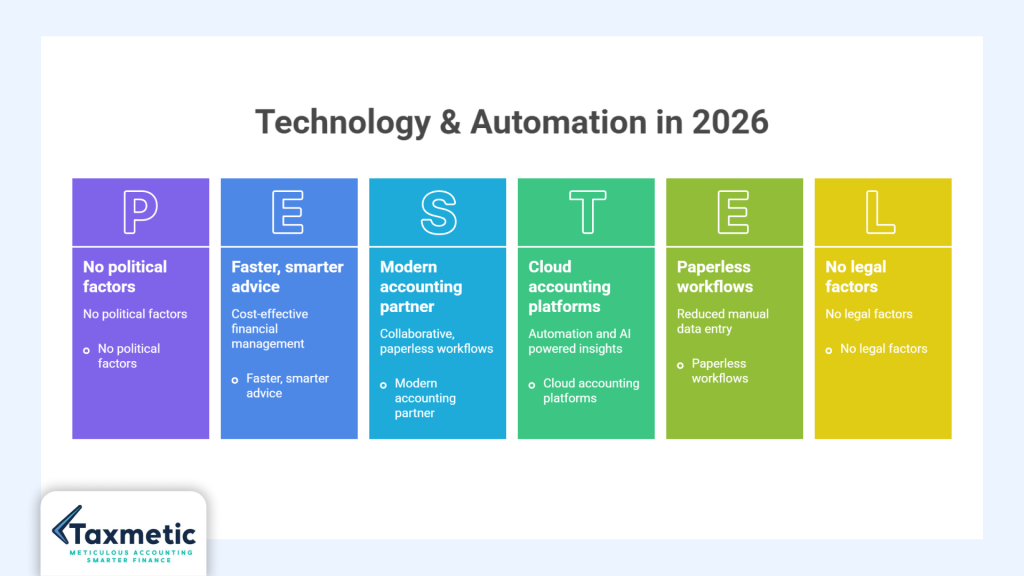
In 2026, the best accountant in Hamilton isn’t just answering emails and mailing them your tax documents; they’re using cloud accounting, automation, and AI powered insights to give you faster, smarter advice.
Key tools and capabilities you should expect:
- Cloud accounting platforms like QuickBooks Online and Xero
- Bank feeds are automatically imported.
- Real time financial dashboards are visible to both you and your accountant.
- Collaborative, paperless workflows that reduce manual data entry.
- Real time reporting
- Monthly profit and loss and cash flow reports updated live.
- Custom KPIs tracked over time (e.g., gross margin, client acquisition cost, overhead ratios).
- Early warning signs are flagged before small issues turn into big problems.
- AI powered insights (where applicable)
- Automated anomaly detection (unexpected drops in revenue, unusual expenses).
- Forecasting suggestions based on past trends and industry benchmarks.
- Smarter tax scenarios (e.g., “What happens if you defer this income?”) without manually rebuilding spreadsheets every time.
For Taxmetic, this tech driven approach means you’re not just getting a tax accountant Hamilton style, you’re getting a modern accounting partner who uses automation to keep your books clean, up to date, and optimized year round, not only during tax season.
CPA vs Tax Preparer vs Bookkeeper (What You REALLY Need)
If you’re trying to hire the best accountant in Hamilton, the first thing you need is clarity: What is the difference between a CPA, a tax preparer, and a bookkeeper, and which one actually fits your business in 2026?
Many small business owners mix up these roles, pay the wrong person for the wrong job, and end up with messy records, missed deductions, or costly compliance issues. Let’s break it down in plain language, Hamilton ready terms.
What is a CPA (and why it matters)?
A CPA (Chartered Professional Accountant) is the highest professional standard for accountants in Canada, governed by CPA Canada and provincial institutes like CPA Ontario.
To become a CPA, professionals must complete:
- University level education in accounting or a related field.
- The CPA Professional Education Program (CPA PEP).
- A period of supervised practical experience and a rigorous set of exams.
In practice, this means a CPA:
- Follows national accounting standards and ethics requirements.
- Can provide tax filing, complex tax planning, financial statement preparation, and advisory services.
- Is often the only people you can rely on if you face CRA audits, financing applications, or detailed financial reporting.
When Hamilton business owners talk about the best accountant in Hamilton Ontario, they’re usually looking for a CPA level advisor, not just a one season tax filer.
Accountant vs Bookkeeper (Key Differences)
The confusion between an accountant and a bookkeeper is one of the biggest money wasters in small business finance. Here’s how they actually differ:
| Role | What They Do | What They Don’t Do (Typically) |
| Bookkeeper | Records daily transactions, reconciles bank accounts, manages invoices and bills, tracks payroll basics, and keeps your general ledger clean. | Little to no tax filing or high level strategy. Doesn’t usually sign CRA ready financial statements. |
| Accountant | Doesn’t usually key every day to day transaction into your system unless acting in a hybrid role. | Doesn’t usually key every day to day transaction into your system unless acting as a hybrid role. |
In short:
- Bookkeepers handle transactions.
- Accountants handle analysis, tax filings, and strategy.
If you’re relying only on a bookkeeper for tax filing, you may be missing out on deductions and planning opportunities. If you’re paying a full CPA to do only data entry, you’re overpaying.
When You Need Each (Simple Decision Guide)
You don’t always need every role at the same time. Here’s a simple, Hamilton friendly guide for when to bring in each type of professional:
- Startup/Solopreneur: Bookkeeper first
- You’re busy running the business and need someone to keep invoices, expenses, and bank reconciliations organized.
- A bookkeeper ensures your records are clean and ready for tax time, while you perhaps still do returns yourself or use a seasonal tax preparer.
- Growth Phase: Accountant (often a CPA)
- Revenue is rising, you may have employees or contractors, and tax rules are getting more complicated.
- You need tax optimization, year round reviews, and basic financial planning. This is where a Hamilton based accountant or CPA typically comes in.
- Scaling/Complex Business: CPA level advisor
- You’re expanding into new markets, hiring more staff, or considering incorporation and financing.
- A CPA led accountant can help with complex tax structures, audits, CRA representation, and strategic financial modeling acting like a true top rated accountant in Hamilton Ontario.
For many Hamilton businesses, the sweet spot in 2026 is a bookkeeper and a CPA working together: the bookkeeper keeps your records shipshape, and the CPA turns that data into tax savings and growth strategy.
If you’re unsure where you stand, you can also revisit our guide on whether you actually need an accountant for your small business in Hamilton for a more tailored answer.
How to Choose the Best Accountant in Hamilton (Step-by-Step)
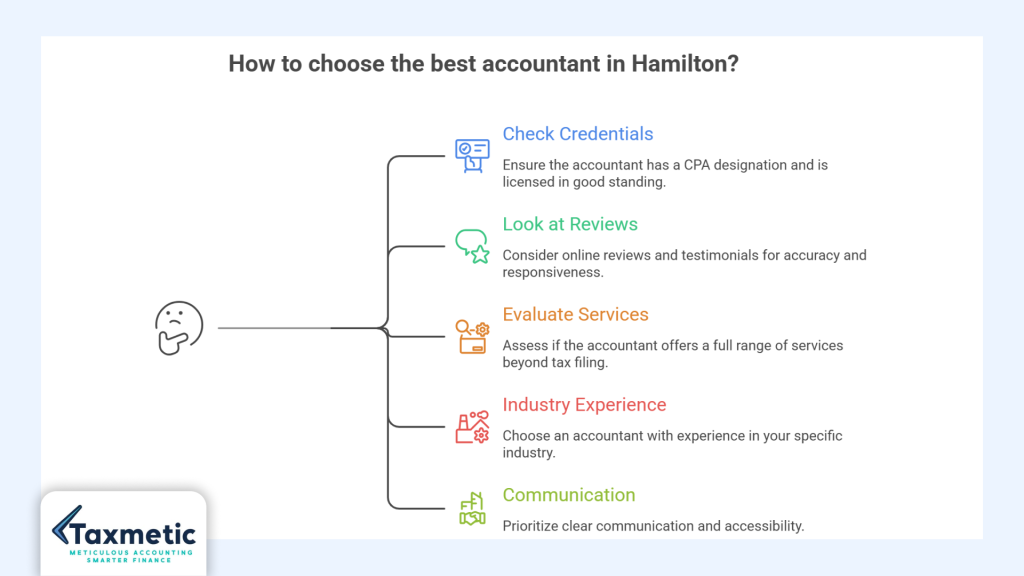
If you’re asking “how to choose an accountant Hamilton style,” you’re probably tired of guesswork and a bad fit. The best accountant in Hamilton Ontario, isn’t just the one with the fanciest website; it’s the one whose credentials, services, and communication style actually match your business stage and goals.
Here’s a simple, step by step way to vet potential accountants without getting overwhelmed.
Step 1: Check Credentials (CPA is Gold Standard)
First and foremost, check licences and certifications. In Canada, the CPA (Chartered Professional Accountant) designation is the highest standard for accountants and is regulated by CPA Canada and provincial bodies like CPA Ontario.
What to look for:
- CPA designation clearly listed on the website or marketing materials.
- A licence in good standing (you can usually verify this via the provincial CPA directory).
- Relevant experience (years in practice and types of clients served).
Red flags to watch for:
- Titles like “tax expert” or “tax guru” with no CPA or equivalent qualification.
- No clear mention of licensing, and no direct links to CPA membership information.
- Vague answers when you ask, “Are you a CPA?” or “How are you regulated?”
If you’re serious about tax planning and long term growth, a CPA level accountant is the safest starting point.
Step 2: Look at Reviews & Reputation (Accountant Reviews Hamilton)
Online reviews and word of mouth are powerful signals for accountant reviews Hamilton style. You don’t have to take every five star review at face value, but a consistent pattern of positive feedback is a strong indicator.
Where to check:
- Google Reviews for the firm or individual. Look for mentions of accuracy, responsiveness, and value.
- Yelp or local directories that list accounting firms in Hamilton, including client experiences.
- Client testimonials or case studies on the accountant’s own website (many top Hamilton firms highlight strong client satisfaction and tailored solutions).
What to pay attention to:
- Complaints about missed deadlines, inaccurate filings, or poor communication.
- Repeat mentions of timely help with CRA issues, tax savings, or clear explanations.
If an accountant has no online presence or reviews at all, that’s a warning sign in 2026’s digital first market.
Step 3: Evaluate Services (Beyond Tax Filing)
Many people think, “I just need someone to do my taxes,” but the best accountant in Hamilton offers much more. Ask yourself: Do they act like a tax only vendor or a full service financial partner?
Typical service areas to look for:
- Bookkeeping: Ongoing record keeping, bank reconciliation, and clean financials all year.
- Payroll: Compliant processing, remittances, and year end T4/T4A slips.
- Advisory & business consulting: Cash flow analysis, growth planning, and scenario modeling.
- Tax optimization: Not just filing, but strategic planning to reduce your tax legally.
If you’re already reading our content on Hamilton business owners’ tax planning, you know that tax is just one piece of a bigger puzzle. A modern accountant should help you connect the dots between operations, cash flow, and tax strategy.
Step 4: Industry Experience Matters
Hamilton’s economy is diverse, with real estate, healthcare, manufacturing, e-Commerce, professional services, and more, and each sector has its own quirks: deductions, record keeping, and compliance rules.
When evaluating an accountant, ask:
- “How many businesses in my industry do you serve?”
- “Can you share examples of how you’ve helped similar clients save tax or grow?”
Why it matters:
- An accountant familiar with real estate investors will know about CCA strategies, 45 degree rules, and capital gains planning.
- Someone experienced with healthcare or e-commerce will understand specialized deductions and inventory/Tax GSTR rules.
If your accountant has previous clients in your niche, you spend less time explaining your business and more time getting results.
Step 5: Communication & Accessibility
Even the most qualified CPA won’t feel like the best accountant in Hamilton if you’re waiting days for a reply or drowning in jargon. Communication and accessibility are often the deciding factors between “okay” and “great.”
What to watch for:
- Clear explanations in plain language, not constant accounting acronyms.
- Fast response times (or at least a clear service level expectation) outside of tax season.
- Multiple communication channels, including email, phone, and secure portals, so you can reach them easily.
Good signs in practice:
- They ask questions about your goals and business model, instead of just requesting documents.
- They send you regular updates or summaries (e.g., monthly reports, tax reminders) without you chasing them.
If you’re unsure how to judge this, take a look at our guide on ” Do I need an accountant for my small business in Hamilton,” which walks you through matching your communication needs with the right service model.
Questions to Ask an Accountant Before Hiring
If you want to find the best accountant in Hamilton Ontario, don’t just trust a website tagline. Ask the right questions upfront so you know who you’re actually hiring. These questions naturally cover the keyword “questions to ask an accountant” and help you avoid costly mismatches.
Here’s a practical checklist you can use in a first call or meeting:
- “Are you a CPA?”
- Verify licensure and ask how long they’ve been certified.
- Confirm they’re in good standing with CPA Ontario (or the relevant body).
- “What industries do you specialize in?”
- Ask for examples (real estate, healthcare, eCommerce, manufacturers, etc.).
- A good fit will speak your business language and know your common deductions.
- “How do you help reduce taxes legally?”
- Listen for specific strategies, not vague promises.
- They should mention things like timing income/expenses, sector specific credits, or incorporation planning, not “we’ll just find every deduction.”
- “What software and tools do you use?”
- Expect answers like QuickBooks Online, Xero, or similar cloud platforms, plus secure portals and reporting dashboards.
- This shows they’re tech savvy and can give you real time access.
- “Do you provide year round support or just tax season?”
- A true Top Rated Accountant in Hamilton Ontario style stays involved between April and next year’s filing.
- Ask about check ins, reporting frequency, and how they handle urgent CRA notices or questions mid year.
If the answers feel vague, rushed, or overly salesy, that’s a signal to keep looking.
Red Flags to Avoid When Hiring an Accountant
Even in Hamilton, where there are many qualified professionals, you can still end up with the wrong accountant if you overlook the warning signs. Watch out for these red flags:
- Extremely cheap pricing with no clear breakdown
- Super low fees can mean hidden upsells, rushed work, or missed optimization opportunities.
- Remember: mistakes cost more than hiring a competent professional.
- No CPA designation or unclear licensing
- If they avoid stating whether they’re a CPA or can’t prove regulated status, think twice.
- In Canada, CPA is the recognized standard for serious tax and financial advice.
- Poor communication
- Long delays, confusing replies full of jargon, or no clear contact method are bad signs.
- If you can’t understand their answer to a simple question, how will you handle tax season?
- Only “tax filing” services, no strategy
- If they say they only file your return and don’t ask about your goals, they’re not a partner.
- The best accountant in Hamilton should discuss planning, not just forms.
- No reviews or online presence
- No Google reviews, an outdated website, or zero social/industry presence suggest low accountability.
- In 2026, a legitimate firm should have at least minimal online credibility.
If you notice several of these red flags, it’s safer to pause and keep researching.
Top Traits of a Top Rated Accountant in Hamilton (2026 Trends)
As you search for a Top Rated Accountant in Hamilton Ontario, look for these modern traits instead of just a fancy office and long time branding. These traits are especially relevant in 2026 and reflect what ambitious Hamilton business owners really need.
- Tech driven (automation, AI tools)
- Uses cloud accounting (QuickBooks, Xero), automated bank feeds, and digital workflows.
- May leverage AI assisted reporting (anomaly detection, forecasting, and tax scenario modeling) to give you smarter insights.
- Advisory first approach
- Prioritizes understanding your business model, goals, and cash flow patterns.
- Shifts from “tax filer” to financial advisor, making proactive suggestions instead of waiting for you to ask.
- Transparent pricing
- Offers clear monthly or project based fees, not vague “we’ll figure it out later.”
- Explains exactly what you get (e.g., bookkeeping, tax prep, advisory hours) so there are no surprises.
- Proactive tax planning
- Works with you all year, not just in April, to optimize timing of income, expenses, and purchases.
- Helps you avoid common mistakes many Hamilton owners make with small business tax deductions.
- Scalable services
- Grows with your business, adding support for payroll, inventory, multi entity structures, or financing as needed.
- Can introduce you to accountant for my small business Hamilton, recommendations that fit your size and stage.
When you combine CPA level credentials, local Hamilton, Ontario tax knowledge, and these 2026 style traits, you’re much more likely to land with a top rated accountant in Hamilton, Ontario who actually moves your business forward.
DIY Accounting vs Hiring a Professional
Many Hamilton freelancers and small business owners start with DIY accounting because it feels cheaper and simpler. And in some cases, it really can work. But as your business grows, the risks of DIY often outweigh the savings. Here’s a realistic breakdown of when DIY makes sense and when it becomes risky.
When DIY Works
DIY accounting can be a good fit if you’re in one of these situations:
- Freelancers and solopreneurs with simple income streams
- Just a few clients, no employees, and mostly standard expenses.
- You’re comfortable with basic spreadsheets or simple tax software.
- Very small businesses just starting out
- Revenue is still low, structure is straightforward (sole proprietorship), and you’re testing ideas.
- You’re okay spending time learning the basics of bookkeeping and tax filing yourself.
In these cases, DIY gives you:
- More control over your numbers.
- Lower upfront costs compared to hiring a professional.
However, even here, a one time review or setup with a real accountant can save you future rework and prevent bad habits.
When It Becomes Risky
DIY quickly turns risky when your business becomes more complex. If any of these apply, hiring a professional is usually the smarter move:
- Growing revenue
- More transactions, multiple income sources, and irregular cash flow make manual tracking error prone.
- Simple tools can’t easily help you spot profitability trends or tax saving opportunities.
- You have employees or contractors
- Payroll, CPP/EI remittances, and year end slips (T4/T4A) add layers of compliance.
- A mistake can trigger CRA penalties, interest, or audits costing far more than an accountant’s fee.
- Tax complexity increases
- Multiple business structures, home office claims, vehicle use, inventory, or cross border income.
- Missed small business tax deductions or bad timing on income vs expenses can mean thousands in extra tax.
The bottom line: mistakes with DIY accounting can cost more than hiring a professional. Missed deductions, incorrect filings, late payments, and penalties often add up to far more than what you’d pay a qualified tax accountant in Hamilton to get it right the first time.
If you’re unsure where you stand, our guide on do I need an accountant for my small business Hamilton can help you match your situation with the right level of support.
Final Checklist: Choosing the Best Accountant
Before you sign on with any accountant in Hamilton, run your shortlist through this quick checklist. Use it as a filter to find the best accountant in Hamilton Ontario for your specific situation:
- CPA certified
- Confirm they are a Chartered Professional Accountant in good standing with CPA Ontario.
- Avoid “tax expert” titles without proper licensing.
- Good reviews & reputation
- Check Google reviews, testimonials, and word of mouth feedback.
- Look for mentions of clear communication, tax savings, and responsiveness.
- Offers advisory, not just tax filing
- They should talk about cash flow, growth, and planning, not just clicking “file return.”
- Should be able to explain how they help you reduce taxes legally and avoid future stress.
- Uses modern tools
- Cloud accounting (QuickBooks, Xero), secure portals, and at least some level of automation.
- This keeps your books accurate, accessible, and easy to collaborate on.
- Understands your industry
- Ask about experience with businesses like yours (real estate, health, eCommerce, etc.).
- A Hamilton savvy accountant already knows common deductions and compliance quirks in your sector.
If a firm ticks most of these boxes, you’re on the right track. If they’re missing more than one or two, it’s worth continuing your search.
Frequently Asked Questions:
Q: Who is the best accountant in Hamilton Ontario?
Answer: There’s no single “best” accountant for everyone; the right fit is typically a CPA level professional with local Hamilton and Ontario tax knowledge, clear communication, and advisory first support tailored to your business type.
Q: How do I find a good accountant in Hamilton?
Answer: Check if they’re a licensed CPA, read Google reviews and testimonials, ask about their experience with businesses like yours, and confirm they offer year round support and modern tools, not just tax season filing.
Q: What makes a great accountant in Canada?
Answer: A great accountant in Canada is a qualified professional (usually CPA) who understands CRA rules, provincial tax laws, and industry specific deductions, uses modern cloud tools, and acts as a proactive business advisor, not just a number cruncher.
Q: Do I need a CPA or just a bookkeeper?
Answer: If you’re very small and hands on, a bookkeeper can manage daily records. Once you have employees, growth, or tax complexity, you usually need a CPA or accountant for planning, filing, and strategy.
Q: How much does an accountant cost in Hamilton?
Answer: Typical Hamilton costs are roughly $100 to $500+ per month for bookkeeping, $300 to $2,000+ for tax filing, and higher fees for CPA advisory, depending on your business size and complexity.
Conclusion: Choose the Right Accountant, Grow the Right Way
Choosing the right accountant isn’t an expense; it’s a profit protection move. The right accountant in Hamilton, Ontario can:
- Help you keep more of your money through smart tax planning and missed deduction recovery.
- Cut confusion around CRA rules, Ontario tax, and payroll so you can focus on growth.
- Turn your financial data into a growth roadmap, not just a yearly tax form.
At Taxmetic, we position ourselves as a local Hamilton focused expert who’s modern, tech driven, and built to act as your business growth partner, not just a tax season vendor. Whether you’re a freelancer, a small business owner, or scaling up, we help you combine Hamilton level insights with cloud accounting tools and proactive tax planning.
Ready to stop guessing and start growing?
Book a consultation with Taxmetic today and let’s build an accounting strategy that fits your business stage, goals, and budget.