
Running an incorporated business in Ontario comes with more responsibilities than simply generating revenue and managing day to day operations. One of the biggest areas business owners struggle with is staying on top of corporate tax deadlines and understanding exactly what needs to be filed, when it needs to be paid, and what happens if a deadline is missed.
Every year, thousands of Canadian corporations face avoidable penalties because they misunderstand CRA filing rules, miss payment dates, or fail to track important compliance obligations properly. In many cases, business owners assume that filing a return and paying taxes happen on the same date. Unfortunately, that is not how the CRA system works.
Understanding the difference between your T2 filing deadline, corporate tax payment deadline CRA requirements, payroll remittance obligations, and GST/HST filing responsibilities is essential if you want to keep your corporation compliant in 2026.
For incorporated businesses in Ontario, missing important corporate tax deadlines can lead to:
| CRA Issue | Possible Consequence |
| Late T2 filing | Penalties plus daily interest |
| Late corporate tax payment | Interest charges on unpaid balances |
| Missed payroll remittance | Immediate CRA penalties |
| Late GST/HST filing | Financial penalties and compliance reviews |
| Repeated late filings | Increased CRA scrutiny |
Many business owners focus only on tax season, but CRA compliance is actually a year round responsibility. From payroll deductions to installment payments and T2 corporate returns, each obligation follows its own schedule based on your corporation’s fiscal year, reporting frequency, and business activity.
This is why having a proper CRA compliance calendar 2026 strategy is so important for Ontario corporations. Whether you are a small incorporated startup, a growing professional corporation, or an established business with employees, understanding your deadlines can help you:
- Avoid unnecessary penalties and interest
- Improve cash flow planning
- Stay organized throughout the year
- Reduce CRA audit risks
- Keep your bookkeeping and tax records accurate
Many incorporated businesses also fail to realize that the CRA separates filing deadlines from payment deadlines. For example, your T2 return may be due six months after your fiscal year end, but your corporate taxes could be due much earlier. Missing either one may result in penalties or interest charges from the CRA.
This confusion becomes even more common for new corporations and business owners who recently completed the process of incorporating their company. If you recently incorporated, you may also want to read our guide on how to incorporate a business in Hamilton to better understand your ongoing tax responsibilities after incorporation.
In this complete guide, we will break down the most important corporate tax deadlines Canada businesses need to know in 2026, including:
- T2 filing deadlines
- Corporate tax payment due dates
- Payroll remittance deadlines
- GST/HST filing obligations
- CRA penalty rules
- Important compliance dates for Ontario corporations
We will also explain how your fiscal year affects your reporting obligations, common mistakes business owners make, and practical ways to stay compliant throughout the year.
If you are already managing bookkeeping internally, keeping organized financial records can make tax season significantly easier. Our article on full cycle bookkeeping explains why accurate bookkeeping plays a major role in avoiding missed deadlines and CRA compliance problems.
By the end of this guide, you will have a clear understanding of how corporate tax deadlines work in Canada and what your Ontario business needs to do to stay ahead of CRA requirements in 2026.
Understanding Corporate Tax Deadlines in Canada
Managing an incorporated business involves much more than earning revenue and paying expenses. Every corporation operating in Canada must follow a series of CRA reporting and payment obligations throughout the year. These obligations are known as corporate tax deadlines.
Understanding how these deadlines work is essential for keeping your business compliant, avoiding penalties, and maintaining healthy financial operations.
Many business owners focus only on filing taxes once a year, but corporations often have multiple CRA responsibilities that include:
- T2 corporate income tax returns
- Corporate tax payments
- Payroll remittances
- GST/HST filings
- T4 reporting obligations
- Installment payments
Failing to manage these requirements properly can quickly create financial and compliance problems for businesses of all sizes.
What Are Corporate Tax Deadlines?
Corporate tax deadlines are the official due dates established by the CRA for incorporated businesses to:
- File tax returns
- Pay taxes owing
- Submit payroll deductions
- File GST/HST returns
- Report employee income information
These deadlines vary depending on factors such as:
| Factor | Impact on Deadline |
| Fiscal year end | Affects T2 filing and payment dates |
| Corporation type | May affect payment timelines |
| Payroll size | Determines remittance schedule |
| GST/HST filing frequency | Changes reporting periods |
For example, your T2 corporate income tax return is generally due six months after your fiscal year end, while your corporate tax payment CRA obligation may be due much earlier.
This is one of the most misunderstood areas of corporate taxation in Canada.
Why CRA Deadlines Matter for Incorporated Businesses
The CRA expects incorporated businesses to remain compliant throughout the entire year, not just during tax season.
Missing important corporate tax deadlines Canada businesses must follow can result in:
| CRA Consequence | Potential Impact |
| Late filing penalties | Additional financial costs |
| Daily interest charges | Growing balances over time |
| CRA compliance reviews | Increased scrutiny |
| Collection actions | Payment enforcement |
| Cash flow pressure | Financial instability |
For many Ontario corporations, missed deadlines are not caused by intentional non compliance. Instead, they often happen because of:
- Disorganized bookkeeping
- Lack of deadline tracking
- Confusion between filing and payment dates
- Poor payroll management
- Incomplete financial records
This is why many successful businesses work proactively with accountants and bookkeeping professionals throughout the year instead of waiting until deadlines approach.
If your corporation is still building financial systems and tax processes, our guide on how much does an accountant cost in Hamilton Ontario explains how professional accounting support can help businesses reduce compliance risks and stay organized year round.
Common Mistakes Ontario Corporations Make
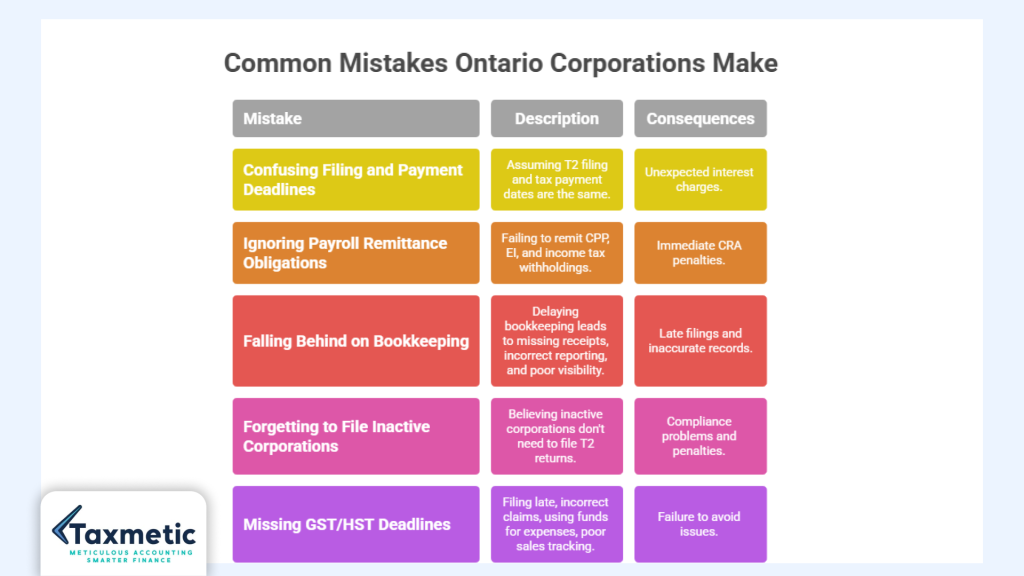
Many incorporated businesses unknowingly create CRA problems because they misunderstand how corporate deadlines work.
Here are some of the most common mistakes Ontario corporations make:
Confusing Filing Deadlines With Payment Deadlines
One of the biggest mistakes businesses make is assuming their T2 filing date and tax payment date are the same.
In reality:
- T2 filing deadline = usually 6 months after fiscal year end
- Corporate tax payment CRA deadline = often 2 or 3 months after fiscal year end
This misunderstanding often results in unexpected interest charges.
Ignoring Payroll Remittance Obligations
Businesses with employees must remit:
- CPP deductions
- EI premiums
- Income tax withholdings
Late payroll remittances can trigger immediate CRA penalties, even if the delay is short.
Falling Behind on Bookkeeping
Businesses that delay bookkeeping often struggle with:
- Missing receipts
- Incorrect GST/HST reporting
- Inaccurate payroll records
- Late filings
- Poor financial visibility
Accurate bookkeeping is one of the most important foundations of CRA compliance.
If your business bookkeeping is becoming difficult to manage internally, our article on do I need an accountant for my small business Hamilton explains when professional support becomes a smart investment.
Forgetting to File Inactive Corporations
Some business owners believe inactive corporations do not need to file T2 returns.
However, most incorporated businesses in Canada are still required to file annual corporate tax returns even if:
- No income was earned
- No taxes are owing
- The company had little or no activity
Failing to file can eventually create compliance problems and penalties with the CRA.
Missing GST/HST Deadlines
Ontario businesses registered for HST must follow regular filing and remittance schedules.
Common mistakes include:
- Filing late GST/HST returns
- Incorrect input tax credit claims
- Using collected HST funds for operating expenses
- Poor sales tracking
Businesses that maintain monthly bookkeeping and organized financial records are usually far more successful at avoiding these issues.
Understanding corporate tax deadlines early can help incorporated businesses avoid unnecessary penalties, reduce stress during tax season, and build stronger financial systems for long term growth.
What Is a Fiscal Year in Canada?
Before you can understand your corporate tax deadlines, you first need to understand how the CRA defines a fiscal year for incorporated businesses in Canada.
A fiscal year is the 12 month accounting period your corporation uses to report income, expenses, taxes, and financial activity. Your fiscal year determines when your books close, when your taxes become payable, and when your T2 corporate income tax return must be filed.
Many business owners assume every company follows the regular January to December calendar year. In reality, incorporated businesses in Canada can often choose their own fiscal year end depending on their operations, industry, and financial planning strategy.
Fiscal Year Canada: Simple Definition
In Canada, a fiscal year is the reporting period used by your corporation for tax and accounting purposes. It normally covers 12 consecutive months.
Your fiscal year begins on the date your corporation starts business and ends on your selected year end date.
For example:
| Corporation Start Date | Fiscal Year End |
| January 1, 2026 | December 31, 2026 |
| April 1, 2026 | March 31, 2027 |
| July 1, 2026 | June 30, 2027 |
Once your fiscal year is established, the CRA uses it to calculate important corporate tax deadlines Canada businesses must follow.
Calendar Year vs Custom Fiscal Year
Ontario corporations generally choose between:
Calendar Year
A calendar year runs from:
| Start Date | End Date |
| January 1 | December 31 |
This is one of the most common options because it aligns with personal taxes, payroll reporting, and year end financial planning.
Custom Fiscal Year
Some corporations choose a custom fiscal year instead of the calendar year.
Examples include:
| Fiscal Year Start | Fiscal Year End |
| April 1 | March 31 |
| July 1 | June 30 |
| October 1 | September 30 |
Custom fiscal years are often used by:
- Seasonal businesses
- Professional corporations
- Construction companies
- Consulting firms
- Growing startups managing cash flow cycles
Choosing the right fiscal year can sometimes improve operational planning and tax management. However, it also changes your T2 filing deadline and corporate tax payment schedule.
If you are unsure whether your business structure and tax setup are optimized properly, our guide on best accountant in Hamilton Ontario what to look for explains how experienced accountants help corporations stay compliant and organized year round.
How Your Fiscal Year Affects Your T2 Due Date Canada
One of the most important things business owners need to understand is that your T2 due date Canada depends entirely on your corporation’s fiscal year end.
The CRA requires most corporations to file their T2 corporate income tax return within six months after the end of their fiscal year.
This means there is no single universal corporate filing date for all businesses.
Common T2 Filing Deadline Examples
| Fiscal Year End | T2 Filing Deadline |
| December 31, 2025 | June 30, 2026 |
| March 31, 2026 | September 30, 2026 |
| June 30, 2026 | December 31, 2026 |
This is why many Ontario business owners search questions like:
“When is my T2 corporate tax return due in Ontario?”
The answer depends on your fiscal year end date.
For most incorporated businesses:
- T2 return filing deadline = 6 months after fiscal year end
- Corporate tax payment deadline = usually 2 or 3 months after fiscal year end
Many corporations accidentally miss payment deadlines because they assume both dates are the same. They are not.
Examples of Common Fiscal Year Ends in Ontario
December 31 Year End
This is the most common fiscal year for small businesses and corporations in Canada.
Benefits include:
- Easier coordination with personal taxes
- Simpler year end reporting
- Easier bookkeeping alignment
For a December 31, 2025 fiscal year end:
| Requirement | Due Date |
| Corporate Tax Payment | March 2026 |
| T2 Filing Deadline | June 30, 2026 |
March 31 Year End
This fiscal year is common for:
- Incorporated professionals
- Consultants
- Businesses with spring planning cycles
For a March 31, 2026 fiscal year end:
| Requirement | Due Date |
| Corporate Tax Payment | June 2026 |
| T2 Filing Deadline | September 30, 2026 |
June 30 Year End
Some corporations choose June 30 to better manage seasonal cash flow and summer operations.
For a June 30, 2026 fiscal year end:
| Requirement | Due Date |
| Corporate Tax Payment | September 2026 |
| T2 Filing Deadline | December 31, 2026 |
Why Understanding Your Fiscal Year Matters
Your fiscal year impacts much more than just your T2 filing deadline.
It also affects:
- Corporate tax installment schedules
- Financial statement preparation
- GST/HST reporting periods
- Payroll reporting
- Tax planning opportunities
- Cash flow management
Business owners who ignore these timelines often face avoidable CRA penalties and filing stress later in the year.
Keeping organized financial records throughout your fiscal year can significantly reduce year end pressure. If you are currently managing bookkeeping software or comparing accounting systems, our detailed comparison of Xero vs Wave vs QuickBooks can help you choose the right accounting platform for your corporation.
In the next section, we will explain the official T2 filing deadline rules for incorporated businesses in Canada and how corporations can avoid costly late filing penalties.
T2 Filing Deadline in Canada (2026 Rules)
One of the most important corporate tax deadlines every incorporated business owner must understand is the T2 filing deadline. Many corporations mistakenly believe they only need to file taxes if the company earned revenue or owes money to the CRA. In reality, the filing requirement applies to almost all incorporated businesses in Canada.
The CRA requires every resident corporation to file a T2 Corporation Income Tax Return every tax year, even if the business had little or no activity.
This means your corporation generally must file a T2 return even if:
- The corporation earned no income
- The business was inactive
- No taxes are owing
- The corporation is a small side business
- Operations temporarily stopped during the year
Failing to file can still result in penalties and future CRA compliance problems.
What Is the T2 Filing Deadline?
The T2 filing deadline for corporations in Canada is:
Six months after the end of your corporation’s fiscal year.
Your T2 due date Canada depends entirely on your chosen fiscal year end, which is why understanding your fiscal year is so important.
T2 Filing Deadline Examples for 2026
| Fiscal Year End | T2 Filing Deadline |
| December 31, 2025 | June 30, 2026 |
| January 31, 2026 | July 31, 2026 |
| March 31, 2026 | September 30, 2026 |
| June 30, 2026 | December 31, 2026 |
These deadlines apply to most incorporated businesses operating in Ontario and across Canada.
CRA Electronic Filing Requirements
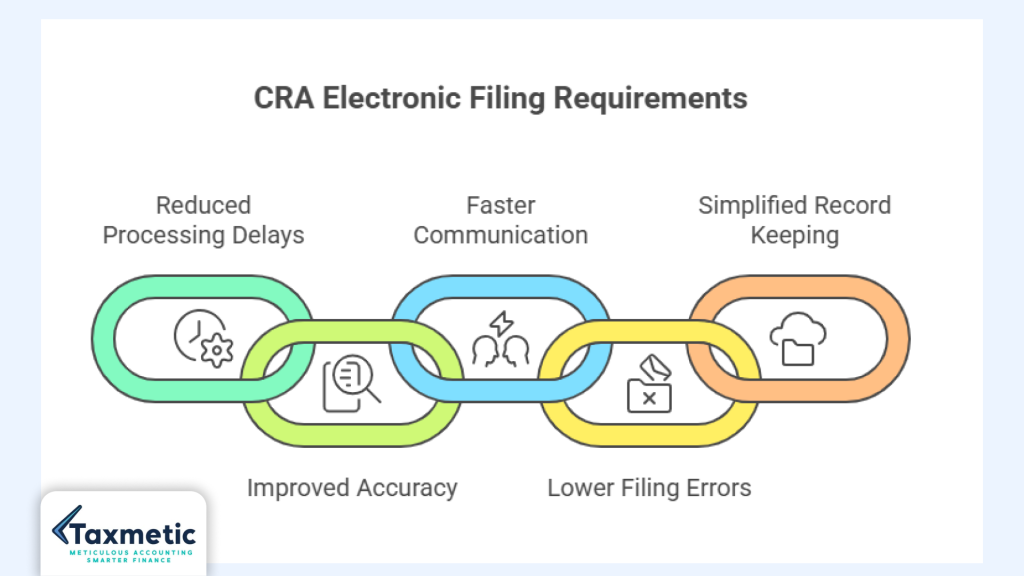
The CRA now requires most corporations to file their T2 returns electronically. Paper filing is limited to certain situations and exceptions.
Electronic filing helps:
- Reduce processing delays
- Improve accuracy
- Speed up CRA communication
- Lower filing errors
- Simplify record keeping
Many businesses use cloud accounting systems and bookkeeping software to organize financial records before filing. If your bookkeeping is disorganized, tax season can quickly become stressful and increase the risk of missed deadlines or inaccurate reporting.
Our guide on full cycle bookkeeping does Hamilton business need it explains how ongoing bookkeeping support helps businesses stay prepared for year end filing requirements.
What Happens If You Miss Your T2 Filing Deadline?
Missing your T2 filing deadline can become expensive very quickly.
The CRA may charge:
| CRA Consequence | Description |
| Late filing penalty | Percentage of unpaid taxes |
| Daily interest | Interest added on balances owing |
| Repeated failure penalties | Higher penalties for repeat late filings |
| Compliance reviews | Increased CRA scrutiny |
Even corporations with no tax owing can face compliance issues for repeated late filing behavior.
Businesses already struggling with overdue filings or CRA notices should also review our guide onwhat happens if you miss the tax deadline in Canada to understand potential penalties and recovery options.
Corporate Tax Payment Deadline CRA Businesses Must Know
One of the most common mistakes incorporated business owners make is assuming their filing deadline and tax payment deadline are the same date.
They are not.
The CRA separates:
- Your T2 filing deadline
- Your corporate tax payment deadline
Understanding this difference is critical for avoiding interest charges and unnecessary penalties.
Filing Deadline vs Payment Deadline
Your T2 return may not be due until six months after your fiscal year end, but your taxes are usually due much earlier.
Most Corporations
Most corporations must pay corporate income taxes within:
Two months after fiscal year end
Eligible Canadian Controlled Private Corporations (CCPCs)
Some eligible CCPCs receive an extended payment period of:
Three months after fiscal year end
This extension usually applies to qualifying small businesses claiming the small business deduction and meeting CRA eligibility rules.
Example of CRA Filing vs Payment Deadlines
For a corporation with a December 31, 2025 fiscal year end:
| Requirement | Due Date |
| Corporate Tax Payment | March 31, 2026 |
| T2 Filing Deadline | June 30, 2026 |
This means your corporation may need to pay taxes several months before your actual T2 return filing deadline.
This is one of the biggest areas where businesses accidentally trigger CRA interest charges.
Why Corporate Tax Payment Deadlines Matter
Missing your corporate tax payment CRA deadline can result in:
- Daily compound interest
- Late payment penalties
- CRA collection activity
- Cash flow problems
- Future compliance concerns
Many Ontario business owners focus only on filing paperwork while forgetting the actual payment schedule.
Businesses that plan ahead with proper tax forecasting and bookkeeping typically avoid these issues more easily. If you are looking to improve long term financial planning, our article on Hamilton business owners tax planning 5 smart moves shares practical strategies businesses use to reduce tax stress and stay financially organized.
CRA Payroll Remittance Deadlines for Employers
If your incorporated business has employees, payroll compliance becomes another major CRA responsibility you cannot afford to ignore.
Every employer in Canada must deduct and remit payroll source deductions to the CRA on time.
These source deductions include:
- CPP contributions
- EI premiums
- Employee income tax deductions
The CRA takes payroll remittances very seriously because these amounts are considered trust funds collected on behalf of employees and the government.
Late payroll remittances can trigger immediate penalties and interest, even if your business eventually pays the balance later.
What Is the Payroll Remittance Deadline CRA Uses?
Your payroll remittance deadline depends on your remitter type. The CRA assigns businesses to different remittance schedules based on payroll size and remittance history.
Monthly Remitters
Most new employers begin as monthly remitters.
Payments are generally due:
On or before the 15th day of the following month
Example:
| Payroll Month | Remittance Due Date |
| January 2026 | February 15, 2026 |
| February 2026 | March 15, 2026 |
Quarterly Remitters
Some eligible small employers can remit quarterly instead of monthly.
This option is available to qualifying employers with:
- Strong compliance history
- Lower payroll amounts
- CRA approval
Quarterly remitting can reduce administrative workload for smaller businesses.
Accelerated Remitters
Larger businesses with higher payroll deductions may be required to remit more frequently.
Accelerated remitters may need to pay:
- Twice monthly
- Up to four times monthly
The CRA determines this schedule based on average monthly withholding amounts.
How Payroll Penalties Are Calculated
The CRA calculates payroll penalties based on:
- Amount owing
- Number of days late
- Frequency of repeated late remittances
Repeated late payroll payments can significantly increase penalty percentages over time.
Businesses that fail to remit source deductions consistently may also attract CRA audits and collections activity.
If you employ staff, understanding payroll reporting requirements is equally important. Our guide onT4 slips what every Hamilton employer needs to know explains employer reporting obligations and common payroll mistakes businesses should avoid.
Best Practices for Staying Payroll Compliant
Managing payroll properly requires consistent systems and organized bookkeeping throughout the year.
Here are some practical ways Ontario corporations stay compliant:
| Best Practice | Benefit |
| Automate payroll software | Reduces missed remittance dates |
| Maintain updated bookkeeping | Improves payroll accuracy |
| Set CRA calendar reminders | Helps avoid late payments |
| Review payroll monthly | Identifies errors early |
| Work with accounting professionals | Reduces compliance risk |
Businesses managing payroll internally should also ensure their accounting system is properly integrated with bookkeeping and tax reporting processes to avoid reporting errors later in the year.
GST/HST Filing Deadlines for Ontario Corporations
For many incorporated businesses in Ontario, GST/HST compliance becomes just as important as corporate income tax filing. Missing GST/HST deadlines can lead to penalties, interest charges, and unnecessary CRA attention, especially for businesses that regularly collect HST from customers.
Once your business is registered for GST/HST, the CRA expects you to:
- File GST/HST returns on time
- Report collected taxes accurately
- Remit balances owing before the deadline
- Maintain proper sales and expense records
Your filing frequency depends on factors such as annual revenue and CRA reporting requirements.
If your corporation has not yet registered for HST and you are unsure when registration becomes mandatory, our guide on when do you need to register for HST in Ontario explains the thresholds and rules Ontario businesses should know.
Annual GST/HST Filers
Many small corporations in Canada are annual filers.
Annual filers typically:
- File one GST/HST return per year
- Remit taxes owing annually
- Follow reporting deadlines based on fiscal year end
For corporations with a December 31 year end, GST/HST returns are commonly due within three months after year end, depending on business structure and filing setup.
Annual filing may simplify administration for smaller businesses, but it can also create large year end balances if taxes are not tracked carefully throughout the year.
Quarterly GST/HST Filers
Some businesses are assigned or choose quarterly filing schedules.
Quarterly filing requires businesses to:
- File returns four times annually
- Remit GST/HST balances every quarter
- Maintain more frequent bookkeeping reviews
Quarterly reporting can improve cash flow management because businesses remit taxes in smaller amounts throughout the year instead of facing one large annual payment.
Monthly GST/HST Filers
Larger corporations and businesses with higher revenues are often required to file monthly GST/HST returns.
Monthly filing means businesses must:
- Track sales tax consistently
- Reconcile records every month
- Submit payments more frequently
This schedule increases administrative responsibility but can also help businesses identify bookkeeping errors earlier.
Corporations with inconsistent bookkeeping often struggle the most with monthly reporting requirements.
HST Payment Rules Businesses Must Understand
One of the biggest misconceptions among small business owners is believing collected HST belongs to the business.
In reality, GST/HST collected from customers is considered money held on behalf of the government until it is remitted to the CRA.
This is why businesses should avoid using collected HST for operational spending or cash flow shortages.
Late GST/HST payments may result in:
| CRA Consequence | Impact |
| Interest charges | Daily interest accumulation |
| Late filing penalties | Financial penalties on overdue returns |
| CRA collection activity | Payment enforcement actions |
| Compliance reviews | Increased CRA monitoring |
Businesses that maintain accurate bookkeeping throughout the year generally avoid most GST/HST filing problems.
Common GST/HST Mistakes Small Businesses Make
Many Ontario corporations unintentionally create GST/HST problems because of poor record keeping or misunderstanding CRA requirements.
Here are some of the most common mistakes:
| Common Mistake | Potential Result |
| Missing filing deadlines | CRA penalties and interest |
| Claiming incorrect input tax credits | CRA reassessments |
| Mixing personal and business expenses | Audit risk |
| Using collected HST for expenses | Cash flow shortages |
| Poor bookkeeping records | Filing inaccuracies |
Businesses already dealing with bookkeeping confusion or tax reporting problems may also benefit from reviewing our guide on do I need an accountant for my small business Hamilton to understand when professional accounting support becomes valuable.
CRA Compliance Calendar 2026 for Incorporated Businesses
One of the best ways to avoid missed deadlines and CRA penalties is by following a structured compliance calendar throughout the year.
Many incorporated business owners focus only on tax season, but CRA compliance actually involves multiple reporting obligations spread across the entire year.
A proper CRA compliance calendar 2026 helps businesses stay organized and avoid last minute filing stress.
Important CRA Deadlines for Incorporated Businesses in 2026
| Deadline Type | Common Due Date |
| T4 Slips | February 28, 2026 |
| Corporate Tax Payment | 2 to 3 months after fiscal year end |
| T2 Filing Deadline | 6 months after fiscal year end |
| GST/HST Filing | Depends on filing frequency |
| Payroll Remittance | Monthly or quarterly |
The exact deadlines for your corporation depend on:
- Fiscal year end
- Payroll size
- GST/HST filing frequency
- Corporate structure
- CRA remitter classification
Businesses that proactively track these deadlines are far less likely to face penalties or cash flow disruptions.
Why a CRA Compliance Calendar Matters
Using a compliance calendar provides several advantages for incorporated businesses:
- Reduces missed filing deadlines
- Improves financial planning
- Helps manage cash flow
- Reduces stress during tax season
- Improves bookkeeping consistency
- Supports CRA audit readiness
Many successful corporations review their reporting deadlines monthly instead of waiting until year end.
This becomes especially important for businesses managing payroll, GST/HST, installments, and corporate tax filings simultaneously.
If your business is growing quickly, organized tax planning becomes even more important. Our guide on small business tax deductions Hamilton owners miss also explains how organized bookkeeping and compliance tracking can help maximize deductions while reducing reporting errors.
Penalties for Missing Corporate Tax Deadlines
Missing corporate tax deadlines can quickly become expensive for Ontario corporations. The CRA applies different penalties depending on the type of missed obligation, how late the filing becomes, and whether the corporation has a history of late compliance.
Even inactive corporations must still file T2 returns in most situations. Many business owners incorrectly assume that no business activity means no filing requirement, which can create problems later with the CRA.
Late Filing Penalties
The CRA applies late filing penalties when corporations fail to submit required returns by the deadline.
These penalties can apply to:
- T2 corporate tax returns
- GST/HST returns
- Payroll filings
- Information slips such as T4s
The longer the delay continues, the larger the penalty may become.
Interest Charges
In addition to penalties, the CRA also charges daily compound interest on unpaid balances.
Interest can apply to:
| Outstanding Balance Type | Interest Applies |
| Unpaid corporate taxes | Yes |
| Late GST/HST balances | Yes |
| Payroll remittances | Yes |
| Installment balances | Yes |
Even small unpaid balances can grow over time if ignored.
Repeated Failure Penalties
Businesses with repeated late filing histories may face increased penalties from the CRA.
Repeated compliance failures may also increase the likelihood of:
- CRA reviews
- Audit activity
- Collection actions
- Additional reporting scrutiny
Corporations that consistently miss deadlines often struggle with disorganized bookkeeping and poor financial tracking systems.
If you want to understand what commonly attracts CRA attention, our guide on CRA audit red flags in Canada 8 triggers explains common reporting mistakes businesses should avoid.
Payroll Remittance Penalties
Payroll remittance penalties are among the strictest CRA penalties because employers are holding employee deductions in trust.
Late remittances involving:
- CPP
- EI
- Income tax deductions
can trigger immediate penalties and interest.
Repeated payroll remittance failures may significantly increase financial consequences over time.
GST/HST Penalties
Late GST/HST filings and payments can also create serious financial pressure for corporations.
Common GST/HST penalty triggers include:
- Filing late returns
- Underreporting collected HST
- Incorrect input tax credit claims
- Failure to remit balances owing
Businesses with incomplete records or inconsistent bookkeeping are often at higher risk for GST/HST reporting issues.
How Ontario Businesses Can Avoid CRA Penalties
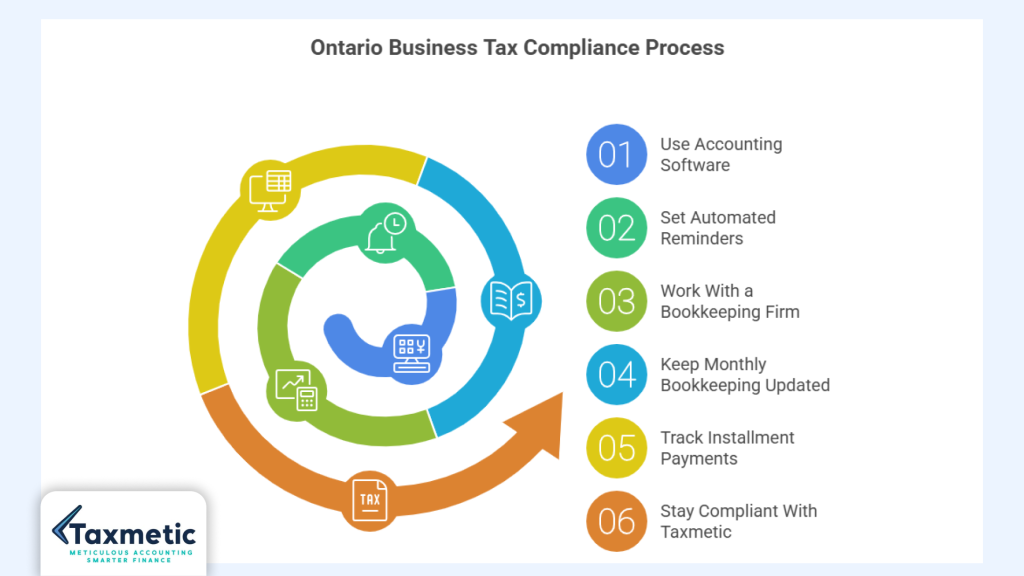
The good news is that most CRA penalties are completely avoidable with proper organization, bookkeeping, and tax planning.
Businesses that stay proactive throughout the year usually experience smoother tax seasons, fewer surprises, and lower compliance risk.
Use Accounting Software
Modern accounting software helps businesses:
- Track income and expenses
- Monitor GST/HST balances
- Organize payroll records
- Generate financial reports
- Prepare year end information faster
Cloud based systems also improve collaboration between business owners, bookkeepers, and accountants.
If you are deciding which accounting platform is best for your business, our comparison of Xero vs Wave vs QuickBooks what best Hamilton business can help simplify the decision.
Set Automated Reminders
Many corporations miss deadlines simply because there is no proper tracking system in place.
Setting automated reminders for:
- Payroll remittances
- GST/HST returns
- Installment payments
- T2 filing deadlines
- T4 preparation
can significantly reduce compliance mistakes.
Work With a Bookkeeping Firm
Professional bookkeeping support helps businesses stay organized throughout the year instead of scrambling during tax season.
A bookkeeping firm can help with:
| Service | Benefit |
| Monthly bookkeeping | Cleaner financial records |
| Payroll processing | Timely remittances |
| GST/HST tracking | Accurate filings |
| Financial reporting | Better tax planning |
| Deadline monitoring | Reduced penalty risk |
Keep Monthly Bookkeeping Updated
Businesses that delay bookkeeping for months at a time often struggle with:
- Missing receipts
- Incorrect expense tracking
- Payroll errors
- GST/HST problems
- Tax filing delays
Keeping records updated monthly creates a much smoother year end process.
Track Installment Payments Carefully
Some corporations are required to make installment payments throughout the year instead of waiting until tax season.
Missing installment payments can result in additional interest charges from the CRA.
Tracking installment obligations properly helps businesses avoid unexpected balances later.
Stay Compliant With Taxmetic
Managing corporate tax deadlines, payroll remittances, GST/HST filings, and bookkeeping responsibilities can become overwhelming for growing businesses.
At Taxmetic, we help Ontario corporations stay organized, compliant, and prepared year round with:
- Corporate tax filing support
- Monthly bookkeeping services
- GST/HST filing assistance
- Payroll management
- Financial reporting
- CRA compliance support
Whether you are a new corporation or an established business looking to improve compliance systems, proactive bookkeeping and tax planning can save your business significant time, stress, and money in the long run.
Frequently Asked Questions About Corporate Tax Deadlines in Ontario
When is my T2 corporate tax return due in Ontario?
Your T2 corporate tax return is generally due six months after your corporation’s fiscal year end.
For example:
| Fiscal Year End | T2 Filing Deadline |
| December 31, 2025 | June 30, 2026 |
| March 31, 2026 | September 30, 2026 |
| June 30, 2026 | December 31, 2026 |
Your exact T2 due date Canada depends on the fiscal year your corporation uses for tax reporting purposes.
What are the CRA deadlines for incorporated businesses in Canada?
Incorporated businesses in Canada may have several CRA deadlines throughout the year, including:
- T2 corporate tax filing deadlines
- Corporate tax payment deadlines
- GST/HST filing deadlines
- Payroll remittance deadlines
- T4 slip filing deadlines
- Installment payment due dates
The exact schedule depends on your corporation’s fiscal year, payroll size, GST/HST filing frequency, and CRA remitter classification.
Businesses that stay organized year round are usually better prepared to meet CRA compliance requirements and avoid penalties.
What happens if I miss my corporate tax deadline?
If you miss your corporate tax deadline, the CRA may apply:
| Possible CRA Consequence | Description |
| Late filing penalties | Penalties based on unpaid taxes |
| Interest charges | Daily compound interest |
| Repeated failure penalties | Higher penalties for repeat late filings |
| Compliance reviews | Increased CRA attention |
Even if your corporation cannot pay immediately, filing your T2 return on time may still help reduce penalties.
If your business has already missed deadlines or received CRA notices, our guide onwhat happens if you miss the tax deadline in Canada explains the next steps businesses can take to recover and stay compliant.
Do inactive corporations need to file a T2 return?
Yes. Most incorporated businesses in Canada are still required to file a T2 return even if:
- There was no business activity
- No revenue was earned
- No taxes are owing
- The corporation was inactive during the year
Many business owners mistakenly assume inactive corporations do not need to file, which can eventually create CRA compliance problems and late filing penalties.
What is the difference between a filing deadline and a payment deadline?
One of the most common corporate tax misunderstandings is assuming your filing deadline and payment deadline are the same.
They are different.
Filing Deadline
Your T2 filing deadline is usually:
Six months after your fiscal year end
Payment Deadline
Your corporate tax payment deadline CRA rules generally require taxes to be paid within:
- Two months after fiscal year end for most corporations
- Three months after fiscal year end for eligible CCPCs
Example
| Requirement | Due Date |
| Corporate Tax Payment | March 31, 2026 |
| T2 Filing Deadline | June 30, 2026 |
Understanding this difference is extremely important because corporations can still face interest charges even if the return itself is filed on time later.
Businesses looking to improve long term tax planning and avoid future filing stress should also review our guide onHamilton business owners tax planning 5 smart moves for practical strategies that help Ontario corporations stay financially organized year round.
Stay Ahead of CRA Corporate Tax Deadlines
Missing important CRA deadlines can quickly lead to penalties, interest charges, cash flow problems, and unnecessary stress for your business. Whether it is a late T2 filing, missed payroll remittance, or overdue GST/HST return, even small compliance mistakes can become expensive over time.
At Taxmetic, we help Ontario corporations stay organized and compliant year round with professional:
- Corporate tax filing services
- Monthly bookkeeping
- Payroll management
- GST/HST filing support
- Financial reporting
- CRA compliance assistance
Our team works with incorporated businesses across Ontario to simplify tax deadlines, improve bookkeeping accuracy, and reduce the risk of costly CRA penalties.
Whether you are a new corporation, a growing business, or an established company looking for reliable accounting support, Taxmetic can help you stay ahead of every important corporate tax deadline in 2026 and beyond.