
CRA Audit Red Flags: What Every Hamilton Small Business Should Know Before Filing
Think CRA audits are random? They are not. The Canada Revenue Agency relies on sophisticated data matching from T4 slips, GST/HST returns, and third party reports, combined with risk scoring algorithms and industry benchmarks to identify outliers.
Hamilton and Ontario small businesses face elevated risks due to prevalent cash heavy sectors like construction, restaurants, and retail, where underreporting concerns draw extra scrutiny from CRA’s regional focus.
In this guide, you’ll discover common CRA audit triggers, steps to prevent them, and exactly what to do if contacted, helping you file confidently and avoid CRA reassessment.
How the CRA Selects Businesses for Audit (Canada Explained)
CRA targets businesses through sophisticated risk assessment systems, moving beyond random selection to focus on high probability non compliance cases. These tools process millions of data points annually to prioritize reviews efficiently.
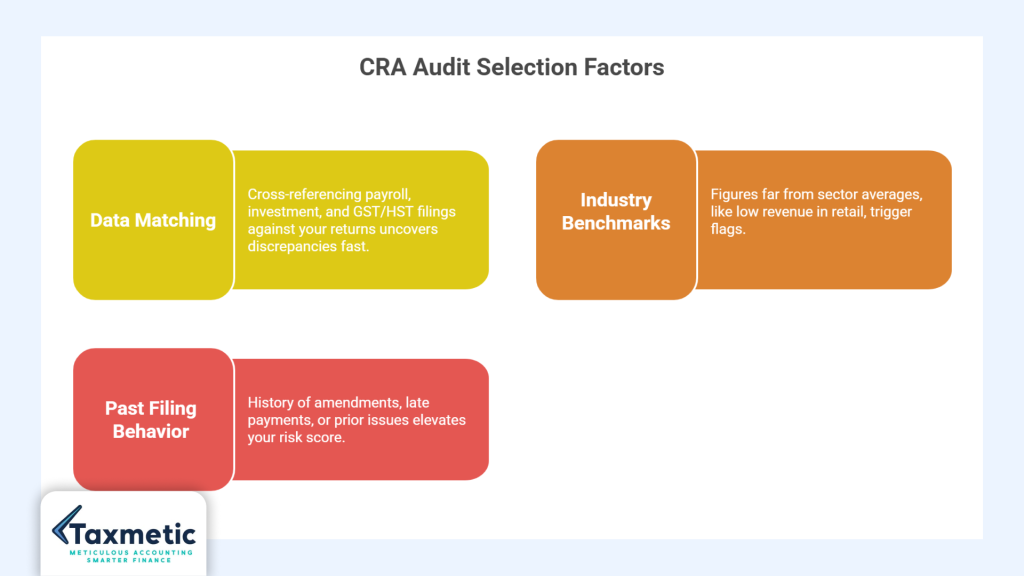
Key selection factors stand out clearly:
- Data matching: Cross referencing T4 payroll slips, T5 investment income, and GST/HST filings against your returns uncovers discrepancies fast.
- Industry benchmarks: Figures far from sector averages, like low revenue in retail, trigger flags.
- Past filing behavior: History of amendments, late payments, or prior issues elevates your risk score.
CRA offers three review types: desk audits conducted remotely via mail or phone for basic checks, field audits with on site visits for detailed probes, and simple review letters for preliminary questions.
While full audits hit only 1 to 2% of small businesses yearly, review letters reach 10 to 15%, underscoring the need for Hamilton owners to maintain solid records proactively.
| Review Type | Scope | Typical Duration | Hamilton Relevance |
| Desk Audit | Remote document review | 4 to 8 weeks | Common for simple filings |
| Field Audit | On site examination | 3 to 6 months | Used for cash heavy locals |
| Review Letter | Quick inquiry | 2 to 4 weeks | High volume, low burden |
Top CRA Audit Red Flags Every Small Business Must Know
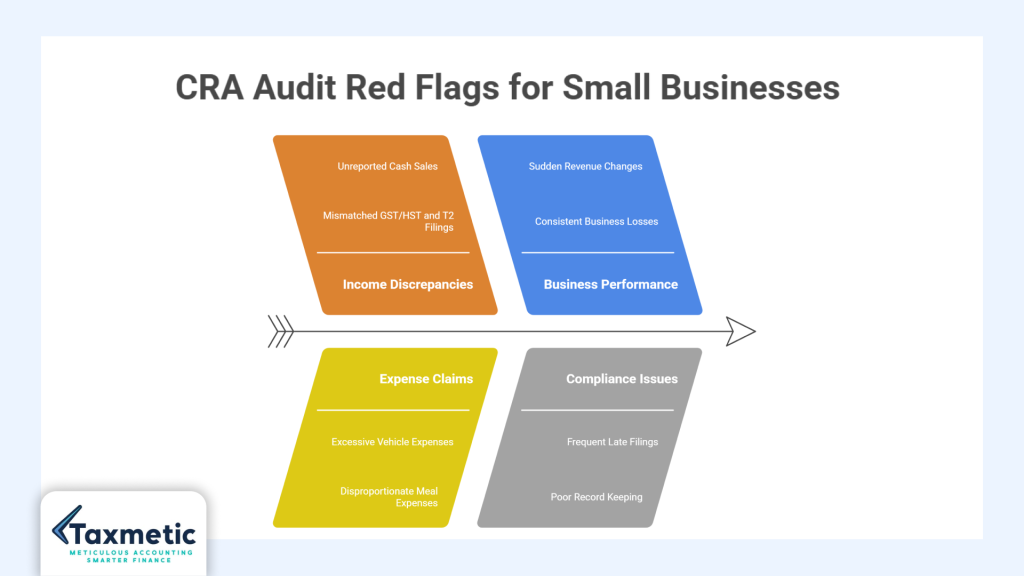
Common red flags signal potential audits through CRA’s data analytics, helping Hamilton businesses stay ahead.
1. Mismatched Income Across Filings
GST/HST returns not matching T2 corporate filings top the risks, as CRA flags these automatically. Financial statements misaligned with tax reports compound the issue, often leading to immediate reviews.
2. Unreported or Underreported Income
Cash sales going unreported or discrepancies with T4 slips and bank deposits trigger cross checks. Hamilton service providers see this frequently when deposits exceed declared revenue.
3. Excessive Expense Claims (Red Flag Deductions)
Vehicle, meals, entertainment, and home office costs disproportionate to income draw scrutiny. Deductions over industry averages, like meals above 5%, prompt deeper looks.
4. Consistent Business Losses
Multiple years of losses raise doubts about business viability versus a hobby. CRA requires proof of a profit motive to allow deductions.
5. Sudden Changes in Revenue or Expenses
Revenue swings or expense jumps over 25% from prior years, without industry alignment, flag anomalies.
6. Cash Heavy Business Activity
Hamilton’s restaurants, construction, and contractors face elevated risks from assumed cash underreporting.
7. Frequent Late Filings or Amendments
Ongoing delays or fixes indicate poor compliance, increasing audit odds.
8. Poor or Missing Books and Records
No receipts or sloppy bookkeeping fails substantiation; retain records for six years.
| Red Flag | Risk Level | Prevention Tip |
| Income Mismatch | High | Reconcile GST/T2 quarterly |
| Cash Income | High | Deposit all sales, log daily |
| Excessive Expenses | Medium | Keep detailed logs/receipts |
| Losses | Medium | Document growth plans |
| Fluctuations | Medium | Note explanations in filings |
What the CRA Actually Looks for in a Business Audit
CRA auditors zero in on the accuracy of your reported income, cross checking it against bank deposits, contracts, and third party slips like T4s to spot underreporting.
They demand supporting documents such as receipts, invoices, and mileage logs for every deduction, while scrutinizing the divide between business and personal expenses to prevent improper claims. Reasonableness tests pit your numbers against industry norms, flagging outliers like unusually high meal costs.
Books and records validation forms the core focus, requiring organized ledgers and six year retention to substantiate all filings.
| Priority Check | Examples Reviewed | Red Flag If… |
| Income Accuracy | Deposits, slips | Doesn’t match sales records |
| Documentation | Receipts, contracts | Missing or vague |
| Expense Split | Home office logs | Personal overlap evident |
| Industry Fit | Benchmarks | 20%+ above peers |
What Happens If You Get a CRA Audit Letter
CRA contacts you primarily by mail with an official audit notification letter or sometimes by phone for initial low level inquiries, clearly stating the tax years in scope and next steps. This formal notice arrives via Canada Post or through your My Business Account portal, giving you clear instructions from the start.
The audit unfolds in clear stages: initial contact to confirm details, a document request listing specifics like ledgers and receipts, an in depth review phase that might involve meetings, and finally an outcome such as no change, minor adjustments, or a CRA reassessment notice. Most Hamilton businesses handle this without on site disruption if prepared.
Timeline expectations range from 4 to 8 weeks for simple desk audits to 3 to 6 months for field visits, depending on your responsiveness and case complexity.
| Audit Stage | Key Actions | Expected Timeline |
| Initial Contact | Read the CRA audit letter, acknowledge receipt | Within 30 days |
| Document Request | Gather receipts, books, and slips | 2 to 4 weeks prep |
| Review & Meetings | Auditor questions, clarifications | 4 to 12 weeks |
| Outcome Delivery | Report issued, possible CRA reassessment | 8 to 24 weeks total |
CRA Reassessment: What It Means for Your Business
A CRA reassessment revises your original tax notice after an audit finds discrepancies, recalculating taxes owed with adjustments applied retroactively from the original filing date. This often stems from missing income not captured in returns or denied expenses lacking proper support, directly impacting your bottom line.
Penalties add 20% for negligence or up to 50% for repeated issues, alongside daily compounding interest around 9% in 2026. Hamilton businesses commonly face these over GST mismatches within the standard four to year window.
| Common Reason | Tax Impact | Added Risk |
| Missing Income | Back taxes due | 10% penalty possible |
| Denied Expenses | Refund reversal | Interest from due date |
| Documentation Gaps | Full disallowance | Escalates to gross negligence |
How to Respond to a CRA Audit (Step by Step Guide)
Don’t panic most audits end without major changes if you act methodically. Start by reading the CRA audit letter carefully to understand scope and deadlines, then gather only the requested documents to build a strong defense.
Respond on time via My Business Account to avoid extra penalties, and partner with an accountant experienced in Hamilton audits to interpret requests accurately. Limit communication to facts, avoiding voluntary extra details that could invite deeper scrutiny.
Follow these steps for smooth handling:
- Acknowledge within 30 days to show cooperation.
- Compile indexed files digitally, receipts, ledgers, slips.
- Submit promptly and track via portal.
- Review findings; object within 90 days if needed.
Ready for support? Learn more in our guide on the best accountant in Hamilton or book with Taxmetic for audit defense.
How to Avoid CRA Audit Red Flags in Ontario
Maintaining clean, consistent records forms the foundation of audit avoidance, ensuring every transaction traces back with receipts and ledgers kept for six years as CRA requires. Regularly reconcile GST/HST returns with income tax filings to eliminate mismatches that top CRA audit triggers, a step many Ontario businesses overlook until it’s too late.
Claim only legitimate expenses backed by documentation, avoiding stretched deductions like excessive home offices, and benchmark your financials against industry peers using tools like QuickBooks reports. Filing on time every year without amendments keeps your compliance history spotless, drastically lowering risk scores.
Simple habits make the difference:
- Use cloud accounting software for real time tracking.
- Review returns twice before submission.
- Separate business and personal bank accounts fully.
Tie this to smarter deductions in our small business tax deductions Hamilton owners miss post.
Pro Tips for Hamilton Small Business Owners
Hamilton’s construction, restaurants, and trades face heightened scrutiny due to cash flow prevalence, making local owners prime targets for CRA’s regional data sweeps. Professional bookkeeping catches discrepancies early, turning potential red flags into non issues and saving hours during reviews.
Hire a CPA when revenues hit $100K, losses persist two years, or HST registration kicks in don’t wait for the CRA audit letter. Costs pay off; see our breakdown in how much does an accountant cost in Hamilton Ontario.
Explore if you need an accountant for your small business and check HST registration timing.
FAQs
Q: What triggers a CRA audit in Canada?
Answer: Income mismatches between GST/HST and T2 returns, unreported cash sales, excessive deductions like vehicle or meals costs, round number reporting, consistent losses, and cash heavy operations top the list. CRA’s data analytics flag these automatically.
Q: What should I do if CRA audits my business?
Answer: Acknowledge the letter within 30 days, organize the requested documents like receipts and ledgers, submit via My Business Account, and consult an accountant immediately to avoid missteps. Stay factual and timely throughout.
Q: How can I avoid a CRA audit in Ontario?
Answer: Reconcile all filings monthly, retain six years of records, claim only substantiated expenses, file on time without amendments, and benchmark against industry norms using accounting software.
Q: How long does a CRA audit take?
Answer: Desk audits wrap in 4 to 8 weeks, while field audits extend to 3 to 6 months based on complexity and your response speed.
Final Thoughts:
Proactive compliance beats audit stress every time consistent records, timely filings, and professional advice keep CRA at bay while freeing you to grow your Hamilton business. Taxmetic specializes in turning compliance into your competitive edge.
Worried about CRA audit red flags? Taxmetic offers a free consultation, dedicated audit support, and bookkeeping cleanup to safeguard your operations. Book your session today or explore our best accountant in Hamilton guide. Contact us now at Taxmetic.ca.