

Why most Canadian business owners overpay taxes every year
Many small business owners in Canada pay more tax than they legally owe, not because they’re ignoring the rules, but because they simply don’t know what they can claim. Between the CRA’s complex wording, frequent updates, and the sheer variety of allowable expenses, it’s easy to treat a business like a personal checking account and leave thousands of deductions on the table each year.
The real reason deductions get missed
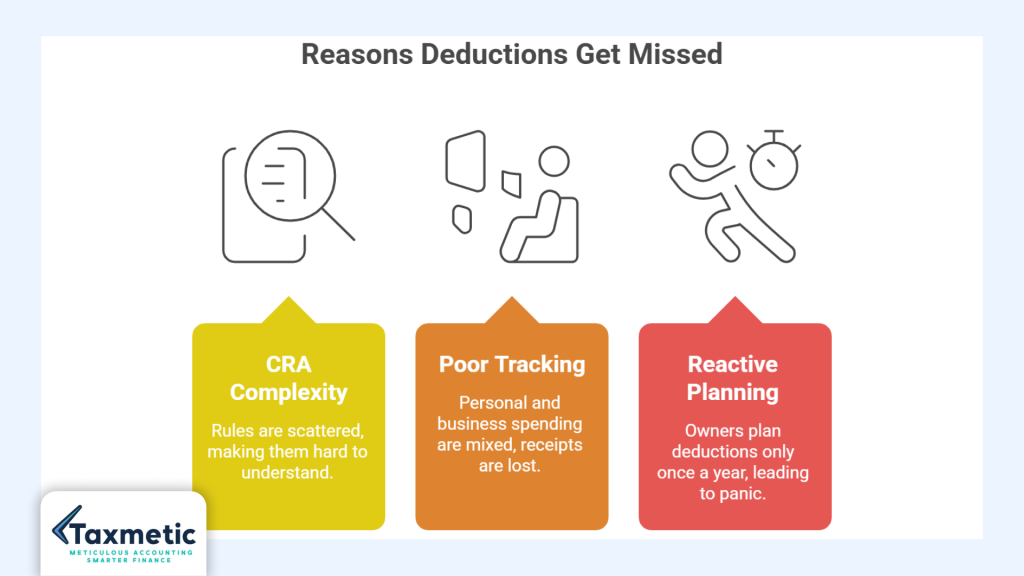
Three main issues keep deductions from being claimed:
- CRA complexity: The rules for “reasonableness,” purpose of income earning, and documentation are scattered across forms and guides, so busy owners never sit down to decode them.
- Poor tracking: Many operators mix personal and business spending, don’t keep receipts, or assume CRA won’t accept “informal” records.
- Reactive planning: Instead of planning deductions throughout the year, owners look at taxes only once a year, right before filing, and then panic file instead of optimizing.
How missing deductions can cost thousands annually
For a typical small business in Ontario, overlooking a handful of common deductions, such as home office, vehicle, meals, software, and insurance, can easily add up to $2,000–$8,000 in extra tax on a modest profit. Grow that over a few years, and the cumulative cost starts to look like a missed office lease, a new vehicle, or a year’s worth of marketing.
What this guide will help you uncover
This deep dive focuses specifically on “tax deductions for business owners” who operate in Canada, with extra attention to small business write offs in Hamilton and Ontario, specific rules like the home office deduction. You’ll learn:
- How to separate personal vs business expenses under the CRA’s “purpose of earning income” test.
- The top 10 CRA deductions that most owners miss in 2026.
- Practical systems and links to our existing resources (like our guide to small business tax deductions Hamilton owners miss and our Hamilton business owners tax planning series), so you can plug gaps in your current approach.
By the time you finish reading, you’ll be able to:
- Spot “hidden” CRA deductions in your existing spending.
- Build a simple tracking routine that keeps CRA auditors off your back.
- Position your tax return so you’re not overpaying every April.
What Counts as a Tax Deduction in Canada? (CRA Rule Explained Simply)
At the core of Canadian business tax law is one simple test: the expense must be incurred for the purpose of earning business income. If you can show that an expenditure was necessary to run, grow, or maintain your business, the CRA generally allows it as a deduction provided it’s also reasonable and documented.
The CRA “purpose of earning income” rule
The CRA expects that any claimed expense:
- Be directly connected to generating revenue (e.g., advertising, rent, supplies, software used to deliver services).
- Not be purely personal (e.g., a family vacation, personal clothing, or a home gym with no business link).
If you can’t clearly connect the expense to generating business income, the CRA will disallow it and possibly flag your file for review.
Personal vs business expenses
The key difference:
- Personal expenses: Costs that benefit you or your family, even if they’re related to your business (for example, a personal cell phone plan that’s 90% personal use). These are not deductible.
- Business expenses: Costs incurred to run the business, such as office supplies, commercial insurance, or mileage from client visits. These are deductible if they meet the “purpose of earning income” test.
When something is mixed use (like a home office style kitchen table or a shared phone line), you must split the cost and claim only the business use portion.
Current vs capital expenses
The CRA also distinguishes how expenses are treated:
- Current (operating) expenses: Recurring costs you use up in the year, like rent, utilities, advertising, meals with clients, and software subscriptions. These are usually fully deductible in the year they’re incurred.
- Capital expenses: Longer lasting assets such as computers, vehicles, office furniture, or renovations. These are not fully deductible right away; instead, you recover them over several years through Capital Cost Allowance (CCA).
Mixing up current and capital items can trigger audits or interest charges if you deduct too much too quickly.
Why “reasonable expense” matters for audits
The CRA doesn’t just care that you spent the money; it also cares how much you spent. An expense must be reasonable in amount and kind for your business type and revenue level.
For example:
- A $200 client dinner for a $1M revenue business might be reasonable; charging $1,000 for the same dinner repeatedly could raise questions.
- Business class flights for a small business owner might be scrutinized if they’re not justified by actual travel needs.
If the CRA deems an expense unreasonable, they can:
- Disallow the full amount.
- Reduce the deduction to a “reasonable” level.
- Trigger a deeper audit of your records.
Quick example to simplify
Imagine a Hamilton based consultant who:
- Pays $1,200 per year for a business only internet line.
- Uses one room in their home as an office (about 15% of the house).
- Spends $1,500 on client dinners during the year.
Here’s how the CRA view would apply:
- The internet bill is 100% deductible because it’s used solely for business.
- A 15% share of rent, utilities, and insurance for the home office is deductible as a business expense.
- The client dinners are deductible at 50% (the CRA’s meal and entertainment rule), leaving $750 as a valid deduction.
In this small example alone, the consultant could easily claim over $2,000 in additional deductions just by understanding the basic CRA rules and documenting everything properly.
This same logic underpins the top 10 missed deductions we’ll walk through next, tailored specifically for tax deductions for business owners in Canada, including small business write offs in Hamilton and home office type costs in Ontario.
Top 10 Tax Deductions For Business Owners Missing in 2026
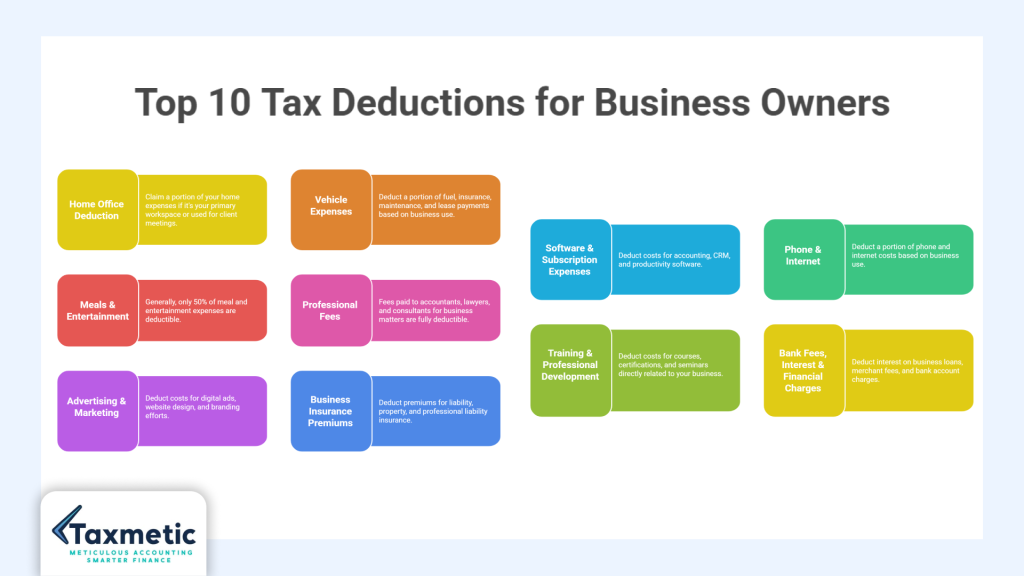
Every year, Canadian business owners, especially in places like Hamilton and across Ontario, leave thousands of dollars in tax savings on the table simply because they don’t know what they can claim or they don’t document it properly. Below are the top 10 CRA compliant deductions most owners miss in 2026, with a focus on small business write offs in Canada, home office rules in Ontario, and CRA friendly tracking habits.
1. Home Office Deduction (Most Underclaimed)
Who qualifies in Ontario / Canada
To claim a business use of home deduction, the CRA requires you to meet one of two conditions:
- Your home office is your principal place of business (you work there more than 50% of the time), or
- You use the space exclusively and regularly to meet clients, customers, or patients.
This applies to self employed sole proprietors, corporations, and Hamilton based small business owners who run operations from home or part time offices.
Simplified vs detailed method
- Simplified method: $2 per day for each day you work at home (up to 300 days), capped at $600 per year. Easy to claim, but can undercompensate larger home office users.
- Detailed method: Pro rate a portion of your rent/mortgage interest, utilities, taxes, insurance, and internet based on the square footage of your office versus the total home area. This often yields a higher deduction but requires careful calculation.
What you can claim
For a qualifying home office in Ontario, eligible expenses typically include:
- Rent (if you rent) or portion of mortgage interest, but not the capital portion.
- Utilities (heat, electricity, water).
- Internet and phone are used for business purposes (we’ll expand on this later).
Common mistake: not claiming partial use
Many owners either:
- Avoid claiming because they fear an audit, or
- Assume they can’t claim anything if the office is also used for personal reading or storage.
If the space is not used exclusively for business, you can still claim a pro rata share of costs based on actual business use (e.g., 60% of utilities if the room is 60% business).
2. Vehicle Expenses (Done Wrong by 90% of Owners)
What qualifies
CRA allows you to deduct a portion of:
- Fuel and electricity (for EVs).
- Insurance, maintenance, and repairs.
- Licence and registration fees.
- Lease payments or interest on a loan used to buy the vehicle.
Depreciation on a vehicle is claimed over time via Capital Cost Allowance (CCA) rather than as a one time deduction.
Mileage log requirement (CRITICAL)
The CRA requires a mileage log to substantiate any vehicle expense claim. For self employed owners, your log must include:
- Date of each trip.
- Start and end locations.
- Business purpose (e.g., “client meeting in downtown Hamilton”).
- Kilometres driven and odometer readings at the start and end of the year.
If you don’t have a log, the CRA can disallow all vehicle expenses, even if they’re legitimate.
Business vs personal split
You can only deduct the business use percentage of vehicle costs. For example, if 60% of your annual kilometres are for clients, you can deduct 60% of fuel, insurance, lease, and maintenance.
Example calculation (simplified):
| Item | Annual Cost | Business Use | Deductible Amount |
| Fuel | $3,500 | 60% | $2,100 |
| Insurance | $1,800 | 60% | $1,080 |
| Maintenance | $1,200 | 60% | $720 |
| Lease payments | $6,000 | 60% | $3,600 |
| Total | $12,500 | $7,500 |
This kind of tracking is especially important for Hamilton area contractors, consultants, and delivery based businesses that drive daily for work.
3. Meals & Entertainment (50% Rule Explained)
CRA 50% deduction rule
The CRA generally allows only 50% of meal and entertainment expenses as a deduction, even if the entire event is business related. Full deduction is possible only in rare, specific cases (for example, providing meals to employees in certain situations).
What qualifies
Deductible at 50%:
- Client meetings at restaurants or cafes (e.g., a Hamilton based contractor meeting a homeowner over lunch to discuss a renovation).
- Travel meals while on business trips (e.g., dinner in Toronto after a client visit).
Exceptions most people don’t know
- Employee meals: If you provide food to employees during overtime or special events, the rules may allow 100% deduction in some cases.
- Conferences or events: When meals are part of a conference registration fee, the 50% rule may still apply to the portion that’s “meals” versus “registration.”
Because the rules are nuanced, many owners either don’t claim anything or accidentally claim 100%, which can trigger an adjustment on audit.
4. Professional Fees (Accountants, Legal, Consultants)
Fully deductible expenses
Fees paid to:
- Accountants and tax preparers (including bookkeepers and payroll providers).
- Lawyers for business related matters (contracts, incorporations, letters of demand).
- Business consultants and advisors (strategy, marketing, HR, or financial planning work).
They are generally 100% deductible as long as they relate to earning business income.
Why business owners forget to claim these
Many owners:
- Treat accounting or legal fees as a “one time cost” and don’t think to code them as business expenses.
- Pay their accountant from a personal account and then forget to transfer them to the business ledger.
Hidden deductions
- Incorporation and registration fees for forming a corporation or registering a trade name.
- Advisory or coaching fees for business growth strategy, which are often lumped into “personal development” and overlooked.
Linking this back to your small business tax deductions Hamilton owners miss piece can help readers see how advisory related write offs tie into overall tax planning moves.
5. Advertising & Marketing Costs
What qualifies
Examples of deductible advertising and marketing costs include:
- Digital ads (Facebook, Instagram, Google Ads, LinkedIn).
- Website design, hosting, and SEO services are aimed at promoting your business (not purely personal branding).
- Branding and design work (logo, brochures, signage, business cards).
These are usually current operating expenses and are deductible in the year they’re incurred.
Canadian vs foreign advertising rules
The CRA generally allows ad expenses regardless of where the ad appears, as long as it’s clearly aimed at your Canadian business. However, if you’re advertising a foreign based venture, the rules become more restrictive and should be reviewed with a tax professional.
Missed deduction: personal brand content
Many small business owners in Hamilton and Ontario create “personal brand” content (YouTube videos, blogs, social media posts) that overlaps with their business. As long as the primary purpose is to promote your services or generate clients, the related costs (equipment, software, hosting, even a dedicated camera or microphone) can often be treated as a business development expense rather than purely personal.
6. Business Insurance Premiums
Types you can deduct
Amounts you usually can deduct include:
- Liability insurance (e.g., general liability for contractors or consultants).
- Property and contents insurance for your office, tools, or inventory.
- Professional liability or errors and omissions (E&O) insurance for service based businesses.
These are treated as current operating expenses and written off in the year paid.
What is NOT deductible
- Life insurance premiums on your own or an employee’s life are typically not deductible unless the policy is part of a formally structured Private Health Services Plan (PHSP) or similar CRA allowed arrangement.
- Premiums for personal, non business policies (e.g., a personal home insurance rider unrelated to your business) are also not deductible.
7. Software & Subscription Expenses
Examples
Common deductible software and SaaS tools:
- Accounting software (QuickBooks, Xero, Wave).
- CRM tools (HubSpot, Salesforce, Zoho).
- Productivity and collaboration tools (Microsoft 365, Google Workspace, project management apps).
Why recurring tools are often ignored
Monthly or annual subscriptions are easy to forget because:
- They show up as a “bank fee” or small recurring charge.
- Owners don’t map them to a clear expense category in their books.
100% deductible if business related
If the software is used primarily for business, the full annual or monthly fee is deductible in the year paid. For example, a Hamilton based consultant using QuickBooks Online for invoicing and payroll can deduct 100% of the subscription.
You can reference this in your salary vs dividends guide to show how tech enabled accounting helps you track both business income and personal draw planning.
8. Phone & Internet (Partial Deduction Strategy)
How to split personal vs business use
There’s no fixed CRA percentage, but you should:
- Track usage patterns (e.g., 70% business calls, 30% personal).
- Use that same percentage for both phone and internet where both are used for business.
If you maintain a separate business only line (e.g., a dedicated cell number for clients), the full bill is usually 100% deductible.
CRA expectations for documentation
The CRA expects at least:
- A consistent allocation method (percentage based or time based).
- A reasonable explanation in your books (e.g., “70% business use based on call logs”).
Common audit mistake
Owners often:
- Claim 100% of a shared line with no supporting logic.
- Keep no notes or logs to back up their split.
If challenged, the CRA may disallow the full deduction or reduce it to a “reasonable” level.
9. Training & Professional Development
Courses, certifications, seminars
Deductible if:
- The training is directly related to your current business (e.g., a Hamilton contractor taking a course on building codes, or a marketer studying digital ad strategy).
- The cost is reasonable and not a purely personal interest course (e.g., a hobby style evening class with no business link).
Allowable costs include:
- Course fees.
- Exam or certification fees.
- Travel and reasonable accommodation if the course is away from your home base.
Travel + education combo deductions
If you attend a course in another city:
- Travel costs (economy flights, mileage) can be combined with course fees.
- Reasonable meals and lodging are partially deductible under the 50% rule.
Strategic tax planning angle
Using training related deductions strategically lets you:
- Lower your taxable income in high income years.
- Invest in skills that grow your business long term.
This naturally ties into your Hamilton business owners tax planning content, where you show how timing education related expenses can smooth out tax bills over time.
10. Bank Fees, Interest & Financial Charges
What qualifies
Allowable deductions include:
- Interest on business loans (e.g., equipment financing, working capital lines of credit).
- Merchant fees charged by payment processors (Stripe, PayPal, point of sale systems).
- Account fees and charges for business bank accounts (monthly service fees, transaction fees, overdraft charges).
Often missed small but recurring costs
These items are usually small per month but can add up to hundreds of dollars over a year. Because they’re “automated” and coded as bank related, many owners:
- Don’t review them intentionally.
- Don’t code them to a proper expense category.
A simple fix:
- Set up a chart of accounts category for “Bank Fees & Interest” and ensure all such charges are coded there.
This section also connects well with your t1 personal tax return complete checklist, where you can remind readers that business related interest and bank fees reduce business income before it flows into their personal tax return.
By systematically claiming these top 10 missed deductions, Canadian business owners especially in Hamilton and Ontario can significantly shrink their tax bill without changing their revenue. In the next sections, we’ll unpack how to layer these into bonus deductions (like CCA and bad debt write offs) and how to avoid common mistakes that trigger CRA audits.
Bonus Deductions Most Business Owners Still Miss
Beyond the “obvious” write offs, there are several CRA recognized deductions that slip under the radar for Canadian business owners especially solopreneurs and small business operators in places like Hamilton and Ontario. When claimed correctly, these bonus deductions can significantly reduce your taxable income without adding new expenses.
Capital Cost Allowance (CCA) explained simply
Capital Cost Allowance (CCA) is how the CRA lets you depreciate long term business assets (computers, vehicles, machinery, office furniture) over several years instead of deducting the full cost in one year.
- How it works: The CRA assigns CCA “classes” and rates (e.g., 30% for furniture, 30% for tools, 55% for computers).
- First year rule: Typically you can claim only 50% of the normal rate in the first year (the “half year rule”), then the full rate in subsequent years on the undepreciated balance.
Simple example:
You buy a business computer for $3,000 that falls under Class 50 (55%).
- Year 1: 50% of $3,000 = $1,500; 55% of $1,500 = $825 CCA.
- Year 2: 55% of remaining balance ≈ $1,175 × 55% ≈ $646.
- You keep claiming CCA each year until the balance is gone or you sell the asset.
Many small business owners forget to claim CCA because they’re unsure how to classify assets or fear making a mistake. In reality, a solid start to finish CCA plan is a powerful way to lower your taxable income while still staying compliant with CRA rules.
Bad debts write offs
If a client owes you money and you can prove it’s uncollectible, you can often write off the bad debt as a deduction.
Key CRA conditions:
- The amount must have been included in your income (e.g., an invoice that was recorded in your books).
- You must determine in the year that the debt is bad (e.g., client goes bankrupt, stops paying, and you can’t reasonably collect).
Bad debt write offs are particularly relevant for Hamilton based service providers, contractors, and consultants who bill clients on account.
Salaries & benefits
Wages paid to:
- Employees (including yourself, if you’re on payroll from a corporation).
- Subcontractors and independent contractors who are genuinely non employees.
are generally fully deductible as long as they’re reasonable and for work that actually supports your business.
Additional deductible items:
- Employer contributions to CPP and EI.
- Private health services plan (PHSP) or group benefit premiums for employees.
Many owners miss opportunities by:
- Paying family members informally.
- Not documenting work performed or market based pay rates when CRA reviews salaries paid to family.
Rent, utilities, and office supplies
These are among the most straight forward yet frequently under claimed expenses for small businesses.
- Rent: Full rent for business space (store, office, warehouse) is deductible; for shared space, claim a reasonable percentage.
- Utilities: Heat, electricity, water, and janitorial services for business premises are deductible.
- Office supplies: Stationery, printer ink, envelopes, postage, and small tools used in daily operations are current expense write offs.
Hamilton based small business owners often either:
- Assume they “know” CRA already allows these and don’t track them properly, or
- Code them incorrectly (e.g., as personal draw instead of an expense).
Common Tax Deduction Mistakes (That Trigger CRA Audits)
Even small missteps can trigger a CRA audit or adjustment, especially when deductions are unusually high compared with your revenue. Below are the most common mistakes Canadian business owners make and how to avoid them.
Mixing personal and business expenses
- Paying personal bills from a business account without proper tracking.
- Treating a personal credit card as a “business” card without clear separation.
CRA view: If the distinction is unclear, they can disallow expenses or re characterize transactions entirely.
No receipts / poor documentation
- Relying on memory instead of invoices, bank statement notes, or mileage logs.
- Throwing away receipts or not keeping them in a retrievable format.
The CRA expects contemporaneous evidence (e.g., dated receipts, written logs, saved bank statement downloads).
Claiming 100% of shared expenses
- Writing off an entire home internet bill or cell phone plan with no business use split.
- Deducting 100% of a vehicle used mostly for personal trips.
A more defensible approach is:
- Use a reasonable percentage.
- Document why that percentage is reasonable (e.g., call logs, trip logs, time use estimates).
Not keeping records for 6 years
CRA rules generally require you to keep records for at least six years from the end of the tax year to which they relate. This includes:
- Invoices and receipts.
- Mileage logs, bank statements, accounting records, and tax returns.
Simply deleting files after “the year is over” is enough to trigger adjustments or penalties.
How to Maximize Your Tax Deductions in 2026
To truly turn deductions into lasting tax savings, you need systems that work year round not just in April.
Simple systems to track expenses
A practical routine for Canadian business owners:
- Daily or weekly review: Spend 10–15 minutes each week sorting bank and credit card transactions into business vs personal.
- Use consistent categories: Home office, vehicle, meals, advertising, software, insurance, training, etc.
- Flag “Maybe” items: Keep a folder for questionable expenses and review them with your accountant before filing.
This kind of habit is the backbone of tax planning moves you can highlight in your Hamilton business owners tax planning guide.
Tools & software recommendations
For a small business owner in Ontario:
- Bookkeeping + tax integration: QuickBooks Online, Xero, or Wave for invoicing, bank feeds, and basic financial reporting.
- Expense tracking + receipts: Receipt scanning apps that auto categorize business vs personal costs.
- Mileage tracking: GPS based mileage log apps that create CRA style logs automatically.
These tools help you stay compliant while minimizing manual work especially helpful if you’re also weighing questions like “do I need an accountant for my small business Hamilton?” in your existing content.
When to hire an accountant
You should seriously consider professional help if:
- Your business is growing quickly or recently incorporated.
- You’re unsure about CCA, bad debt write offs, or complex deductions (e.g., home office blends, vehicle use rules).
- You’re trying to optimize salary vs dividends or other tax planning strategies involving your personal return.
Your readers can lean into your tax accountant Hamilton and how much does an accountant cost in Hamilton Ontario pieces to understand how to choose the right professional for their stage.
Tax planning vs last minute filing
- Tax planning: Looking at your business throughout the year buying equipment, timing training, adjusting salaries, or even delaying or accelerating invoices to keep your tax bill as low as possible.
- Last minute filing: Scrambling in February/March, throwing every receipt at your accountant, hoping nothing is challenged.
The real savings come from planning ahead, not just finding deductions after the fact.
Real Example: How One Business Owner Saved $8,000 in Taxes
Let’s look at a realistic scenario for a Hamilton based small business owner (consultant, contractor, or service provider) running an unincorporated business.
Before vs after scenario
Before
- No home office deduction.
- No mileage log for vehicle expenses.
- No CCA claimed on computer, tools, and equipment.
- No regular tracking of bank fees, merchant fees, or training costs.
Result:
- Over taxed on roughly the same revenue because several hundred to a few thousand dollars in legitimate deductions were never claimed.
After
With basic tracking and CRA compliant claims added in 2026:
- Home office: 15% of rent, utilities, and insurance ≈ $1,200 extra deduction.
- Vehicle (60% business use): ≈ $7,500 from fuel, insurance, maintenance, and lease.
- CCA: First year write off on equipment ≈ $3,000.
- Training + bad debt write off: ≈ $2,000.
- Bank and merchant fees: Another $500 recovered.
Even after applying only the 50% rule for meals and leaving a buffer for “gray” expenses, that same business owner can realistically shave off $8,000–$10,000 of taxable income just by claiming what the CRA already allows.
Missed deductions breakdown
| Category | Estimated Missing Deduction |
| Home office | $1,200 |
| Vehicle (business use) | $7,500 |
| CCA (equipment) | $3,000 |
| Training & education | $1,500 |
| Bad debt write off | $800 |
| Bank / merchant fees | $500 |
Takeaway strategy
This example isn’t just about “finding” deductions; it’s about building a routine where you:
- Track expenses weekly.
- Separate personal and business clearly.
- Consult a professional early in the year to plan major purchases, training, and salary/draw decisions.
If you’re a Hamilton based business owner reading this, you can use our T1 personal tax return complete checklist to ensure your business income items flow correctly into your personal return and that your deductions are already lined up before filing season hits.
By combining these bonus deductions, avoiding common audit trigger mistakes, and using the right tools and systems, you can turn 2026 into a year where you stop overpaying taxes and start keeping more of what you actually earned.
Frequently Asked Questions:
Q: What expenses can I claim as a small business in Canada?
Answer: You can generally claim any reasonable expense, incurred to earn business income, and backed by documentation. Typical eligible items include:
- Home office costs (rent, utilities, internet, portion of insurance).
- Vehicle expenses (fuel, insurance, maintenance, lease interest, business use portion).
- Advertising and marketing (digital ads, website, branding).
- Business insurance, phone and internet, software, training, and professional fees (accountant, lawyer, consultants).
- Salaries, benefits, and business related meals and entertainment (50% rule).
Long term assets such as computers, tools, and vehicles are usually claimed over time using Capital Cost Allowance (CCA), not as a one time write off.
Q: Do I need receipts for every deduction?
Answer: Yes, the CRA expects receipts or other documentation for most deductions, especially if there’s any chance of an audit. Acceptable proof includes:
- Itemized invoices or bills.
- Bank and credit card statements that clearly show the business purpose.
- Mileage logs with dates, destinations, and business reasons.
For small, recurring costs (e.g., minor software fees), a clear electronic record tied to your books is usually enough, but it’s still safer to keep receipts or digital copies for at least six years.
Q: Can I deduct my car payment in Canada?
Answer: You cannot deduct the full car payment as a one time expense, but you can claim a portion of vehicle related costs based on business use:
- Lease payments (business use percentage).
- Loan interest (business use portion).
- Fuel, insurance, maintenance, and registration (business use percentage).
If you buy the car with a loan, the vehicle becomes a capital asset, and you claim its value over time using CCA rather than writing off the entire purchase price in one year.
Q: What is the $30,000 rule in Canada?
Answer: The $30,000 rule typically refers to the HST registration threshold:
- Businesses whose taxable revenues exceed $30,000 in any four consecutive months must register for and charge HST.
- Below that, registration is usually optional.
Once you’re registered, you can also claim Input Tax Credits (ITCs) on HST paid business expenses (e.g., software, advertising, business use of home, vehicles), which can further reduce your overall tax burden.
You can read more about timing and strategy in our When do you need to register for HST in Ontario? guide.
Q: How much can I claim for home office in Ontario?
Answer: In Ontario, you can claim a reasonable portion of your home office related costs in one of two ways:
- Simplified method: Up to $2 per day for each day you work at home (maximum 300 days, so up to $600 per year). Easy to claim and popular with small business owners.
- Detailed method: A percentage of rent or mortgage interest, property taxes, insurance, utilities, and maintenance based on the square footage of your office versus the total home.
To use either method, you must meet CRA’s criteria: the home office is either your principal place of business or used exclusively and regularly to meet clients.
Conclusion:
Many Canadian business owners, especially in Hamilton and Ontario, are missing simple, CRA allowed deductions like home office, vehicle expenses, CCA, training, insurance, and recurring fees.
Every unclaimed expense raises your taxable income and leaves you paying more tax than necessary. Setting up basic tracking and planning can easily save thousands over a few years.
If you’re unsure whether you’re claiming everything you’re entitled to, Taxmetic can help you find missed deductions and build a clean, CRA friendly filing routine.
Want to make sure you’re not overpaying taxes?
Book a free consultation with Taxmetic today: taxmetic.ca