

How to Incorporate a Business in Hamilton, Ontario
If you are wondering how to incorporate a business in Ontario, you are not alone. More entrepreneurs are choosing incorporation in 2026 because it can offer legal protection, a more professional image, and better long term planning opportunities for growing businesses.
In Canada, incorporation means creating a separate legal entity for your business. That entity is distinct from you personally, which means the corporation can own assets, sign contracts, incur debts, and operate under its own name. For many Hamilton business owners, this structure can be a smart step once the business is generating steady income or carrying real risk.
Hamilton continues to attract contractors, consultants, trades, service providers, and small business owners who want to build something scalable. With a strong local economy and a growing number of independent entrepreneurs, incorporation has become a practical move for people who want to separate business and personal affairs more clearly.
Here is the quick version of the process for anyone who wants the main steps right away:
- Choose a business name or a numbered corporation.
- Complete a NUANS name search if using a custom name.
- Decide on your corporate structure and registered office.
- Prepare the Articles of Incorporation.
- File through the Ontario Business Registry.
- Register for a business number with the CRA.
- Set up any needed CRA program accounts.
- Create a corporate minute book.
- File the initial return.
- Open a business bank account.
This guide is written for Hamilton entrepreneurs, small business owners, consultants, tradespeople, and anyone planning to move from sole proprietorship to corporation. It is also useful if you want a clear explanation of Ontario incorporation steps before deciding whether to do it yourself or get professional help.
What Does It Mean to Incorporate a Business in Ontario?
Incorporation is the process of turning your business into a separate legal entity. That means the business becomes its own “person” in the eyes of the law, separate from you as the owner. It can own assets, sign contracts, borrow money, and carry on business in its own name.
For many entrepreneurs, that legal separation is the main reason incorporation matters. It creates a clearer line between personal and business activities, which can be especially important once the business starts growing or taking on more risk.
Why business owners choose incorporation
- Limited liability.
A corporation can help protect your personal assets from many business liabilities, as long as the company is properly maintained and operated. - Tax advantages.
Incorporation can offer more flexibility for income planning, especially if you want to leave money in the business, pay yourself strategically, or plan for future growth. - Business credibility.
A corporation often looks more established to clients, lenders, vendors, and partners. For some businesses, that added credibility can help build trust faster.
When incorporation may not be the right move
Incorporation is not always the best starting point. If your business is still very small, has low risk, or is only a side hustle for now, the extra cost and paperwork may not be worth it yet.
You may want to wait if:
- Your income is still unpredictable.
- You are testing a new idea.
- You want the simplest setup possible.
- You do not need the liability protection yet.
That is why it helps to think beyond the word “incorporation” and look at your actual business situation. For some owners, it is the right next step. For others, it is a move better made later.
Federal vs Provincial Incorporation in Canada
This is one of the biggest decisions you will make when setting up a corporation. The difference is simple on the surface, but it can affect name protection, filing requirements, and how you plan to grow.
Federal incorporation
Federal incorporation means your company is created under Canadian federal law. This is a good option if you want to operate across multiple provinces or you want broader name protection across Canada.
A federal corporation can be a strong choice for businesses that expect to expand beyond Ontario. It may also appeal to owners who want a national brand from the beginning.
Ontario incorporation
Ontario incorporation means your company is formed under Ontario law and registered in the province. This is usually the more practical option for Hamilton based businesses that will mostly operate in Ontario.
For many local businesses, provincial incorporation is simpler and easier to manage. If your customers are in Hamilton or nearby Ontario cities, this route often makes more sense.
Main differences at a glance
| Factor | Federal incorporation | Ontario incorporation |
| Name protection | Broader across Canada | Strong within Ontario |
| Cost | Often higher overall | Usually simpler and more affordable |
| Compliance | May require extra provincial registration | More direct for Ontario based business |
| Best for | National expansion plans | Local and provincial businesses |
Which one is better for Hamilton businesses?
For most Hamilton entrepreneurs, Ontario incorporation is usually the better fit. It is straightforward, practical, and usually enough if your business will operate mainly in Hamilton or elsewhere in Ontario.
Federal incorporation can still make sense if you are building a brand that will expand across Canada or if broader name protection matters to your long term plan. But if your business is local, service based, or Ontario focused, provincial incorporation is often the cleaner choice.
In other words, federal incorporation is about reach, while Ontario incorporation is about simplicity. For many small business owners in Hamilton, simplicity wins.
Step-by-Step Guide: How to Incorporate a Business in Hamilton Ontario
This is the part most readers are looking for: the actual incorporation process, broken down in a way that feels practical, not technical. If you are setting up a corporation in Hamilton, the goal is to move through each step in the right order so you do not create avoidable delays later.
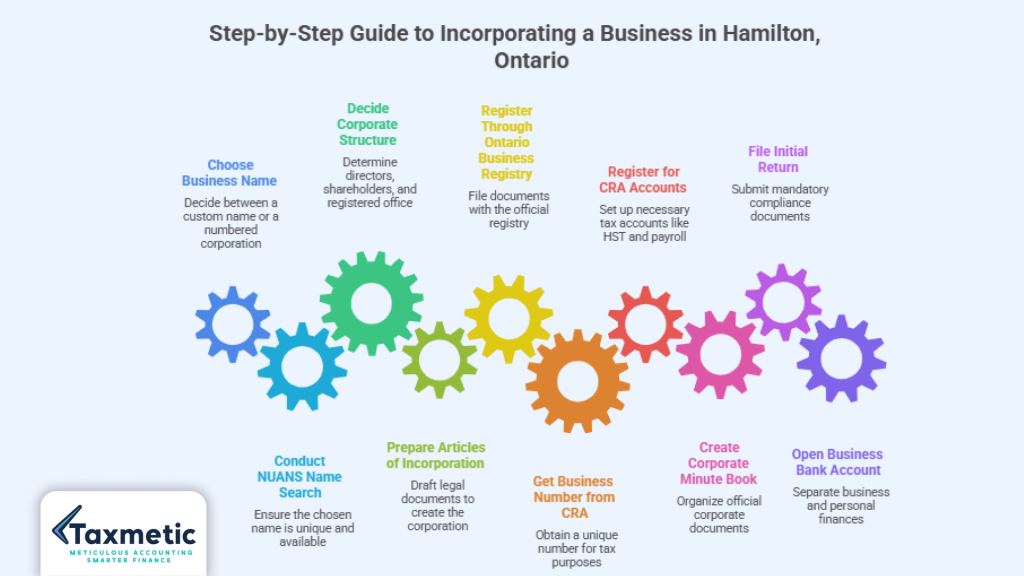
Step 1: Choose Your Business Name or Numbered Corporation
You need to decide whether you want a custom business name or a numbered corporation. A numbered corporation is the fastest option because the government assigns the name for you, which means less back and forth and fewer chances of a name issue.
A custom name is better if you want your business to look branded from the start. It usually feels more professional, but it also means you need to make sure the name follows Ontario naming rules and is not too close to another existing business.
Here is the simple difference:
| Option | Best for | Main advantage |
| Numbered corporation | Fast setup | Less hassle |
| Custom name | Brand building | Stronger business identity |
If your priority is speed, go numbered. If your priority is image and long term branding, choose a custom name.
Step 2: Conduct a NUANS Name Search
If you are using a custom name, you will usually need a NUANS name search Ontario report. NUANS is the system used to check whether your proposed corporation name is already taken or too similar to another registered name.
This step matters because a name that looks available to you might still create problems during filing. A proper search helps reduce the chance of rejection, delays, or a forced name change after incorporation.
A NUANS report does not last forever, so do not let it sit too long before filing. Once you have the name you want, it is best to move quickly while the report is still current.
Step 3: Decide Your Corporate Structure
Before you file, you need to decide who will be involved in the corporation and how ownership will work. This means choosing your directors, shareholders, and share structure.
Directors run the corporation. Shareholders own it. In a small business, one person often fills both roles, but the structure still needs to be set up properly.
You also need a registered office in Ontario. For a Hamilton corporation, that means a valid Ontario address where official documents can be kept and legal notices can be received.
Step 4: Prepare Articles of Incorporation
The Articles of Incorporation are the legal documents that create the corporation. They define the basic framework of the company, so they are one of the most important parts of the whole process.
These documents usually include:
- The business name.
- The share structure.
- The directors.
- The registered office.
- Any special restrictions or rules.
This is where many business owners either file online themselves or use a service provider for help. If the structure is simple, online filing can work well. If there are shareholders, different share classes, or future planning concerns, professional help can save mistakes.
Step 5: Register Through Ontario Business Registry
Once the Articles are ready, the corporation is filed through the Ontario Business Registry. This is the official system for Ontario corporate registrations and related filings.
The government fee is usually around $300. If everything is prepared properly, incorporation can sometimes be completed the same day or within a few business days.
That speed is one reason many entrepreneurs like the process. But the filing itself is only smooth when the documents are accurate from the start.
Step 6: Get Your Business Number from CRA
After incorporation, you will need a business number CRA account. This is the number the CRA uses to identify your corporation for tax and program purposes.
You can register through CRA Business Registration Online. This is where the business gets linked to tax accounts, and it is an important step if you want the corporation to operate properly.
A business number matters because it is used for things like tax filing, payroll, and HST registration. Without it, the corporation is not fully set up for normal business operations.
Step 7: Register for CRA Accounts If Needed
Not every corporation needs every account right away, but some will need them immediately. The most common ones are HST/GST, payroll, and the corporate tax account.
Here is a simple way to think about it:
- HST/GST. Needed if you are charging tax on taxable sales or reach the registration threshold.
- Payroll. Needed if you pay yourself a salary or hire employees.
- Corporate tax account. Needed for filing corporate income tax returns.
This is where CRA registration after incorporation becomes important. You only register for the accounts your business actually needs, but missing one can create problems later.
Step 8: Create Your Corporate Minute Book
A minute book corporation Hamilton record is the official set of corporate documents that keeps everything organized. Think of it as the corporation’s legal filing cabinet.
A proper minute book usually contains:
- Share certificates.
- Director resolutions.
- Articles of Incorporation.
- Corporate registers.
- Ownership records.
This matters because the minute book proves your corporation is being maintained correctly. Banks, lawyers, accountants, and government offices may need to see it, so it is not something to leave for later.
Step 9: File Your Initial Return
After incorporation, Ontario corporations must file an initial return within the required deadline. This is a mandatory compliance step and should not be ignored.
The deadline is usually 60 days from incorporation. The filing generally asks for basic information about the corporation, including directors, office address, and ownership details.
Many owners assume the job is done once the corporation is registered, but this step is part of keeping the company in good standing. It is one of those details that is easy to forget and annoying to fix later.
Step 10: Open a Business Bank Account
The final step is opening a business bank account for the corporation. This keeps business and personal money separate, which is one of the biggest practical benefits of incorporation.
Most banks will ask for:
- Incorporation documents.
- The business number.
- ID for directors or signing officers.
Some banks may also ask to see the minute book or other corporate records before opening the account. Once the account is open, your corporation is ready to operate in a cleaner and more professional way.
The structure is now in place, the tax setup is underway, and the business can start functioning as a real corporation rather than just a registered name.
How Long Does It Take to Incorporate in Ontario?
For many business owners, the incorporation itself can move quite quickly. If everything is prepared properly and filed online, Ontario incorporation may be completed the same day or within a few business days.
The biggest variable after that is the CRA side of things. Your business number and related registrations can take a bit longer depending on what you need and whether any additional review is required.
Here is the simple timeline most people can expect:
| Step | Typical timing |
| Ontario incorporation filing | Same day to a few days |
| Business number setup | Often soon after incorporation |
| CRA program accounts | Depends on the account and details provided |
Delays usually happen when people rush the filing and miss something important. Common issues include name problems, incomplete director information, missing address details, or confusion about share structure.
If you want the process to stay smooth, the best approach is to prepare everything before filing rather than fixing errors afterward. That usually saves both time and frustration.
Cost to Incorporate a Business in Hamilton Ontario (2026)
The cost to incorporate depends on whether you do it yourself or use professional help. At the government level, the main filing fee is usually around $300 for Ontario incorporation.
If you are using a custom business name, you may also need a NUANS report, which adds another cost. The exact price can vary depending on where you obtain it, but it is generally a separate expense from the incorporation filing itself.
There are also optional professional fees if you want an accountant or lawyer to handle the setup. That cost can be worthwhile if your share structure is more complex, you want tax planning guidance, or you simply want the paperwork handled correctly from the start.
A simple way to think about it is this:
- DIY incorporation is usually cheaper upfront.
- Professional incorporation usually costs more, but reduces the chance of mistakes.
- The right choice depends on how simple or complex your business setup is.
If you are incorporating a basic small business in Hamilton, the DIY route may be enough. If you want help with structure, compliance, or future tax planning, professional support may save more in the long run than it costs upfront.
Documents Required to Incorporate in Ontario
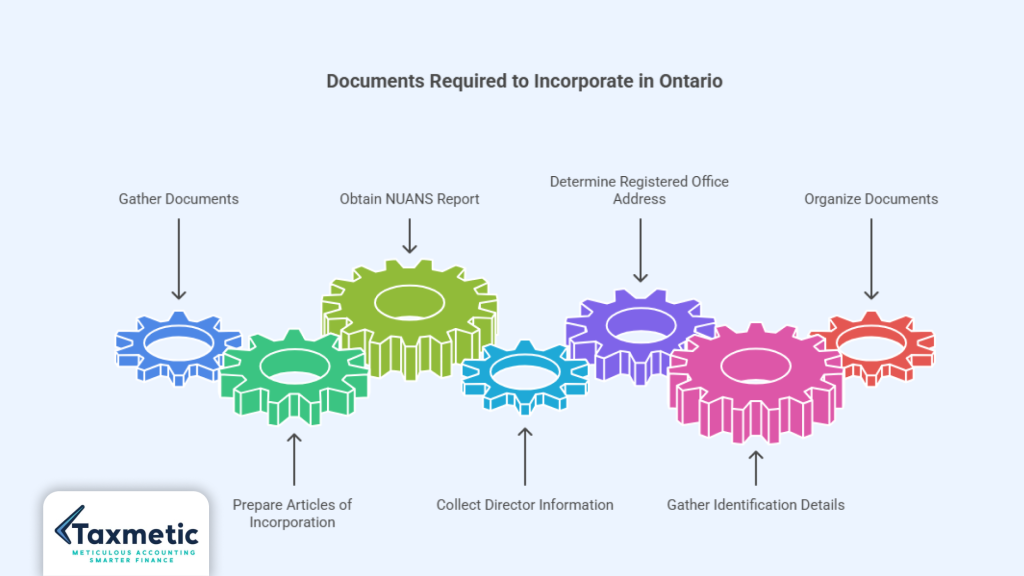
Before you file, it helps to have all your documents and details ready. A lot of incorporation delays happen because one small piece of information is missing at the last minute.
Here are the main documents and details you usually need:
- Articles of Incorporation.
- NUANS report, if you are using a custom name.
- Full director information.
- Registered office address in Ontario.
- Identification details for the people involved.
The Articles of Incorporation are the main legal filing document, so this is the most important item on the list. If you are using a custom name, the NUANS report should match the name you plan to file.
You will also need accurate director information, because the corporation cannot be set up properly without it. The registered office address is equally important since this is where official notices and records will be tied to the company.
For identification, banks, service providers, or filing platforms may ask for ID to confirm the people involved in the corporation. It is a good idea to keep everything organized in one place before you start.
Common Mistakes to Avoid When Incorporating
A lot of incorporation problems happen because owners rush the setup and assume the paperwork is straightforward. In reality, a few small mistakes at the beginning can create headaches later with banking, taxes, ownership records, or compliance.
Here are the most common ones to watch for:
- Choosing the wrong structure.
Some businesses should start as a sole proprietorship, while others are ready for incorporation. Picking the wrong setup can cost more than it saves. - Skipping the NUANS search.
If you are using a custom name, this step matters. Skipping it can lead to filing delays or name conflicts after you have already invested in branding. - Using the wrong share structure.
Many owners set up shares too casually, then later realize they should have planned for family members, investors, tax planning, or future changes. - Missing CRA registrations.
Incorporation does not automatically handle every tax account. If you need HST, payroll, or other CRA program accounts, those must be registered properly. - Not maintaining the minute book.
A corporation is not just a filing. It needs records, resolutions, and ongoing documentation to stay organized and legally sound.
The easiest way to avoid these mistakes is to slow down at the start. A clean setup now is much easier than fixing problems after the business is already operating.
Do You Need an Accountant to Incorporate a Business?
You do not always need an accountant to incorporate, but that does not mean professional help is unnecessary. If your business is simple, a DIY approach may be fine. If there are ownership changes, tax questions, or future planning concerns, getting help can be a smart move.
An accountant makes the most sense when you want more than just a basic filing. That often includes situations where you are trying to decide whether to pay yourself salary or dividends, register for HST, or structure the company in a tax efficient way.
Here is where professional help can really add value:
- You want the structure set up correctly from day one.
- You need help deciding between salary and dividends later.
- You expect the business to grow and want tax planning support.
- You want help with CRA setup, records, and compliance.
- You do not want to deal with avoidable filing mistakes.
For many Hamilton business owners, incorporation is not just a legal step, it is part of a bigger financial plan. That is where a firm like Taxmetic can help make sure the corporation is not only registered, but also set up with the future in mind.
Incorporation vs Sole Proprietorship in Ontario
A sole proprietorship is the simplest way to run a business. You and the business are the same legal person, which makes setup easier but also means there is no legal separation between your personal and business obligations.
A corporation is more formal, but it gives you a separate legal entity. That separation can help with liability protection, credibility, and tax planning, especially as the business grows.
| Factor | Sole proprietorship | Corporation |
| Setup | Simple and inexpensive | More formal and structured |
| Liability | Less personal separation | Better legal separation |
| Taxes | Reported on personal return | Separate corporate tax filing |
| Image | Basic | More established |
| Best for | Small, low risk businesses | Growing or higher risk businesses |
The tax difference is also important. A sole proprietor reports business income on a personal tax return, while a corporation files separately and may offer more flexibility in how income is taken out.
Many businesses start as sole proprietorships and switch later once income grows or risk increases. That switch often makes sense when the business is more stable, earns enough to justify the extra administration, or needs better liability protection.
For many owners, the right time to incorporate is not “right away” or “never.” It is when the business has enough activity, risk, or growth potential to make the extra structure worthwhile.
FAQs
Q: How to incorporate a business in Hamilton Ontario step by step?
Answer: The basic process is to choose a business name or use a numbered corporation, complete a NUANS search if needed, prepare the Articles of Incorporation, file through the Ontario Business Registry, get a CRA business number, register any needed tax accounts, create a minute book, file the initial return, and open a business bank account.
Q: Federal vs provincial incorporation Canada, which is better?
Answer: For most Hamilton based businesses, Ontario incorporation is usually the better fit because it is simpler and more practical for a local or provincial operation. Federal incorporation can make more sense if you want broader name protection across Canada or plan to expand nationally.
Q: How long does incorporation take in Ontario?
Answer: If the filing is prepared correctly and submitted online, incorporation can often be completed the same day or within a few business days. CRA setup may take a bit longer depending on the account type and any extra review needed.
Q: What documents do I need to incorporate in Ontario?
Answer: You usually need the Articles of Incorporation, a NUANS report if you are using a custom name, director information, a registered office address in Ontario, and identification details for the people involved. Keeping everything organized before filing helps avoid delays.
Q: Do I need a NUANS report in Ontario?
Answer: If you are using a custom corporation name, a NUANS search is typically required to check name availability. If you are using a numbered corporation, you usually do not need a custom name search.
Q: Is a CRA business number automatic after incorporation?
Answer: No, a CRA business number is not always automatic just because the corporation is formed. In many cases, you still need to register for the business number and any related CRA program accounts after incorporation.
Final Thoughts
Incorporating a business in Hamilton is not just about filing a form and moving on. It is a process that works best when each step is handled carefully, from choosing the right name to setting up the CRA accounts and keeping the corporate records in order.
The businesses that do best are usually the ones that start with a clean structure from day one. When your incorporation, banking, tax setup, and minute book are all organized properly, you save time later and avoid problems that can be expensive to fix.
Need help incorporating your business in Hamilton?
If you want to incorporate your business in Hamilton without the stress of missing a step, Taxmetic can help with the setup from start to finish. That includes incorporation, bookkeeping, and CRA registration, so your business begins on solid ground.
A proper setup today can save you from avoidable issues later with taxes, compliance, and records. For many business owners, getting the structure right early is one of the smartest decisions they make.