
New Immigrant Tax Return
Moving to a new country is one of the biggest decisions a person can ever make. You have already navigated visa applications, packed your life into suitcases, and started building a future in Canada. The last thing you want is to fall behind on something as important as your taxes. Yet for most newcomers, the Canadian tax system feels like a foreign language on top of everything else that is already new.
If you arrived in Canada recently and are wondering whether you need to file taxes, what income to report, how to deal with the CRA, or whether you qualify for government benefits, you are not alone. These are the exact questions thousands of newcomers ask every single year, and the confusion is completely understandable.
Here is what most people do not realize: your very first New Immigrant Tax Return in Canada can actually work in your favour. Filing your taxes correctly and on time is not just a legal obligation. It is the gateway to government benefits like the GST/HST credit, the Canada Child Benefit, and climate action payments that can put real money back in your pocket. Many newcomers leave hundreds or even thousands of dollars unclaimed simply because they did not know they had to file, or they were unsure how to do it properly.
The Canada Revenue Agency, commonly known as the CRA, is the federal body responsible for administering taxes in Canada. For newcomers to Canada CRA has specific rules around residency status, worldwide income reporting, and benefit eligibility that are very different from what most people are used to back home. Add to that the process of getting a Social Insurance Number, understanding what a T1 return is, and figuring out whether you even qualify to file online, and it is easy to see why so many first-year immigrants feel overwhelmed.
This guide was written specifically for you. Whether you arrived in Canada this year or last year and are now facing your first T1 return as a new immigrant, we are going to walk you through everything you need to know, step by step and in plain language. No complicated tax jargon, no assumptions that you already know how the system works.
By the time you finish reading this, you will understand exactly what a new immigrant tax return involves, when and how to file it, what documents you need, how to set up your CRA account, what benefits you are entitled to, and how working with a local tax professional in Hamilton, Ontario, can make the entire process stress-free.
Let us start from the beginning.
Quick Note for Hamilton Newcomers: If you have recently settled in Hamilton or the surrounding areas and need hands-on help with your first Canadian tax return, the team at Taxmetic specializes in helping newcomers navigate the CRA process from day one. You can also explore our Personal Tax Services to learn how we can support you.
What Is a New Immigrant Tax Return in Canada?
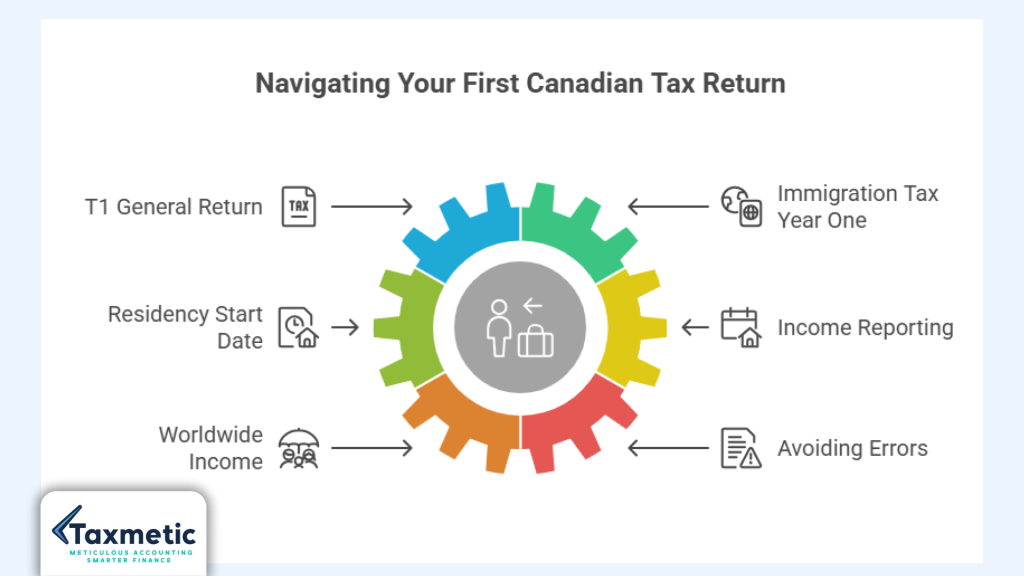
When you arrive in Canada and become a tax resident, the CRA expects you to report your income and file a return for the portion of the year you lived in the country. This is what is commonly referred to as a New Immigrant Tax Return. It is not a separate or special form created just for newcomers. Instead, it is the same T1 General return that all Canadian residents file, but the rules around what you report, how you calculate your income, and what credits you can claim are different in your first year.
The T1 General return is Canada’s standard individual income tax form. It covers all sources of income, deductions you are eligible for, and the tax credits you can claim. When you file for the first time as a newcomer, you are completing what many tax professionals call immigration tax year one, meaning the partial year you spent as a Canadian tax resident before December 31st.
What makes this filing different from a regular Canadian return is that your residency did not start on January 1st. It started on the date you established significant residential ties in Canada, which is typically the date you arrived and settled here. That means your Canadian income is only reported from your arrival date onward, but as we will explain in a later section, your worldwide income for the full year still plays a role in calculating certain benefits.
Understanding this distinction early saves you from reporting the wrong figures and potentially triggering a CRA review. Many newcomers either underreport because they assume only Canadian income counts, or they overreport because they include income from their home country incorrectly. Both situations can create problems.
The good news is that once you understand the structure of your first T1 return as a new immigrant, the process becomes much more manageable. And if you want a comprehensive checklist of what goes into a T1 filing, our blog on the T1 Personal Tax Return Complete Checklist covers this in detail.
Who Is Considered a Newcomer by the CRA?
The CRA does not define a newcomer simply based on your immigration status or how long you have held a Canadian visa. Instead, the definition is built around the concept of tax residency, which is determined by your residential ties to Canada.
According to the CRA, you become a Canadian tax resident on the date you establish significant residential ties in Canada. This is an important distinction because your immigration status and your tax residency status are two separate things. You could be a permanent resident, a temporary foreign worker, a student, or even a refugee claimant, and each situation can lead to a different determination of when and how you are taxed.
What counts as a significant residential tie?
The CRA considers the following as primary residential ties:
| Residential Tie | Description |
| A home in Canada | Renting or owning a place to live in Canada |
| A spouse or common-law partner in Canada | Your family has relocated with you |
| Dependants in Canada | Your children are living with you in Canada |
Beyond these primary ties, the CRA also considers secondary ties such as Canadian bank accounts, a Canadian driver’s licence, provincial health insurance coverage, memberships in Canadian clubs or organizations, and the location of your personal property, like vehicles or furniture.
Temporary Residents vs Permanent Residents
Both temporary and permanent residents can be considered Canadian tax residents if they have established enough residential ties. For example, a temporary foreign worker who rents an apartment in Hamilton, opens a Canadian bank account, and brings their family over would typically be considered a tax resident from their arrival date, even if they do not hold permanent resident status yet.
On the other hand, someone who enters Canada on a tourist visa with no intention of settling here, no home, and no family connections would likely not be considered a tax resident.
This is where the line between newcomers to Canada CRA and non-residents becomes important. If you are unsure of your tax residency status, it is always worth speaking to a professional before you file. Getting this wrong in year one can affect your benefit eligibility and your tax obligations for years to come. You can also review how resident vs non-resident tax rules in Canada apply to your situation in a dedicated section further down in this guide.
When Do New Immigrants Need to File Taxes?
One of the most common questions newcomers ask is whether they actually need to file a tax return in their first year, especially if they only worked for a few months or had very little income. The short answer is yes, and here is why it matters.
The Canadian Tax Year
Canada’s tax year runs from January 1st to December 31st. Even if you arrived in September and only worked for three months, you are still required to file a return for that year. Your return will cover only the period from your arrival date to December 31st, but it still needs to be filed.
Filing Deadlines
| Situation | Filing Deadline |
| Employed newcomer | April 30th of the following year |
| Self-employed newcomer or spouse is self-employed | June 15th of the following year |
| Tax owing in all cases | Must be paid by April 30th regardless |
Missing the April 30th deadline when you owe taxes results in a late-filing penalty of 5% of the balance owing, plus 1% for each full month the return is late, up to a maximum of 12 months. This penalty can compound if you have missed a previous year as well.
Do You Need to File Even With No Income?
Yes. Even if you had zero Canadian income in your first year, filing a tax return is still strongly recommended and in some cases required. Here is why:
Filing triggers your eligibility for GST/HST credits and the Canada Child Benefit. Without a filed return, the CRA cannot calculate what you are owed. Many newcomers with little or no income are actually entitled to refundable credits that put money back in their hands, but only if they file.
People Also Ask: How do I file my first tax return as a new immigrant in Canada?
You file your first return using the T1 General form, which covers your income from your arrival date in Canada to December 31st of that year. You will need your Social Insurance Number, any T4 slips from Canadian employers, details of any foreign income earned before you arrived, and your immigration documents. You can file by mail if you cannot use NETFILE, which we explain in the step-by-step section below. Many first-time newcomer filers choose to work with a tax professional to make sure everything is reported correctly.
Documents You Need Before Filing Your First Tax Return
Being organized before you sit down to file saves you significant time and reduces the risk of errors. As a newcomer, your document list is slightly longer than that of a typical Canadian resident because you may have income and assets from another country that need to be accounted for.
Here is a full overview of what you should gather:
| Document | Purpose |
| Social Insurance Number (SIN) | Required to file any tax return in Canada |
| Passport and immigration documents | Confirm your arrival date and residency status |
| T4 slips | Shows employment income and deductions from Canadian employers |
| T4A slips | Covers other income like scholarships, freelance, or self-employment |
| Bank statements | May be needed for interest income reporting |
| Foreign income details | Income earned in your home country before or after arrival |
| Foreign tax paid receipts | To claim a foreign tax credit if applicable |
| Rental receipts | If you paid rent, some provinces offer renter’s credits |
| Tuition receipts (T2202) | If you studied at a Canadian institution |
| RRSP contribution slips | If you made any RRSP contributions |
| Medical expense receipts | Eligible for the medical expense tax credit |
| Childcare receipts | If you paid for daycare or childcare services |
| RC151 form | For claiming GST/HST credit as a newcomer without a prior return |
If your financial situation involves both Canadian and foreign income sources, keeping these records organized throughout the year makes your filing far less stressful. This is where having proper bookkeeping in place from day one makes a real difference. Our team at Taxmetic offers Bookkeeping Services tailored to both individuals and small businesses, so nothing falls through the cracks.
If you received employment income in Canada, your employer is required to issue you a T4 slip by the last day of February following the tax year. For a deeper understanding of how T4 slips work, take a look at our blog on T4 Slips: What Every Hamilton Employer Needs to Know.
How to Get a SIN for Tax Filing in Canada
Before you can file any tax return in Canada, you need a Social Insurance Number. A SIN is a nine-digit number issued by the Government of Canada that is used to identify you for tax purposes, employment, and access to government programs. Without it, you cannot legally work in Canada, and you cannot file your taxes.
Who Can Get a SIN?
Anyone who is authorized to work in Canada or who requires access to government programs and services can apply for a SIN. This includes permanent residents, temporary foreign workers, international students with a valid work permit, and protected persons.
How to Apply for a SIN
You can apply for a SIN in two ways:
Online: Service Canada allows eligible newcomers to apply for a SIN online through the official website. You will need to upload digital copies of your immigration documents, such as your Confirmation of Permanent Residence or work permit. Processing is usually fast and your SIN can arrive within days.
In Person: You can visit any Service Canada Centre with your original immigration documents. The SIN is issued on the spot in most cases, so you walk out with your number the same day.
There is no fee to apply for a SIN.
Important Notes About Your SIN
If your SIN begins with the number 9, it means it was issued with an expiry date tied to your work or study permit. You must update your SIN before it expires, and you must notify the CRA if your SIN changes. Failing to do so can create complications with your tax filings and benefit payments.
Your SIN is confidential. Never share it unnecessarily, and make sure you store any documents containing it in a safe place.
Once you have your SIN in hand, you are ready to start the actual filing process. SIN tax filing Canada requirements are straightforward: have it ready before you begin your return because every form you submit to the CRA will require it.
Step-by-Step: How to File Your First T1 Return as a New Immigrant
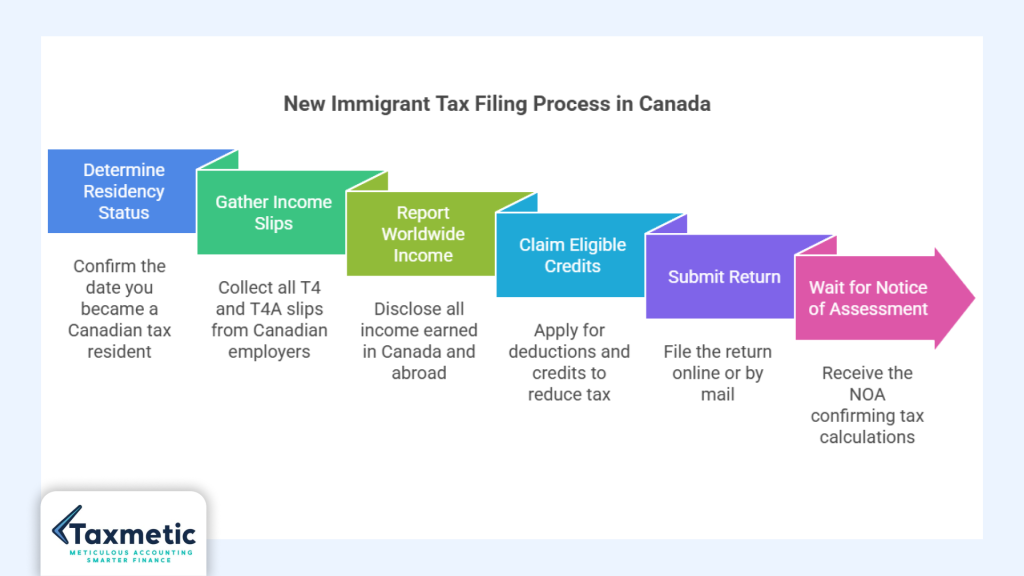
Filing your first tax return in Canada does not have to be intimidating. Follow these six steps in order and you will have a clear path from start to finish.
Step 1 – Determine Your Residency Status
Before anything else, confirm the exact date you became a Canadian tax resident. This is usually your arrival date if you established residential ties on that day, such as moving into a rented home or joining your spouse who was already living here. Your residency start date determines how much of the year you are filing for, and it affects how your income and credits are calculated.
If you are uncertain about your residency status, particularly if your situation involves multiple countries or a complicated immigration path, speak with a tax professional before filing. Getting this step wrong affects everything that follows.
Step 2 – Gather Income Slips
Collect all T4 and T4A slips from any Canadian employer you worked for during the year. Also gather records of any other Canadian income you received, such as rental income, investment income, or self-employment income. You will also need records of any foreign income you earned, which we cover in more detail in the worldwide income section below.
If an employer has not sent your T4 by late February, contact them directly. You can also view slips through your CRA My Account once it is set up, though first-year filers often need to wait until after their initial return is processed.
Step 3 – Report Worldwide Income
This step surprises many newcomers to Canada. The CRA requires you to report your worldwide income for the entire calendar year, even the portion earned before you arrived in Canada. This does not always mean you will be taxed on that foreign income, but it does affect the calculation of income-tested benefits like the GST/HST credit and the Canada Child Benefit.
For example, if you arrived in Canada in July and earned income in your home country from January through June, that income still needs to be disclosed on your return. A tax professional can help you understand exactly how this affects your tax and benefit calculations.
Step 4 – Claim Eligible Credits
As a newcomer, you may be eligible for several deductions and credits. These include the basic personal amount, the GST/HST credit, the Canada Child Benefit if you have children, the medical expense credit, and the climate action incentive if you live in an eligible province. Make sure you do not miss these. They can significantly reduce your tax owing or increase your refund.
If you are self-employed, you may also be able to deduct business expenses. Our guide on Home Office Deduction Canada for Self-Employed in Hamilton explains how this works in practical terms.
Step 5 – Submit Your Return Online or by Mail
Most Canadians file their returns using NETFILE, the CRA’s online filing system. However, many first-time newcomer filers are not immediately eligible for NETFILE because their identity has not yet been verified in the CRA system. If that is the case for you, you will need to file a paper return by mailing your completed T1 General form to the CRA.
Once your first paper return has been assessed and a Notice of Assessment has been issued, you will typically be able to use NETFILE for future years. Many CRA-approved tax software programs allow first-time filers to submit their returns electronically if their information can be verified.
Step 6 – Wait for Notice of Assessment
After you file, the CRA will review your return and issue a Notice of Assessment, commonly referred to as an NOA. This document confirms what the CRA calculated as your income, your tax owing or refund, and your benefit entitlements. Keep your NOA in a safe place because you will need it for future reference, for setting up your CRA My Account, and as proof of income for rental applications, mortgage pre-approvals, and other financial needs.
Processing times vary. Paper returns typically take 8 weeks or more. Online returns can be processed in as little as 2 weeks.
Understanding Worldwide Income for New Immigrants
Of all the concepts that confuse newcomers to Canada during their first Canadian tax filing, worldwide income is the one that creates the most questions and, unfortunately, the most mistakes. Let us break it down clearly.
What Does Worldwide Income Mean?
Worldwide income refers to all income you earn from any source, in any country, during the entire calendar year. The CRA uses this figure to determine your eligibility and payment amounts for income-tested benefits like the GST/HST credit and the Canada Child Benefit. This is true even if you only lived in Canada for part of the year.
Income Earned Before Arriving in Canada
Here is the key distinction that trips up many newcomers to Canada. The income you earned in your home country before arriving in Canada is generally not taxed by the CRA. Canada has tax treaties with many countries specifically to prevent double taxation. However, that foreign income still needs to be reported on your return so the CRA can accurately assess your total worldwide income for benefit purposes.
Common Types of Worldwide Income to Report
| Income Type | Example |
| Employment income from home country | Salary paid by a foreign employer before immigration |
| Self-employment or business income | Running a business in your country of origin |
| Foreign rental income | Owning and renting out property abroad |
| Investment income | Dividends or interest from foreign bank accounts |
| Pension or retirement income | Receiving a pension from a foreign government |
| Foreign capital gains | Selling property or investments before arriving |
Why This Affects Your Benefits
Let us say you arrived in Canada in August and earned the equivalent of $60,000 CAD in your home country between January and July. Even though none of that income was earned in Canada, the CRA will use that figure when calculating your GST/HST credit and Canada Child Benefit amounts. Higher worldwide income means lower benefit payments. This is why accurate reporting matters both for compliance and for making sure you receive exactly what you are entitled to.
Worldwide income tax Canada rules can be complex, especially if you have investment accounts, rental properties, or a business back home. This is one of the strongest reasons to work with a professional who understands international tax situations for newcomers to Canada.
Resident vs Non-Resident Tax Status in Canada
Your tax obligations in Canada depend heavily on whether the CRA considers you a resident or a non-resident. These are not the same as your immigration categories, and understanding the difference is essential before you file.
The Four Categories
| Status | Who It Applies To | Tax Obligations |
| Resident | Established significant ties in Canada | Taxed on worldwide income; eligible for most credits and benefits |
| Non-Resident | No significant ties; living outside Canada | Taxed only on Canadian-source income; limited benefit eligibility |
| Deemed Resident | Sojourned in Canada for 183 or more days in a year | Treated as a resident for tax purposes even without strong ties |
| Part-Year Resident | Became a resident partway through the year | Resident rules apply from arrival date; non-resident rules apply before |
Most newcomers to Canada who have relocated to Canada and established a home here will fall into the part-year resident or resident category. The non-resident category typically applies to people who visit Canada temporarily without establishing ties, or Canadians who have moved abroad.
What Changes Based on Status
Residents are entitled to claim the full basic personal amount for the entire year, can access most federal and provincial tax credits, and are eligible for benefits like the GST/HST credit and CCB. Non-residents face withholding taxes on Canadian-source income and have very limited access to credits and benefits.
For newcomers to Canada who are uncertain whether they are considered a resident or non-resident during their arrival year, the safest step is to consult a professional. Making the wrong determination can lead to either underpaying taxes, which results in interest and penalties, or overpaying, which means money left on the table.
This is closely tied to the broader concept of resident vs non-resident tax Canada that affects not just your filing but also your investment income, rental income reporting, and access to government programs.
How to Create a CRA Account for Newcomers
The CRA’s My Account portal is one of the most useful tools available to Canadian taxpayers. Through it, you can view your tax returns, check benefit payments, download slips, update your personal information, and communicate with the CRA directly. However, many newcomers discover that they cannot create a CRA account right away.
Why Newcomers Face Delays
The CRA verifies your identity during the My Account registration process using information from your previously filed tax returns. If you have never filed a Canadian tax return before, there is no record in their system to match against. This means most newcomers need to file their first paper return, wait for the Notice of Assessment, and then use that information to register.
How to Create a CRA Account for Newcomers: Step by Step
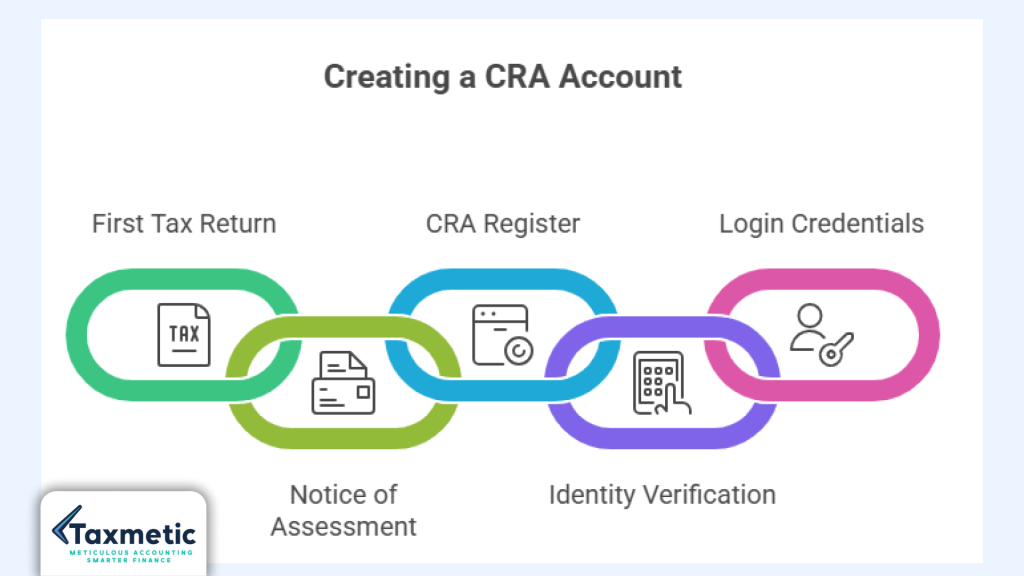
Step 1: File your first tax return, either by paper or through a certified tax professional.
Step 2: Wait for your Notice of Assessment to arrive by mail. This can take 8 to 10 weeks for paper returns.
Step 3: Go to the CRA My Account login page and select “CRA register.”
Step 4: Enter your SIN, date of birth, and the information from your most recent NOA, including your net income and postal code on file.
Step 5: Complete the identity verification process. The CRA may mail you a security code to the address on your return, which you then enter online to activate your account.
Step 6: Set up your login credentials, including a username and password or a Sign-In Partner option through your Canadian bank.
What You Can Do Once Your Account Is Active
Once your CRA My Account is set up, you can view your benefit payment dates, track your refund, access all your tax slips, set up direct deposit, and manage correspondence from the CRA. It is genuinely one of the most helpful tools available and worth setting up as soon as your first return has been processed.
Many newcomers on community forums have noted that the waiting period between filing and being able to create a CRA account can feel frustrating, especially when you are waiting on benefit payments. The fastest way to speed up this process is to have your first return prepared accurately by a professional so there are no delays from corrections or reviews.
Tax Credits and Benefits Available to New Immigrants
One of the most important things to understand about the Canadian tax system is that it is designed to support lower and middle-income residents through a range of benefits and credits. As a newcomer, you may be eligible for several of these from the moment you arrive, and filing your tax return is what unlocks them.
Here is an overview of the main programs available to new immigrants:
| Benefit or Credit | What It Is | How to Access |
| GST/HST Credit | Quarterly cash payment to offset sales tax costs | File RC151 form before first return, or through T1 filing |
| Canada Child Benefit (CCB) | Monthly tax-free payment for families with children | File RC66 form or claim through T1 return |
| Climate Action Incentive | Quarterly payment to offset carbon pricing costs | Claimed automatically through T1 return |
| Ontario Trillium Benefit | Provincial benefit combining energy, property, and sales tax credits | Claimed through Ontario provincial return |
| Canada Workers Benefit | Refundable credit for low-income working individuals | Claimed through T1 return |
You Do Not Always Have to Wait Until You File
Many newcomers do not realize that some benefits can be applied for before you file your first return. For example, the GST/HST credit can be requested by submitting form RC151 to the CRA shortly after your arrival. Similarly, the Canada Child Benefit can be initiated through form RC66. This means eligible newcomers can start receiving benefit payments sooner rather than waiting through an entire tax year.
If you want to understand what tax planning opportunities exist beyond your first year in Canada, our blog on Hamilton Business Owners Tax Planning: 5 Smart Moves offers useful strategies that apply to individuals and business owners alike.
GST/HST Credit for Newcomers in Ontario
The GST/HST credit is a federal program that provides quarterly, tax-free payments to individuals and families with low to modest incomes. It is designed to offset the Goods and Services Tax and Harmonized Sales Tax that Canadians pay on everyday purchases. For newcomers in Ontario, this credit can be a meaningful source of financial support, especially during the early months of settlement when expenses are high.
Are You Eligible?
To be eligible for the GST/HST credit, you must be a Canadian resident for tax purposes, be 19 years of age or older, have a spouse or common-law partner, or be a parent living with your child. Your income level determines how much you receive. Higher incomes result in smaller payments, and above a certain threshold, the credit phases out entirely.
How Newcomers Apply
Because you do not yet have a filed return, the CRA offers a specific form for newcomers:
RC151 – GST/HST Credit Application for Individuals Who Become Residents of Canada
You fill out this form and mail it to the CRA along with a copy of your immigration documents. Once approved, the CRA will calculate your credit amount based on your estimated income and begin sending quarterly payments.
Payment Schedule
GST/HST credit payments are issued four times per year: in January, April, July, and October. The exact amount depends on your net income and family situation. Payments are deposited directly into your bank account if you have set up direct deposit with the CRA, or mailed as a cheque.
Approximate Payment Ranges (2024/2025)
| Family Situation | Approximate Annual Credit |
| Single individual | Up to approximately $519 |
| Married or common-law couple | Up to approximately $680 |
| Per child under 19 | Additional approximately $179 per child |
These amounts are subject to change based on CRA annual adjustments and your family’s net income. Filing your taxes accurately every year ensures the CRA is always using the most current income information to calculate your credit.
For newcomers in Ontario, the GST credit newcomer Ontario program works alongside the Ontario Trillium Benefit and other provincial supports to provide meaningful financial relief during your settlement period.
Canada Child Benefit for New Immigrants
If you have children under the age of 18, the Canada Child Benefit is one of the most significant financial supports available to you as a newcomer. The CCB is a monthly, tax-free payment provided by the federal government to help families with the cost of raising children.
Eligibility for Newcomers
To receive the CCB as a new immigrant, you must meet the following criteria:
You must live with the child and be primarily responsible for their care and upbringing. You must be a Canadian resident for tax purposes. Permanent residents, temporary residents who have lived in Canada for the past 18 months and have a valid permit in the 19th month, protected persons, and certain other immigration categories are eligible.
How to Apply
Newcomers apply for the CCB using form RC66, the Canada Child Benefits Application. You will also need to complete form RC66SCH, the Status in Canada and Income Information form, which helps the CRA determine your eligibility based on your immigration status and worldwide income.
Supporting documents typically required include your child’s birth certificate, your immigration documents, and proof of the child living with you in Canada.
Payment Timeline
Once your application is approved, CCB payments begin the month after the CRA receives and processes your application. Payments are issued on the 20th of each month. The amount you receive depends on your adjusted family net income, the number and ages of your children, and whether any children have disabilities.
Approximate CCB Amounts (2024/2025)
| Child’s Age | Maximum Annual Benefit Per Child |
| Under 6 years old | Up to approximately $7,787 per year |
| 6 to 17 years old | Up to approximately $6,570 per year |
These amounts decrease as family income rises. For lower-income newcomer families, the full amount or close to it is often available.
For families in Hamilton, the CCB new immigrant Hamilton process works the same way as anywhere else in Canada, but having a local tax professional guide you through the application ensures nothing is missed. Our Personal Tax Services team helps newcomer families apply correctly and on time.
Common Mistakes New Immigrants Make on Tax Returns
Even well-intentioned newcomers make errors on their first Canadian tax return. Most of these mistakes are not the result of dishonesty. They come from a lack of familiarity with the Canadian system. Here are the most common ones and how to avoid them.
Not Reporting Worldwide Income
This is the single most common mistake. Many newcomers assume they only need to report income earned in Canada after their arrival date. In reality, your worldwide income for the full calendar year must be disclosed. Failing to do so can result in incorrect benefit payments and potential issues with the CRA down the line.
Incorrect Residency Start Date
Listing the wrong arrival or residency date affects how your income is split between your home country and Canada. It also impacts your eligibility for certain credits that are prorated based on your residency period.
Missing Eligible Benefits
Newcomers often do not know about the GST/HST credit, the CCB, the Ontario Trillium Benefit, or the Climate Action Incentive. Not claiming these means leaving government money unclaimed that you are legally entitled to receive.
Filing Late or Not Filing at All
Assuming you do not need to file because your income was low is a common misconception. Even with little or no income, filing is necessary to access benefits and to establish your CRA profile. Late filing penalties add up quickly.
Not Keeping Records
The CRA can audit your return for up to four years in most cases. Without proper records of your foreign income, receipts, and immigration documents, defending your return becomes very difficult. Good bookkeeping habits start in year one.
Incorrect Marital Status
Your marital status directly affects your benefit amounts and certain deductions. Newcomers sometimes list themselves as single when they have a spouse or common-law partner abroad, which results in incorrect benefit calculations.
Wrong or Missing SIN
Filing without a SIN or using an expired one causes processing delays and can prevent your benefits from being paid.
Working with a professional accountant for your first return eliminates most of these errors before they happen. The cost of getting it right the first time is almost always less than the cost of fixing it later. For a clear picture of what professional tax help costs, take a look at our blog on How Much Does an Accountant Cost in Hamilton Ontario.
Do New Immigrants Get Tax Refunds in Canada?
Yes, new immigrants absolutely can and often do receive tax refunds in Canada. Whether you get a refund depends on how much tax was withheld from your Canadian employment income compared to what you actually owe, and whether you are entitled to refundable credits that result in a payment even if you owe no tax at all.
How Tax Refunds Work
When you work for a Canadian employer, they deduct income tax from each paycheque based on an estimate of your annual income. If your actual income for the year ends up being lower than the estimate, or if you have deductions and credits that reduce your taxable income, you will have overpaid tax. The CRA refunds that overpayment when you file your return.
Refundable vs Non-Refundable Credits
This is an important distinction for newcomers to understand.
| Credit Type | How It Works |
| Non-Refundable Credit | Reduces the tax you owe, but if your tax is already zero, you receive nothing |
| Refundable Credit | Paid to you directly even if your tax owing is zero |
Refundable credits are where many low-income newcomers see real money. Programs like the GST/HST credit, the Canada Child Benefit, the Canada Workers Benefit, and the Ontario Trillium Benefit are all refundable or direct-payment programs. Even if you owe no tax whatsoever, you can still receive these payments.
People Also Ask: What taxes do new immigrants pay in Canada?
New immigrants who are Canadian tax residents pay federal and provincial income tax on their Canadian-source income. They may also pay CPP contributions and EI premiums if they are employed. The amount depends on income level, with Canada’s progressive tax brackets meaning lower earners pay proportionally less.
People Also Ask: Do new immigrants get a tax refund in Canada?
Yes. If more tax was withheld from your paycheques than you owe after credits and deductions, you receive the difference as a refund. Additionally, even if you owe no tax, you may still receive benefit payments through refundable credit programs.
Should You Use an Accountant for Your First Tax Return?
Technically, you can file your first Canadian tax return on your own. The CRA provides guides and some free software options. But the real question is not whether you can do it yourself. The question is whether doing it yourself is the best decision given the stakes involved.
Why the First Year Is the Most Complex
Your first return as a newcomer is almost always more complicated than returns in subsequent years. You have a partial residency period. You likely have foreign income to report. You may have foreign assets or bank accounts. You are establishing your CRA profile for the first time. You may be applying for multiple benefits simultaneously. Any one of these factors alone is manageable. Together, they create a level of complexity that makes professional help genuinely worthwhile.
The Risk of Getting It Wrong
A mistake on your first return can create a ripple effect. If your residency start date is wrong, your benefits may be miscalculated for years until it is caught and corrected. If you miss reporting foreign income, the CRA may flag your return for review. If you claim credits you are not entitled to, you may face a repayment demand later.
The Cost of Getting It Right
A professional accountant who specializes in newcomer tax Canada Hamilton filings will not just file your return. They will review your full situation, identify every credit and benefit you are entitled to, advise you on CRA account setup, and help you avoid the common pitfalls. In most cases, the money they save you in optimized benefits and avoided penalties far exceeds their fee.
For newcomers in Hamilton looking for an accountant for newcomers in Hamilton Ontario, choosing someone with local experience and familiarity with the immigrant community makes a significant difference. They understand the specific concerns of settlement, housing costs, and the unique financial picture that comes with starting over in a new country.
If you are wondering what separates a good tax accountant from a great one, our blog on Secrets to Finding the Best Tax Accountant in Hamilton walks you through exactly what to look for.
At Taxmetic, we offer a free initial consultation for newcomers. You can contact us through our website to book your appointment and get clarity on your first return before the filing deadline.
Newcomer Tax Filing Help in Hamilton, Ontario
Hamilton has grown into one of Ontario’s most welcoming cities for new immigrants. With a diverse population, strong community services, and an expanding job market, it attracts thousands of newcomers each year from every part of the world. And with that growth comes a very real need for local, knowledgeable tax help that understands the newcomer experience specifically.
Why Local Expertise Matters
Filing taxes as a new immigrant is not just about entering numbers into a form. It involves understanding Ontario-specific credits like the Ontario Trillium Benefit, knowing which provincial supports apply to Hamilton residents, and having someone you can actually sit down with and ask questions in plain language. Working with a tax professional who has experience with the Hamilton newcomer community means you are getting advice grounded in real, local knowledge, not generic online guidance.
Virtual Filing Options
Not everyone is able to come into an office during tax season, and many newcomers are still navigating transportation or work schedules in their first year. Taxmetic offers virtual tax filing services so you can share your documents securely online, have everything prepared by a professional, and receive your completed return without ever needing to leave your home. This is especially helpful for families who are still settling into their neighbourhood and getting established.
What Taxmetic Offers Newcomers
At Taxmetic, we have helped hundreds of newcomers in Hamilton and the surrounding area file their first Canadian tax return with confidence. We guide you through residency determination, worldwide income reporting, benefit applications, and CRA account setup. We make sure you are not leaving money on the table and that your return is filed the first time correctly.
Whether you arrived this year or you are catching up on a missed prior-year return, we are here to help. You can learn more about our services by visiting our Personal Tax Services page or by exploring our full range of financial services, including Bookkeeping, Payroll Services, and Tax Planning Services.
And if you are a newcomer who has recently started a business in Canada, our guide on Self-Employed in Hamilton: Your Complete 2026 Tax Guide is a great next read.
Reach out to us today and let us take the stress out of your first Canadian tax season.
Frequently Asked Questions
Q: How do I file my first tax return as a new immigrant in Canada?
Answer: You file using the T1 General form, which covers your income from your arrival date to December 31st of that year. Gather your SIN, T4 slips, immigration documents, and foreign income details. If you cannot use NETFILE, submit a paper return by mail to the CRA. Many first-time newcomer filers work with a tax professional to ensure everything is reported correctly.
Q: What taxes do new immigrants pay in Canada?
Answer: As a Canadian tax resident, you pay federal and provincial income tax on your Canadian-source income. If you are employed, CPP contributions and EI premiums are also deducted from your paycheque. Canada uses a progressive tax system, so the more you earn, the higher your tax rate. Lower-income newcomers often pay little to no tax and may actually receive refundable benefit payments.
Q: Do new immigrants get tax refunds in Canada?
Answer: Yes. If your employer withheld more tax than you actually owe, the CRA refunds the difference after you file. Additionally, newcomers with low or no income may still receive payments through refundable credits like the GST/HST credit, Canada Child Benefit, and the Canada Workers Benefit, even when no tax was paid.
Q: Can I file taxes without a CRA account?
Answer: Yes. You do not need a CRA My Account to file your tax return. First-time newcomer filers who cannot access NETFILE can submit a paper T1 General return by mail. Once your return is processed and you receive your Notice of Assessment, you can then register for CRA My Account using that information.
Q: Do I need to report foreign income in Canada?
Answer: Yes. Once you become a Canadian tax resident, you are required to disclose your worldwide income for the full calendar year, including income earned in your home country before you arrived. This income may not be taxed in Canada if a tax treaty exists between Canada and your country, but it must still be reported as it affects your benefit calculations.
Q: Can newcomers receive GST/HST credits?
Answer: Yes. Newcomers can apply for the GST/HST credit before filing their first tax return by submitting form RC151 to the CRA. Once approved, quarterly payments are issued in January, April, July, and October. Eligibility depends on your residency status and income level.
Q: When can I create my CRA My Account?
Answer: Most newcomers can create a CRA My Account after their first tax return has been assessed and they have received a Notice of Assessment. The CRA uses information from that NOA to verify your identity during registration. This typically takes 8 to 10 weeks after submitting a paper return.
Q: What is worldwide income for newcomers?
Answer: Worldwide income is the total income you earned from all sources, in any country, during the entire calendar year. This includes employment income, self-employment income, rental income, investments, and pensions earned both inside and outside Canada. The CRA uses this figure to calculate your eligibility and payment amounts for income-tested benefits like the GST/HST credit and Canada Child Benefit.
Final Thoughts
Filing your first Canadian tax return as a newcomer is one of the most important financial steps you will take in your first year here. The earlier you file, the sooner your benefits start arriving, and the sooner you establish your standing with the CRA. Even if your income was low, even if you are unsure about your foreign income, and even if you have never dealt with a tax system like this before, filing on time is always the right move.
Canada’s tax system is genuinely generous to newcomers who engage with it properly. The GST/HST credit, Canada Child Benefit, Ontario Trillium Benefit, and other programs exist to support you during your settlement period. But none of them arrive automatically. You have to file to unlock them.
If there is one piece of advice worth taking from this entire guide, it is this: do not navigate your first Canadian tax return alone if you do not have to. The rules around worldwide income, residency status, and benefit eligibility are specific enough that a single misunderstanding can cost you money or create complications with the CRA that take years to sort out.
At Taxmetic, we work with newcomers in Hamilton and across Ontario every tax season. We understand the questions you have, the documents you need, and the benefits you are entitled to. Whether you want to come in, meet virtually, or simply start with a conversation, we are here to make your first Canadian tax return as smooth and rewarding as possible.
Contact Taxmetic today to book your newcomer tax consultation and start your Canadian financial journey on the right foot.