

Are you a Self Employed in Hamilton
Self employment is thriving across Hamilton, from creative freelancers working out of downtown apartments to independent contractors and gig workers powering our local service economy. While the freedom of being your own boss is rewarding, the complexities of the Canadian tax system often go unnoticed until CRA deadlines arrive. Many new business owners find that a single oversight in expense tracking or a missed HST filing can trigger unnecessary penalties and interest. Whether you are an Uber driver, a digital consultant, an Etsy seller, or a remote professional, this 2026 guide is designed to clarify your obligations and help you keep more of what you earn.
Need help filing your self employed taxes in Hamilton? Taxmetic can help.
Who Counts as Self Employed in Canada?
In Canada, understanding your classification is the first step toward tax compliance. While terms like freelancer and contractor are often used interchangeably, they describe your relationship with clients, while sole proprietor and incorporated business describe your legal business structure.
Key Classification Distinctions
- Employee: You work for an employer who deducts income tax, Canada Pension Plan (CPP), and Employment Insurance (EI) from your paycheque. You have little control over how and when your work is performed.
- Independent Contractor: You are a business owner providing services to clients. You control your workflow, your tools, and your schedule. You do not have taxes deducted at the source.
- Sole Proprietor: This is the simplest legal structure for an unincorporated business. You and the business are the same legal entity. All income is reported on your personal T1 tax return.
- Incorporated Business: Your business is a separate legal entity from you. This structure offers potential tax advantages and liability protection but requires more complex filing and record keeping.
Whether you are a delivery driver, a YouTuber, an AI consultant, a marketer, or a Shopify seller, if you are earning income without an employer withholding taxes, the Canada Revenue Agency considers you Self Employed in Hamilton. If you find the administrative side overwhelming, professional bookkeeping services can ensure your records remain compliant and audit ready. If you are debating the long term benefits of shifting your structure, our guide on how to incorporate a business in Hamilton provides a clear comparison of your options.
Do Self Employed People Pay More Tax in Canada?
A common misconception among new entrepreneurs is that self-employed individuals in Hamilton are taxed at higher rates than employees. In reality, your income tax rates remain the same as anyone else’s, based on your total annual earnings. However, the method of payment and the total cost of Canada Pension Plan (CPP) contributions can make it feel like you are paying more.
Why Your Take Home Pay Differs
Unlike employees who have their taxes automatically withheld by their employer, you are responsible for calculating and setting aside your own tax money. As a rule of thumb, we recommend setting aside 25% to 35% of your gross income throughout the year to ensure you are ready for your tax bill. Beyond income tax, you face a significant difference in how you contribute to your future pension.
The Hidden Impact of CPP Contributions
As an employee, you pay half of your CPP contribution, and your employer pays the other half. When you are Self Employed in Hamilton, you are the business owner, meaning you must pay both the employee and the employer portions.
Consider this example for the 2026 tax year:
- If you have a net self employment income of $75,000, your CPP contribution obligations are significantly higher than an employee earning that same salary.
- For 2026, the combined employer and employee CPP contribution rate is 11.9% on pensionable earnings up to the limit.
- Due to the CPP enhancement and the second tier of contributions, a high earning self employed professional can see their total annual CPP contribution exceed $8,000.
Because you do not have an employer managing this, the Canada Revenue Agency may require you to pay these amounts through quarterly installments to avoid a massive lump sum payment each spring. Managing these payments and your overall tax planning effectively is the best way to avoid the stress of unexpected tax season costs.
How Self Employed Taxes Work in Ontario
When you transition to self employment, you lose the safety net of automated payroll systems. Unlike employees, who have income tax, CPP, and other deductions withheld by an employer at every paycheque, self employed individuals receive their gross income in full. This means your tax obligations including federal income tax, provincial income tax, and your full CPP contributions are calculated and paid when you file your personal tax return.
Because you are essentially paying for an entire year’s worth of taxes at once, it is critical to stay organized. A reliable strategy is to set aside 25% to 35% of every dollar you earn into a high interest savings account specifically for tax purposes. This buffer ensures you are prepared for your annual filing and any potential HST obligations you might face as your business grows.
What Is Form T2125?
If you are a sole proprietor, the T2125 is the most important document in your tax toolkit. The Canada Revenue Agency uses Form T2125 to calculate your net business income, which is the amount you are actually taxed on after deducting legitimate business expenses from your gross income.
Navigating Your T2125
The form is divided into sections that capture the financial reality of your business activities, from your total revenue to the specific costs of keeping your operations running.
| Section | Description |
| Business Information | Identify your business name, address, and the correct industry code. |
| Gross Income | Report all revenue earned during the year. |
| Expenses | Claim costs such as advertising, software, internet, and office supplies. |
| Home Office | Calculate the percentage of your home costs used for business. |
| Vehicle Costs | Claim a portion of fuel, insurance, and maintenance based on business use. |
How to Fill Out Your T2125 Step by Step
- Gather all your financial documents, including bank statements, invoices, and receipts for business expenses.
- Select the correct industry code (NAICS code) that best describes your business activity in Hamilton.
- Calculate your gross business income for the year.
- Input your deductible expenses. Be meticulous about separating business use from personal use for items like internet, phone, and home office space.
- Calculate your net income by subtracting your total expenses from your gross income. This net figure is what you will report on your personal T1 tax return.
- If you have multiple distinct business activities, you must complete a separate T2125 for each one.
Using professional tax software or working with an expert can simplify this process and ensure you are capturing every eligible deduction. For those just starting out, keeping accurate small business tax deductions in mind throughout the year can make filling out this form much easier when the deadline arrives.
Best Freelancer Tax Deductions in Canada
One of the greatest advantages of being self employed is the ability to reduce your taxable income by claiming legitimate business expenses. The Canada Revenue Agency allows you to deduct costs incurred to earn your business income, but you must be able to substantiate these claims with valid receipts. Always remember that for any shared expense, you should only deduct the business use percentage of the cost.
Common Deductible Expenses for Freelancers
| Expense Type | Examples |
| Home Office | Rent, mortgage interest, utilities, property taxes |
| Vehicle | Gas, insurance, repairs, lease payments |
| Internet | Work use portion of your monthly bill |
| Phone | Business use portion of your mobile plan |
| Software | Canva, QuickBooks, Microsoft 365, accounting tools |
| Marketing | Facebook ads, domain registration, website hosting |
| Education | Professional development courses, seminars |
| Meals | 50% of the cost of business meals and entertainment |
| Travel | Hotels, flights, and public transit for business trips |
| Equipment | Laptops, monitors, printers, office furniture |
Leveraging Your Hamilton Home Office
For many remote workers and consultants in Hamilton, the home office deduction is a primary way to offset taxable income. Because housing costs continue to be a significant portion of a household budget, calculating the square footage of your dedicated workspace relative to the total area of your home can provide meaningful relief.
When claiming these expenses, focus on accuracy and consistency. If you find it difficult to track these items throughout the year, utilizing the right accounting software can help you categorize expenses automatically. For a deeper dive into the specific write offs that many owners overlook, check out our guide on top 10 tax deductions for business owners.
Home Office Deduction for Self Employed Workers in Hamilton
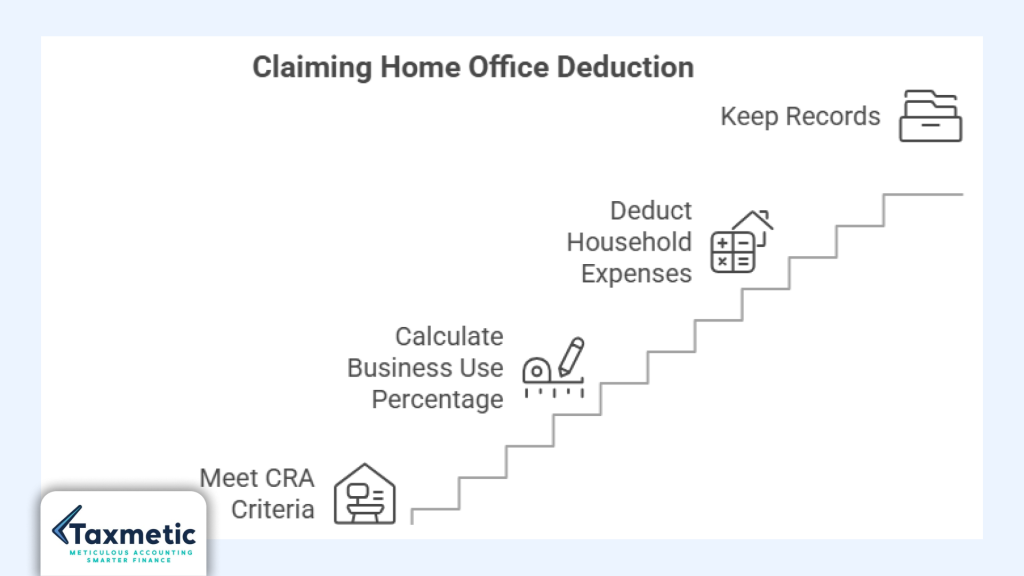
For many professionals in Hamilton, your living space is also your place of business. To claim a home office deduction for self employed workers in Hamilton, your space must meet specific CRA criteria: it must be your principal place of business, or a space used exclusively to earn income where you meet clients or customers on a regular basis.
Calculating Your Claim
Once you meet the eligibility requirements, you can deduct a portion of your household expenses. The most common approach is the percentage method, where you divide the area of your workspace by the total finished area of your home.
For example, if your home office occupies 150 square feet and your total home area is 1,500 square feet, your business use percentage is 10%. You can then deduct 10% of your rent or mortgage interest, heat, electricity, insurance, and maintenance costs. Keeping a clear record of these measurements and a log of your business activities is essential to validate your claim during a review.
Self Employed HST Rules in Ontario
Navigating self employed HST in Ontario is a critical task for any growing business. You are generally required to register for a GST/HST account if your worldwide taxable revenues from all your businesses exceed $30,000 in a single calendar quarter or over four consecutive quarters. Once registered, you must charge your clients the 13% Ontario HST on your taxable supplies and remit those funds to the CRA.
Why Voluntary Registration Matters
While you may qualify as a small supplier if you earn less than $30,000, you have the option to register voluntarily. This can be a smart move if you incur significant business expenses, as it allows you to claim Input Tax Credits (ITCs) to recover the HST you paid on your business purchases. If you are unsure whether your business model requires this step, our resource on when to register for HST in Ontario can help you decide.
Quarterly Tax Installments for Self Employed Workers
The Canada Revenue Agency expects taxes to be paid throughout the year as you earn income. If your net tax owing is over a specific threshold typically $3,000 for Ontario residents the CRA may require you to make quarterly installments for self employed taxes. These payments help prevent a large, unexpected bill when you file your return in the spring.
Important Payment Dates
Mark these dates on your calendar to avoid late installment interest and penalties:
- March 15
- June 15
- September 15
- December 15
If you find yourself consistently owing at the end of the year, these installments are not just a requirement; they are a tool to manage your cash flow. If you are ever uncertain about your tax position, our Hamilton business owners tax planning guide provides strategies to stay ahead of these requirements.
CPP for Self Employed People in Ontario (2026 Update)
When you are self employed, the Canada Pension Plan (CPP) calculation changes significantly because you act as both the employee and the employer. This means you are responsible for contributing both portions of the CPP premiums. These contributions are calculated based on your net business income the profit remaining after all your legitimate business expenses have been deducted rather than your gross revenue.
2026 CPP Contribution Overview
For 2026, the basic CPP contribution rate is 5.95% for employees, meaning self employed individuals must pay the combined rate of 11.9%. Additionally, the CPP enhancement (CPP2) requires further contributions on income earned above the Year’s Maximum Pensionable Earnings (YMPE).
| CPP Component | 2026 Rates (Self Employed) | Maximum Contribution (2026) |
| Base CPP | 11.9% | $8,460.90 |
| CPP2 Enhancement | 8% | $832.00 |
| Total Potential | — | $9,292.90 |
As shown in the figures above, if your net business income is high, your annual CPP contributions can total up to $9,292.90. While these numbers may seem significant, these contributions directly increase your future CPP retirement benefits, essentially acting as a mandatory savings plan. Because these amounts are calculated at the end of the year on your T1 return, many self employed professionals use tax planning strategies to ensure they have the cash flow available to meet their obligations.
Tax Deadlines Self Employed Canadians Must Know
Staying compliant with the Canada Revenue Agency means more than just submitting your forms on time; it requires awareness of different deadlines for payments and filings. While the filing deadline for self employed individuals is later than that of a standard employee, your payment obligations begin much earlier.
Essential Calendar Dates for 2026
| Deadline | Description |
| April 30 | Personal income tax payment deadline for any balance owing |
| June 15 | Personal income tax filing deadline for self employed individuals |
| Quarterly Dates | Installment payments due March 15, June 15, Sept 15, and Dec 15 |
| HST Filing | Based on your annual, quarterly, or monthly reporting frequency |
It is a common point of confusion, but you must remember that even though your tax return filing deadline is June 15, any tax balance owing is technically due by April 30. If you miss this April 30 payment date, the CRA will begin charging interest on the balance, even if you file your return on time by the June deadline.
Effectively managing these dates is a hallmark of a well organized business. If you find the tax season stressful or struggle to keep track of your filing status, our T1 personal tax return checklist can help you prepare for a seamless filing experience.
Common Self Employment Tax Mistakes
Even seasoned entrepreneurs can fall into traps that invite scrutiny from the Canada Revenue Agency. The most frequent errors include failing to save receipts, mixing personal and business bank accounts, and ignoring the requirement to collect and remit HST. Many also underestimate their CPP obligations or miss quarterly installment payments, which leads to interest charges. Furthermore, attempting to claim personal living expenses as business deductions is a major red flag. Maintaining clean, separate, and organized full cycle bookkeeping is the simplest way to avoid these costly pitfalls.
Gig Worker Tax Guide for Hamilton Residents
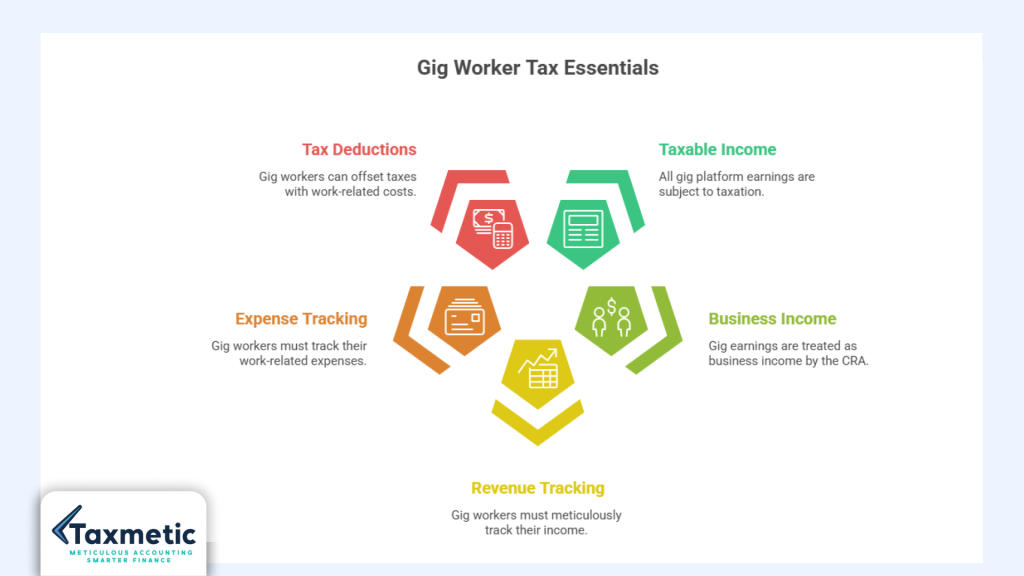
If you generate income through platforms like Uber, DoorDash, Instacart, Fiverr, Upwork, Etsy, or Amazon, you are part of the gig economy. A crucial reality for all gig workers in Hamilton is that your platform income is fully taxable, regardless of whether you receive a T4 or a formal tax slip. The CRA treats these earnings as business income, meaning you must track your own revenue and expenses. Using a structured gig worker tax guide for Hamilton ensures you aren’t paying tax on money that could be offset by your work related costs.
Should You Incorporate or Stay Sole Proprietor?
Choosing your structure is a pivotal decision. As a sole proprietor, you enjoy simplicity and lower setup costs, as your business and personal finances remain under one roof. However, as your profits grow, you might consider incorporating. A corporation offers significant advantages, including advanced tax planning, liability protection, and a better foundation for long term business growth. If you are ready to explore your options, read our guide on how to incorporate a business in Hamilton Ontario.
What Records Should Self Employed People Keep?
Your records are your defense in any tax audit. You should maintain a comprehensive archive of invoices, receipts, bank statements, mileage logs, and client contracts. It is also vital to keep detailed HST records that track the credits you have claimed. The CRA recommends keeping all supporting documentation for a minimum of six years to ensure you can verify any claim made on your returns.
Self Employed Tax Checklist for 2026
Before you file, ensure you have completed these essential steps:
- Organize all receipts and invoices chronologically.
- Calculate your total annual gross income.
- Review and categorize all deductible expenses.
- Prepare your T2125 form with accurate industry codes.
- Calculate your total HST collected versus credits paid.
- Estimate your required CPP contribution for the year.
- Verify your status regarding outstanding quarterly installment obligations.
When to Hire a Tax Professional in Hamilton
Managing your own taxes is possible, but certain situations call for expert intervention. You should consider hiring a professional if you manage multiple income streams, face ongoing HST confusion, find yourself behind on tax filings, or have received notices from the CRA. Whether you are an incorporated business or a sole proprietor with large deductions, professional guidance provides peace of mind. Taxmetic helps Hamilton self employed workers with comprehensive bookkeeping, HST filing, personal tax returns, and CRA support to keep your business running smoothly.
Frequently Asked Questions
Q: How do self employed people file taxes in Hamilton, Ontario?
Answer: Self employed individuals file their taxes by completing a T1 General Income Tax Return, which includes Form T2125 to report business income and expenses. In Hamilton, this filing is submitted to the Canada Revenue Agency (CRA) by the June 15 deadline, though any balance owing must be paid by April 30 to avoid interest.
Q: What can I deduct as self employed in Canada?
Answer: You can deduct reasonable expenses incurred to earn business income, such as home office costs, vehicle expenses, software subscriptions, advertising, professional development, and the business use portion of your internet and phone bills. You must keep valid receipts for all claims to ensure they are audit ready.
Q: Do self employed people pay more tax in Canada?
Answer: No, self employed individuals are subject to the same income tax rates as employees. However, because you are both the employer and employee, you must pay both portions of the Canada Pension Plan (CPP) contributions, which can lead to higher total annual costs compared to an employee earning the same salary.
Q: Do I need HST if I make under $30,000?
Answer: If your worldwide taxable revenues are $30,000 or less over four consecutive quarters, you are considered a small supplier and are not required to register for an HST account. However, you may choose to register voluntarily if you wish to claim Input Tax Credits (ITCs) on the expenses you pay for your business.
Q: How much CPP do self employed people pay?
Answer: In 2026, self employed individuals pay a combined rate of 11.9% on pensionable earnings up to the annual limit, covering both the employer and employee portions. Additionally, you may be required to contribute to the CPP2 enhancement, meaning your total annual CPP contributions can exceed $9,000 depending on your net business income.
Q: Can I deduct my home office in Ontario?
Answer: Yes, if your home office is your principal place of business or a space used exclusively for earning income where you meet clients regularly, you can deduct a percentage of your household costs. This percentage is typically based on the square footage of your office relative to the total area of your home.
Q: What is T2125?
Answer: Form T2125, Statement of Business or Professional Activities, is the document used by the CRA to report the revenue, expenses, and net profit of a sole proprietorship. This form is a critical component of your personal tax return as it determines the actual business income that is subject to tax.
Q: What happens if I don’t pay quarterly installments?
Answer: If the CRA determines that you are required to pay installments but you fail to do so, you may be charged late installment interest and potential penalties. These payments are designed to prevent large tax bills at the end of the year, so missing them can lead to an unexpected and significant financial burden during tax season.
Conclusion
Being self employed in Hamilton gives you flexibility, independence, and the opportunity to grow your income on your own terms. However, managing taxes as a freelancer, contractor, gig worker, or sole proprietor also requires proper planning and organization.
Understanding your tax obligations, tracking expenses, claiming eligible deductions, and staying prepared for HST, CPP, and quarterly installments can help you reduce stress and avoid costly CRA penalties. The more organized your records are throughout the year, the easier tax season becomes.
Whether you are just starting your self employment journey or already running a growing business, having the right tax strategy can save you time and money.
Need help with self employed taxes in Hamilton? Contact Taxmetic today.