

As a Hamilton business owner, you might only dust off your financial records come tax season, scrambling to make sense of a year’s worth of receipts and bank statements. But poor bookkeeping doesn’t just create headaches it leads to cash flow surprises, CRA penalties, inaccurate reports, and missed deductions that could save you thousands. Imagine running your business with clear monthly insights instead of constant stress.
Full cycle bookkeeping changes that. It’s the complete process of handling your finances from start to finish, keeping everything organized and compliant. Let’s break down what full cycle bookkeeping actually means and whether your Hamilton business needs it.
What Is Full Cycle Bookkeeping?
Full cycle bookkeeping is the end-to-end management of your business’s financial records. It covers everything from recording daily transactions to generating reports and closing the books at year-end. Unlike basic data entry, it ensures your numbers are accurate, up-to-date, and ready for taxes or decisions.
This process includes recording sales and expenses, handling invoicing, managing accounts payable and receivable, processing payroll, reconciling bank statements, tracking HST, preparing month-end reports, and gearing up for year-end filings. For Ontario businesses, it’s essential for staying on top of provincial requirements like WSIB premiums and CRA remittances.
What Is the Accounting Cycle?
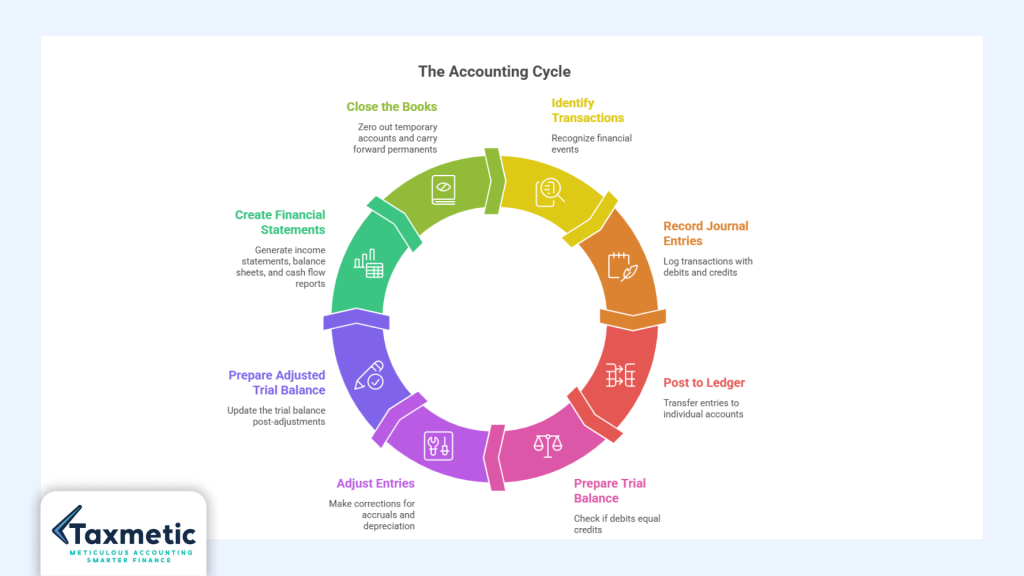
The accounting cycle is the structured sequence of steps to record, process, and report your business’s financial activity over a period, usually monthly or annually. It forms the backbone of full cycle bookkeeping, turning raw data into reliable financial statements.
Here’s a simple breakdown of the 8 Steps of the Accounting Cycle:
| Step | Description |
| 1. Identify Transactions | Spot all financial events like sales, purchases, or payments. |
| 2. Record Journal Entries | Log them in a journal with debits and credits. |
| 3. Post to Ledger | Transfer entries to individual accounts (e.g., cash, expenses). |
| 4. Prepare Trial Balance | List all account balances to check if debits equal credits. |
| 5. Adjust Entries | Make corrections for accruals, depreciation, or prepayments. |
| 6. Prepare Adjusted Trial Balance | Update the trial balance post-adjustments. |
| 7. Create Financial Statements | Generate income statements, balance sheets, and cash flow reports. |
| 8. Close the Books | Zero out temporary accounts and carry forward permanents. |
Think of it like a factory assembly line: raw transactions go in, polished reports come out. This cycle repeats every period, keeping your Hamilton business audit-ready.
What Does a Full Cycle Bookkeeper Do Every Month for a Small Business?
If you’re wondering, “What does a bookkeeper do every month for a small business?”, here’s the real picture. A full cycle bookkeeper handles ongoing tasks to keep your finances humming, freeing you to focus on growth.
Daily Tasks
- Recording sales and revenue from invoices or POS systems.
- Categorizing expenses from receipts and bills.
- Uploading digital receipts to cloud software like QuickBooks or Xero.
- Tracking outstanding invoices to ensure timely payments.
Weekly Tasks
- Reviewing and paying accounts payable.
- Following up on accounts receivable for overdue payments.
- Updating payroll records and running test calculations.
- Spot-checking expenses for unusual patterns.
Monthly Tasks
- Reconciling bank and credit card statements.
- Calculating and accruing HST for Ontario filings.
- Preparing profit and loss statements, balance sheets, and cash flow reports.
- Generating key metrics like monthly profit margins.
Quarterly and Year-End Tasks
- Filing CRA remittances for payroll source deductions and HST.
- Submitting WSIB reports for Ontario employers.
- Coordinating with your accountant for T4s and year-end adjustments.
- Cleaning up books for audits or tax prep.
This routine prevents the tax-season panic so common among Hamilton entrepreneurs.
Full Cycle Bookkeeping vs Basic Bookkeeping
Not all bookkeeping is equal. Basic bookkeeping is like jotting notes in a notebook, helpful but limited. Full cycle takes it further for proactive insights.
| Feature | Basic Bookkeeping | Full Cycle Bookkeeping |
| Scope | Records transactions only | Manages entire workflow, including reconciliations and reporting |
| Reporting | Minimal or none | Monthly P&L, cash flow, and balance sheets |
| Focus | Data entry | Proactive analysis and compliance |
| Timing | Often reactive (e.g., tax time) | Ongoing monthly processes |
| Outcome | Survival mode | Strategic business decisions |
For growing Hamilton businesses, full cycle provides the edge over DIY spreadsheets.
Why Full Cycle Bookkeeping Matters for Hamilton Businesses
Imagine you’re a Hamilton contractor finishing a kitchen reno on Locke Street your quotes look solid, but come month-end, expenses blur with personal truck gas, and cash flow vanishes. Or picture running a bustling Dundas restaurant: tips fluctuate, inventory spoils, and HST filings sneak up. These aren’t hypotheticals they’re weekly realities for local owners. Ontario’s rules amp the stakes: HST registration kicks in at $30,000 revenue (see our HST registration guide), plus payroll deductions, WSIB for workers, and quarterly remittances. Mess up, and face 10% late fees or CRA scrutiny exactly the audit red flags we’ve helped clients dodge.
Common Pain Points in Hamilton Industries
Local businesses battle unique headaches:
- Contractors: Seasonal slowdowns + mixed job/personal expenses.
- Restaurants: Tip tracking + volatile food costs.
- Real Estate Pros: Commission splits + marketing deductions.
- Clinics: OHIP billing + supply categorization.
- eCommerce: Shipping returns eating margins.
- Consultants: Retainer chases + home office claims.
DIY vs Full Cycle: The Real Difference
| Approach | DIY Spreadsheets | Full Cycle Bookkeeping |
| Cash Flow | Guesses & surprises | Accurate tracking, forecasts |
| Compliance | Risk of penalties | HST/WSIB/CRA ready |
| Time Spent | Weekends buried in receipts | Hands-off, focus on growth |
| Insights | Basic totals | Profit trends, tax deductions spotted early |
| Cost of Errors | Audits, fines ($1K+) | Near-zero mistakes |
Full cycle bookkeeping flips the script. Here’s how it delivers for Hamilton hustlers:
- Smooths Cash Flow: Catches seasonal dips before they hit.
- Unlocks Savings: Flags overlooked deductions like vehicle logs.
- Ensures Compliance: Auto-handles filings, no CRA stress.
- Frees Your Time: Ditch DIY for what you do best.
It’s not just records it’s peace of mind, powering smarter moves in Hamilton’s competitive scene.
Signs Your Hamilton Business Needs Full Cycle Bookkeeping
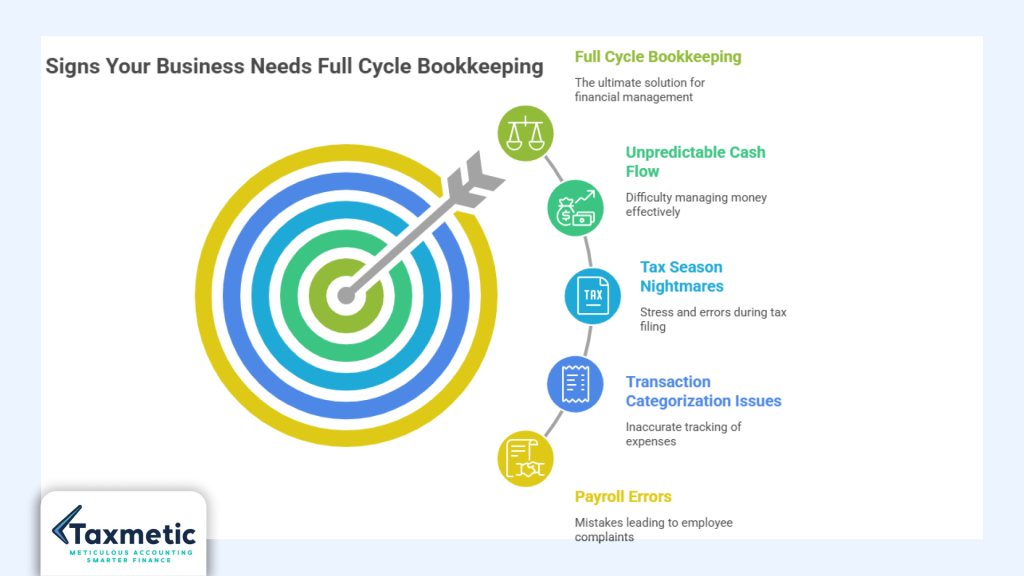
You’re a prime candidate if:
- You’re months behind on categorizing transactions.
- Tax season turns into a nightmare of lost receipts.
- You can’t recall your monthly profits offhand.
- Cash flow feels unpredictable month to month.
- Payroll errors lead to employee complaints or CRA notices.
- HST calculations confuse you every quarter.
- Your accountant spends hours fixing your books.
- Spreadsheets no longer cut it as you’ve hired staff or hit six figures in revenue.
Don’t wait for a CRA letter address these now.
Benefits of Full Cycle Accounting
Full cycle accounting (often used interchangeably with bookkeeping) delivers tangible wins:
- Crystal-clear financial visibility for spotting trends.
- Smoother tax filing with organized records.
- Fewer CRA issues and penalties.
- Precise cash flow tracking to avoid overdrafts.
- Data-driven decisions, like when to hire or expand.
- Hours saved for core business activities.
- Smarter budgeting tied to real numbers.
- Scalable systems as you grow.
Good bookkeeping doesn’t just help you survive tax season it powers smarter moves, like optimizing salary vs dividends.
Full Cycle Accounting Process Explained
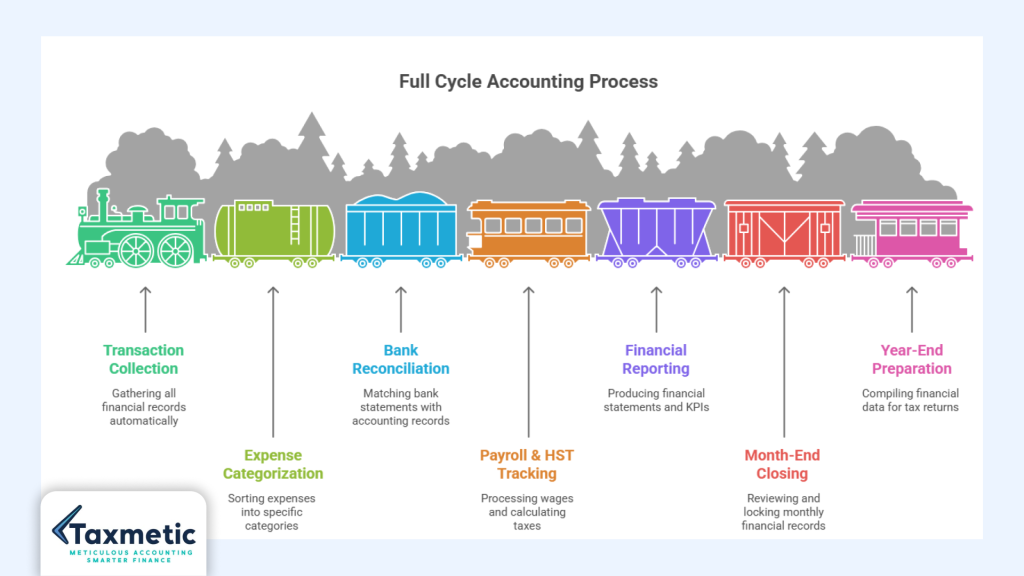
Dive into the workflow:
Step 1: Transaction Collection
Gather all invoices, receipts, and bank feeds automatically via cloud tools.
Step 2: Expense Categorization
Sort into buckets like rent, marketing, or supplies for accurate reporting.
Step 3: Bank Reconciliation
Match statements to books, catching discrepancies fast.
Step 4: Payroll & HST Tracking
Process wages, deductions, and calculate 13% Ontario HST owed.
Step 5: Financial Reporting
Produce P&L, balance sheets, and KPIs.
Step 6: Month-End Closing
Review, adjust, and lock the period.
Step 7: Year-End Preparation
Compile for T2 corporate returns or audits.
This process keeps Hamilton businesses compliant and informed.
Should Small Businesses Outsource Full Cycle Bookkeeping?
Let’s be real: If you’re a solo Hamilton freelancer logging gigs from a coffee shop on King Street West, DIY bookkeeping in Excel might suffice. But as your business scales hiring that first employee, chasing bigger contracts, or hitting HST thresholds it turns into a nightmare. Weekends vanish sorting receipts, errors creep in (like miscategorizing a client lunch), and stress builds toward tax deadline panic. Sound like your story?
Why DIY Falls Short for Growing Businesses
We’ve heard it from countless Hamilton owners:
- Time Drain: 10-20 hours/month stolen from revenue-generating work.
- Error Risks: 1 in 5 small businesses faces CRA penalties from sloppy records (CRA data).
- Scaling Limits: Spreadsheets crumble with payroll or inventory.
- Stress Factor: “My books are a mess” is a top regret on local Reddit threads.
Outsourcing full cycle bookkeeping flips this. You get pro oversight, seamless cloud tools like those in our Xero vs QuickBooks comparison, real-time dashboards, and bulletproof CRA/HST/WSIB compliance.
DIY vs Outsourcing: Head-to-Head
| Factor | DIY Bookkeeping | Outsourced Full Cycle |
| Time Commitment | 15+ hours/month | Near zero experts handle it |
| Accuracy | Prone to human error (20-30% mistake rate) | 95%+ accuracy with software |
| Cost | “Free” but opportunity loss | $400-1,200/month (ROI via savings) |
| Insights | Basic snapshots | Real-time reports + tax planning tips |
| Compliance | Risky guesswork | CRA-ready, audit-proof |
Forum wisdom backs it: Hamilton small biz owners on r/OntarioBusiness and r/Hamilton rave about outsourcing once books eat weekends. One restaurant owner shared: “Switched to Pros, errors dropped 80%, and I spotted $3K in missed deductions.” Industry stats agree: Outsourced firms cut compliance errors by 80% (per CPA Canada).
4 Steps to Seamless Outsourcing
- Assess Needs: Tally transactions/payroll over 200/month? Outsource.
- Choose Experts: Look for Hamilton locals with QuickBooks certs.
- Migrate Smoothly: Cloud setup in days, not weeks.
- Track Wins: Monthly reports show the value.
Ready to ditch the hassle? Many growing Hamilton spots outsource to focus on operations. It’s not an expense, it’s an investment in your freedom.
How Taxmetic Helps Hamilton Businesses
At Taxmetic, we specialize in full cycle bookkeeping for Hamilton’s small businesses. Our services include:
- Monthly transaction recording and reconciliations.
- Payroll processing with CRA remittances.
- HST filing and WSIB compliance.
- Custom financial reports and cash flow forecasts.
- Book a cleanup for overdue messes.
- Cloud setups with QuickBooks or Xero expertise.
- Direct CRA support and audit prep.
As locals, we understand Hamilton’s scene from contractors to clinics. Learn more about accountant costs in Hamilton or if you need an accountant.
FAQ
Q: What is full cycle bookkeeping?
Answer: Full cycle bookkeeping manages your entire financial process: recording transactions, reconciliations, reporting, payroll, HST, and year-end prep.
Q: What is the accounting cycle?
Answer: It’s the 8-step process from identifying transactions to closing books, repeated monthly or annually.
Q: Does my small business need full cycle bookkeeping in Ontario?
Answer: Yes, if you’re growing, dealing with HST/payroll, or tired of tax stress, especially over $30K revenue.
Q: What does a full cycle bookkeeper do?
Answer: Daily recording, weekly payables, monthly reconciliations/reports, quarterly filings.
Q: How much does bookkeeping cost in Ontario?
Answer: Starts at $300-800/month for small businesses, depending on transactions. Check our accountant cost guide.
Q: Can I do bookkeeping myself?
Answer: Possible for basics, but outsourcing scales better and avoids errors.
Q: What’s the difference between bookkeeping and accounting?
Answer: Bookkeeping records transactions; accounting analyzes and advises (we do both).
Q: How often should bookkeeping be updated?
Answer: Daily for transactions, weekly reviews, monthly closes.
Q: Is full cycle bookkeeping worth it for small businesses?
Answer: Absolutely saves time, cuts penalties, boosts insights.
Ready to Simplify Your Books?
Full cycle bookkeeping keeps your Hamilton business compliant, profitable, and stress-free amid Ontario’s tax demands. Whether catching up on backlogs or setting up proactive systems, it’s key to growth without the guesswork.
Contact Taxmetic today for a free consultation. Let’s get your finances on track, book now, and discover why we’re a top choice like our best accountant guide.