
If you drive for Uber, deliver for DoorDash, or hustle across multiple gig apps in Hamilton, you already know how much the landscape has changed over the past few years. What started as a side income for many Ontario residents has quietly become a primary source of earnings for thousands of drivers across the Greater Hamilton Area and beyond. The gig economy taxes is not slowing down, and neither are the Uber and DoorDash Tax obligations that come with it.
Hamilton has seen a significant surge in rideshare and delivery activity. With a growing population, expanding urban boundaries, and increasing demand for on demand services, platforms like Uber, Uber Eats, DoorDash, SkipTheDishes, and Lyft have become deeply embedded in the daily fabric of city life. For drivers, that means more earning opportunities. But it also means more responsibility when tax season arrives.
Here is where things get complicated for a lot of drivers. Unlike a traditional job where your employer deducts income tax, CPP, and EI from every paycheque, gig platforms do not touch your taxes at all. No deductions happen automatically. No one reminds you to register for HST. No one tracks your mileage or tells you what you can claim. By the time April rolls around, many Hamilton drivers are left scrambling through receipts, confused about T4A slips, unsure whether they owe HST, and genuinely uncertain how to report their income correctly to the Canada Revenue Agency.
The CRA does not treat gig workers as employees. In the eyes of the CRA, if you drive for Uber or deliver for DoorDash, you are running your own business. That means you are classified as self employed, and the rules that apply to you are very different from those that apply to salaried workers. This distinction has major implications for how you file, what you can deduct, and what happens if you get something wrong.
This guide was written specifically for Hamilton drivers who want clear, practical, and up to date answers. Whether you are brand new to the gig economy taxes or have been driving for a few years and want to make sure you are filing correctly, you will find everything you need right here. Here is a quick look at what this guide covers:
- Whether Uber and DoorDash drivers are truly self employed under Canadian tax law
- How HST works for rideshare and delivery drivers in Ontario
- What tax forms you will receive and what to do with them
- How to file your taxes correctly using the T1 return and T2125
- Every deduction Hamilton drivers can legally claim, including mileage, fuel, phone, and vehicle expenses
- How much to set aside so you are never caught off guard by a tax bill
- Common mistakes drivers make and how to avoid a CRA audit
- Key deadlines for the 2026 tax filing season
- Whether incorporation makes sense for your situation
- And when it is time to stop guessing and call a tax professional in Hamilton
If you are also self employed in other areas beyond gig driving, you may want to read our Complete 2026 Tax Guide for Self Employed Workers in Hamilton alongside this one, as many of the same rules apply across different types of independent income.
Let us get into it.
Are Uber and DoorDash Drivers Self Employed in Canada?
This is the question most new gig drivers ask first, and the answer has a big impact on everything else related to your taxes. Yes, if you drive for Uber, deliver for DoorDash, pick up rides on Lyft, or fulfill orders through SkipTheDishes, the CRA treats you as self employed. You are not an employee of these platforms. You are an independent contractor running your own small business, whether or not you think of yourself that way.
How CRA Classifies Gig Workers
The CRA uses several factors to determine whether a working relationship looks like employment or self employment. For gig drivers, the answer is almost always self employment. You set your own hours. You use your own vehicle. You bear the risk of profit and loss. You are free to work for multiple platforms at the same time. These are all characteristics of an independent contractor, not an employee.
This classification is not something Uber or DoorDash decided on their own. The CRA has consistently treated rideshare and delivery drivers as self employed individuals earning business income. That ruling comes directly from how these platforms structure their contracts and how drivers actually operate.
Difference Between Employee and Contractor
Understanding this distinction matters because it changes your entire tax situation.
| Factor | Employee | Gig Driver (Self Employed) |
| Tax deducted at source | Yes, automatically | No, you handle it yourself |
| Receives T4 slip | Yes | No traditional T4 |
| CPP contributions | Shared with employer | You pay the full amount |
| EI eligible | Usually yes | Generally not eligible |
| Can claim business expenses | Limited | Yes, broad deductions available |
| Files T2125 | No | Yes, mandatory |
| HST obligations | Employer handles | Your responsibility |
As you can see, self employment gives you more flexibility but also more responsibility. The tax deductions available to you are significant, but they come with obligations you have to manage on your own.
Why Uber Drivers Receive Business Income
When Uber or DoorDash pays you, that money is classified as business income under Canadian tax law. It is not employment income. This means you report it on Form T2125, which is the Statement of Business or Professional Activities. This form is filed as part of your T1 personal tax return each year.
On T2125, you report your gross income from all gig platforms, then deduct your eligible business expenses to arrive at your net business income. You pay federal and provincial income tax on that net amount. You also pay CPP contributions on it, and this is where many drivers get surprised.
As a self employed individual, you are responsible for both the employee and employer portions of CPP. In a traditional job, your employer covers half. When you are self employed, the full CPP contribution falls on you. For the 2025 tax year, the self employment CPP contribution rate is 11.9% on net business income up to the maximum pensionable earnings threshold. That is a meaningful amount, and it catches many gig workers off guard if they have not been setting money aside throughout the year.
For more on what self employment means for your overall tax picture in Ontario, our Complete 2026 Tax Guide for Self Employed Workers in Hamilton covers these topics in broader detail.
Do Uber Drivers Pay HST in Canada?
This is one of the most searched questions among Hamilton rideshare drivers, and the answer is more important than most people realize. Yes, Uber drivers in Canada are generally required to register for and collect HST, regardless of how much money they earn. This is different from most other self employed individuals, and the rule catches many drivers off guard.
Uber HST Rules Explained
In Ontario, the HST rate is 13%. As a business owner, you are generally not required to register for HST until your business income crosses $30,000 in a calendar year. This is called the small supplier threshold. However, rideshare drivers are subject to a different rule under the Excise Tax Act.
The federal government has specifically designated ridesharing as a commercial activity that requires mandatory HST registration from day one. This means that even if you earned $5,000 driving for Uber last year, you were still required to be registered for HST and to charge and remit it. There are no exceptions for rideshare income when it comes to this threshold.
The $30,000 Rule and Exceptions
Here is how the two rules compare side by side, because the difference between rideshare and delivery driving is significant:
| Type of Gig Work | HST Registration Threshold |
| Rideshare driving (Uber, Lyft) | Mandatory from day one, no threshold |
| Food delivery only (DoorDash, SkipTheDishes) | Required only after $30,000 in revenue |
| Mixed work (rideshare and delivery) | HST registration required for all income |
If you only do food delivery and have not crossed the $30,000 threshold, you may not be required to register yet. But the moment you accept even a single rideshare trip through Uber, the mandatory registration rule kicks in for that portion of your income. Many drivers who do both rideshare and delivery choose to register for HST on all of their income at once to keep things simple and compliant.
Why Rideshare Drivers Must Register for HST
When Uber collects fares from passengers, HST is embedded in that fare. Uber collects the HST on your behalf and remits it to the CRA directly. However, you still need to be registered so the process works correctly and so you can claim Input Tax Credits on your business expenses.
Input Tax Credits, commonly called ITCs, allow you to recover the HST you paid on eligible business expenses. This is one of the real financial benefits of HST registration. When you buy fuel, pay for repairs, purchase a dash cam, or pay for a phone plan used for your gig work, you paid 13% HST on those purchases. By being registered, you can claim that HST back as an ITC when you file your HST return.
If you are unsure whether you should already be registered, our blog on when you need to register for HST in Ontario walks through the rules in more detail and applies them to different self employment situations.
How DoorDash Taxes Work in Ontario
DoorDash operates differently from Uber in one important way when it comes to taxes, and it is worth understanding that difference clearly so you are not applying the wrong rules to your situation.
DoorDash Self Employment Tax Canada
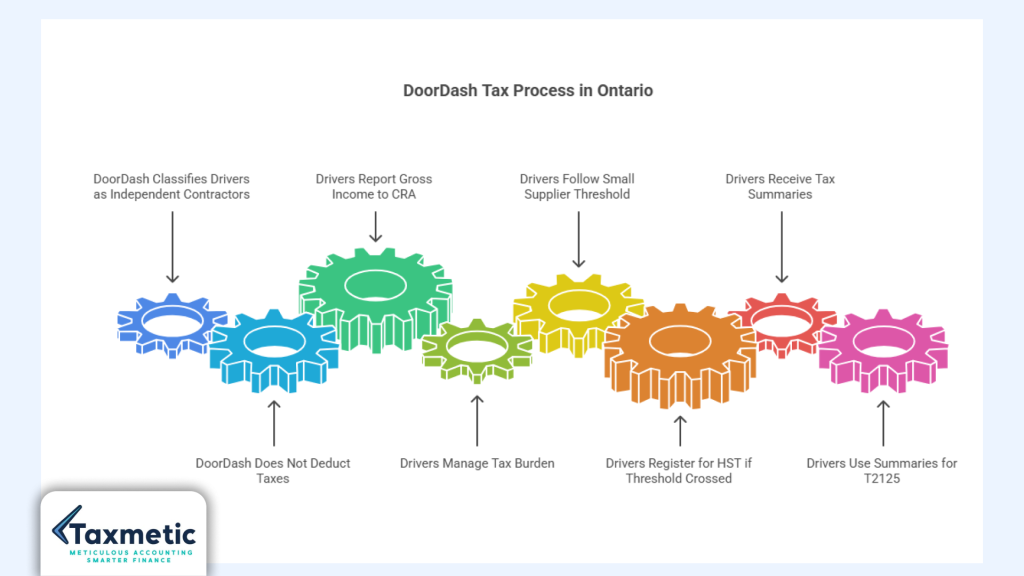
Like Uber, DoorDash classifies its drivers as independent contractors, not employees. This means DoorDash does not deduct income tax, CPP, or any other amount from the payments you receive. Every dollar DoorDash deposits into your account is gross income that you are responsible for reporting to the CRA. The entire tax burden falls on you, and you are expected to manage it throughout the year rather than having it handled automatically.
This arrangement is perfectly legal and standard across the gig economy taxes. But it requires DoorDash drivers to be much more financially disciplined than a traditional employee would need to be. Many drivers who are new to the platform assume that because taxes are not being deducted, they do not owe any. That assumption leads to painful surprises when April arrives.
Does DoorDash Deduct Taxes?
No. DoorDash does not withhold any taxes from driver earnings in Canada. This applies to federal income tax, provincial income tax, and CPP contributions. You receive your full earnings, and it is entirely your responsibility to set aside the appropriate amount for taxes throughout the year.
HST Rules for Delivery Drivers
Here is where DoorDash drivers get a slight break compared to Uber drivers. Food delivery drivers are not subject to the mandatory HST registration rule that applies to rideshare. Instead, delivery drivers follow the standard small supplier threshold of $30,000 per year. If your total business income from delivery apps stays below that amount in a calendar year, you are not required to register for HST.
However, keep a few things in mind. First, if you earn income from multiple sources such as DoorDash, SkipTheDishes, and Uber Eats combined, all of that income counts toward the $30,000 threshold together, not separately. Second, if you also do any rideshare driving through Uber or Lyft at any point during the year, the mandatory rideshare HST registration rule applies and you should register for all your gig income at once.
Once you cross the threshold or begin rideshare work, you have 30 days to register for an HST number with the CRA. Waiting too long can result in penalties and retroactive remittance obligations.
What Tax Forms Uber and DoorDash Drivers Receive
Tax slip season creates a lot of confusion for gig workers in Hamilton, mostly because the forms you receive as a gig driver look very different from the T4 slip that most employees are used to getting from their employer. Understanding what you will and will not receive from these platforms is essential to filing correctly.
Understanding Uber Tax Summaries
Uber does not issue a traditional T4 slip to drivers because you are not an employee. Instead, Uber Canada provides an annual tax summary through the driver app. This summary breaks down your total earnings for the year, the HST collected on your behalf, any fees Uber charged you, and other relevant financial details.
This tax summary is not an official CRA form. It is a report that Uber generates to help you understand your income. You use this information to complete your T2125, but the tax summary itself does not get submitted to the CRA. You are responsible for taking those numbers and reporting them correctly on your own return.
Uber T4A Hamilton Confusion
Some Uber drivers in Hamilton receive a T4A slip, while others only get the tax summary. This inconsistency causes a lot of confusion. A T4A can be issued when Uber pays you for certain types of incentives or bonuses outside of regular trip earnings. If you receive a T4A from Uber, it needs to be reported on your tax return, but it does not replace the need to also report your regular trip income using the tax summary figures.
If you received a T4A and are not sure what to do with it, the key thing to know is that T4A income from Uber is still business income and should be included on your T2125 along with the rest of your gig earnings. Do not treat it like employment income or report it on the wrong line of your return.
What If DoorDash Sends No Tax Slip?
DoorDash Canada does not consistently issue tax slips to drivers. In many cases, drivers receive no official slip at all. This does not mean your income is unreported or that you do not owe taxes on it. It simply means DoorDash has left record keeping entirely in your hands.
Here is what that means practically:
| Platform | What You Typically Receive | What You Must Do |
| Uber | Annual tax summary plus sometimes a T4A | Use summary to complete T2125 |
| DoorDash | No standard slip in many cases | Track your own earnings through the app |
| SkipTheDishes | Tax summary through driver portal | Download and save before filing |
| Lyft | Annual earnings statement | Use to complete T2125 |
Regardless of what any platform sends you, the CRA expects you to report all income accurately. The absence of a slip does not excuse unreported income. Keep weekly or monthly records of your earnings from each app, download your year end summaries as soon as they are available, and hold onto them for at least six years in case of a CRA review.
How to File Taxes as a Gig Worker in Ontario
Filing your taxes as a gig worker is not the same as filing a simple employment return. There are additional forms involved, and getting the structure right matters both for accuracy and for maximizing your deductions legally.
Filing T2125 Correctly
The T2125, Statement of Business or Professional Activities, is the core form for reporting self employment income in Canada. Every gig driver who earned income from Uber, DoorDash, SkipTheDishes, Lyft, or any other platform must complete this form as part of their annual T1 return.
On T2125 you will report your gross business income, which is the total amount you earned before any expenses. Then you deduct all of your eligible business expenses, which we will cover in detail in the next section. The result is your net business income, and that is the amount used to calculate your income tax and CPP contributions.
One important note: you report gross income, not the amount deposited to your bank account. If Uber took platform fees, service charges, or other deductions from your earnings before paying you, you still report the full gross amount and then claim those fees as a business expense on the same form. This is how the CRA expects it to be done, and doing it any other way can trigger questions.
Reporting Uber and Lyft Income
If you drove for both Uber and Lyft during the same tax year, you can report all of that rideshare income together on a single T2125 under one business activity. You do not need to file a separate T2125 for each platform. Combine your gross earnings from both, combine your expenses, and report it all together.
The same applies if you do both rideshare and delivery work. As long as it is all related to your vehicle based gig work, combining it on one T2125 is acceptable. However, if you also have a separate self employment activity, such as freelance work or a side business, that income would go on its own T2125.
Filing Multiple Gig Apps Together
As your gig income grows, you may also need to start making quarterly tax installments. The CRA requires installments when your net tax owing for the year exceeds $3,000 after subtracting any tax withheld at source. Since no tax is withheld from gig income, this threshold can be reached faster than you might expect.
Quarterly installment due dates for 2026 are March 15, June 15, September 15, and December 15. Missing these dates results in interest charges on the amount owed. The CRA will usually send you an installment reminder if you owed more than $3,000 in a prior year, but waiting for that letter is not a reliable strategy.
Our T1 Personal Tax Return Complete Checklist for Filing is a helpful companion resource to make sure you have everything organized before you sit down to file.
Best Tax Deductions for Hamilton Drivers
This is the section most drivers are eager to get to, and for good reason. The deductions available to self employed gig workers in Canada are genuinely significant. The CRA allows you to deduct any reasonable expense you incurred for the purpose of earning business income. For Hamilton drivers, this covers a wide range of everyday costs that you may not have realized are deductible.
Gig Worker Deductions Canada 2026
The key principle is that the expense must be for business purposes. Some expenses are 100% deductible if they are used entirely for your gig work. Others are partially deductible based on how much you use them for business versus personal purposes. Your vehicle is the most common example of a mixed use expense.
What Rideshare Drivers Can Claim
| Expense Category | Deductible | Notes |
| Fuel and gas | Proportional to business use | Based on business mileage percentage |
| Car insurance | Proportional to business use | Must document business use percentage |
| Vehicle repairs and maintenance | Proportional to business use | Keep all receipts |
| Car washes | Proportional to business use | Only if needed for business cleanliness |
| Parking fees (while on duty) | 100% deductible | Keep receipts |
| Cell phone and data plan | Proportional to business use | Estimate business vs personal use |
| Delivery bags and equipment | 100% if used for business | SkipTheDishes and DoorDash bags qualify |
| Dash cam | 100% if used for business | Also improves safety and documentation |
| Vehicle depreciation (CCA) | Based on business use percentage | Class 10 or 10.1 for most vehicles |
| Accountant or tax preparation fees | 100% deductible | Fees paid to file your business return |
| Bank fees for business account | 100% deductible | Separate business account recommended |
| Platform service fees and commissions | 100% deductible | Uber and DoorDash platform fees |
| Licensing and registration fees | Proportional to business use | Vehicle licensing costs |
| Interest on auto loan | Proportional to business use | If vehicle is financed |
Common Missed Deductions
Many Hamilton drivers leave money on the table because they do not realize certain expenses qualify. Dash cam purchases are deductible and also serve as valuable protection in case of an accident or dispute. Delivery bags, insulated totes, and drink carriers used for DoorDash or SkipTheDishes orders are deductible. The monthly cost of a phone plan, even a personal one, can be partially deducted based on the percentage of time you use your phone for business navigation, app management, and customer communication.
Your accountant fees are also fully deductible. If you paid someone to help you file your gig income taxes, that cost comes right off your taxable income. For more detail on the broader landscape of deductions available to self employed Canadians, our blog on small business tax deductions Hamilton owners miss highlights several that apply equally to independent contractors.
Mileage Deduction Rules for Rideshare Drivers
Vehicle expenses are typically the largest deduction available to rideshare and delivery drivers, and mileage tracking is the foundation of how those deductions are calculated. This area is also where CRA audits tend to focus most heavily, so getting it right matters.
How Mileage Deductions Work
There are two methods for claiming vehicle expenses in Canada. The first is the logbook method, also called the actual expense method, where you track all of your vehicle costs and then apply your business use percentage to determine your deductible amount. The second is not a simple per kilometre flat rate the way some people assume.
Canada does not have a universal flat mileage deduction rate for self employed individuals the way the US does. Instead, you calculate your actual vehicle expenses and then determine what portion of your total driving was for business. That percentage is applied to the total expenses.
For example, if you drove 30,000 kilometres in total during the year and 18,000 of those kilometres were for gig work, your business use percentage is 60%. You would then be able to claim 60% of your eligible vehicle costs as a business deduction.
CRA Mileage Log Requirements
The CRA requires you to maintain a mileage log to support any vehicle expense claim. This log needs to include the following for every business trip:
The date of the trip, the starting point and destination, the purpose of the trip (for example, picking up a DoorDash order or completing an Uber trip), and the number of kilometres driven. You also need to track your total kilometres driven for the year, including personal driving, so the business use percentage can be calculated accurately.
A full logbook must be maintained for at least one complete year. After that, the CRA allows a simplified method where you use a representative sample year as the base and only need a three month sample logbook in subsequent years, as long as your driving patterns remain consistent. However, if your situation changes significantly, you need to go back to a full logbook.
Best Mileage Tracking Methods
Tracking mileage manually with a paper logbook is still accepted by the CRA, but most Hamilton drivers find it easier and more reliable to use a mileage tracking app. Several apps are designed specifically for Canadian gig workers and can automatically log trips using GPS, calculate your business use percentage, and export CRA compliant reports at tax time.
Popular options include MileIQ, Driversnote, and Everlance. Your Uber and DoorDash driver apps also track trip mileage for the time you are actively on a delivery or ride, but that data alone is not sufficient for a complete CRA mileage log. You also need to track deadhead kilometres, which are the kilometres driven from your home to where you start working, between pickups, and returning home at the end of a shift. These kilometres may or may not be deductible depending on your situation, and a tax professional can help you determine what qualifies.
The CRA takes missing mileage logs seriously. If you are ever reviewed and cannot provide documentation for your vehicle expense claims, those deductions can be denied entirely, resulting in unexpected tax owing plus interest. Consistent mileage tracking from day one protects you.
Vehicle Expenses You Can Claim
Beyond mileage percentage, it helps to understand exactly which vehicle related costs qualify for deduction and how each one works. Your car is your business tool as a gig driver, and the CRA recognizes that by allowing a broad range of vehicle expenses.
Actual Expense Method Explained
Under the actual expense method, you add up every dollar you spent on your vehicle throughout the year and multiply that total by your business use percentage. The categories that count toward your total vehicle expenses include fuel, insurance, maintenance and repairs, license and registration fees, interest on a car loan (up to CRA limits), and capital cost allowance (CCA), which is the term for vehicle depreciation.
CCA for a vehicle used in self employment is calculated using the declining balance method. Most passenger vehicles fall into CRA Class 10 or Class 10.1. Class 10 applies to vehicles that cost less than the CRA’s passenger vehicle cost limit (which adjusts periodically), while Class 10.1 applies to more expensive vehicles. The CCA rate for both classes is 30% on a declining balance, but there are specific rules about how much you can claim in the first year a vehicle is purchased. A tax professional can help you calculate CCA correctly based on your vehicle’s cost and the year you started using it for business.
Fuel vs Mileage Tracking
Some drivers wonder whether they should track fuel receipts or just track kilometres. The answer is that you should do both. Your fuel receipts are part of the actual expense method. Your mileage log establishes the business use percentage that determines how much of those fuel costs you can claim. Without both pieces, you cannot calculate your deduction correctly.
Leasing and Financing Deductions
If you lease your vehicle, your monthly lease payments are deductible based on your business use percentage, subject to CRA limits on the maximum monthly lease cost that qualifies. If you financed the vehicle with a loan, the interest portion of your payments is deductible, again subject to CRA limits and prorated for business use. The principal portion of a loan payment is not directly deductible, but the vehicle’s value is captured through CCA.
For a broader look at expense deductions that often go unclaimed, check out our blog covering the top 10 tax deductions for business owners, several of which apply directly to self employed gig workers.
How Much Tax Should Gig Workers Save?
This question has a different answer depending on how much you earn, but the principle is the same for every gig driver: you need to set aside a portion of every payment you receive before you spend it. Many Hamilton drivers learn this lesson the hard way after their first full year of gig work.
Estimated Tax Percentages
There is no single exact number that applies to everyone, because your tax rate depends on your total income from all sources and the deductions you can claim. That said, a commonly recommended starting point is setting aside between 25% and 30% of your gross gig income for tax purposes. This covers federal and provincial income tax as well as the self employment CPP contribution.
Here is a rough breakdown of what you might owe based on different income levels in Ontario, keeping in mind that these are estimates and your actual tax owing depends on your deductions, credits, and other income:
| Annual Net Business Income | Estimated Federal Tax | Estimated Ontario Tax | Estimated CPP | Approximate Total |
| $20,000 | Approx. $2,000 | Approx. $1,000 | Approx. $2,380 | Approx. $5,380 |
| $40,000 | Approx. $5,500 | Approx. $3,200 | Approx. $4,760 | Approx. $13,460 |
| $60,000 | Approx. $10,000 | Approx. $6,200 | Approx. $5,800 | Approx. $22,000 |
| $80,000 | Approx. $16,000 | Approx. $10,000 | Approx. $6,300 | Approx. $32,300 |
These figures are approximate and assume no other income sources or tax credits. Always speak with a professional for a calculation specific to your situation.
CPP Obligations for Contractors
One piece that many new gig drivers do not anticipate is the full CPP contribution. Unlike an employee who pays only half the CPP rate, self employed individuals pay both halves. For 2025, the combined self employed CPP contribution rate is 11.9% on net self employment income, up to the maximum pensionable earnings ceiling. This can add thousands of dollars to your annual tax bill beyond what you would owe on income tax alone.
Avoiding Surprise Tax Bills
The simplest approach is to open a dedicated savings account and transfer 25% to 30% of every gig payment you receive into it immediately. Treat that money as if it does not exist for spending purposes. When tax season comes, you will not be scrambling to find funds, and you may even have money left over if your deductions bring your taxable income down significantly.
If your net self employment income exceeds $3,000 after deductions, the CRA will expect you to make quarterly installment payments for the following year. Setting money aside regularly makes those installments manageable.
Common Tax Mistakes Hamilton Drivers Make
After working with self employed individuals and gig workers in Hamilton, certain mistakes come up again and again. Knowing about them in advance can save you from costly corrections and stressful CRA interactions.
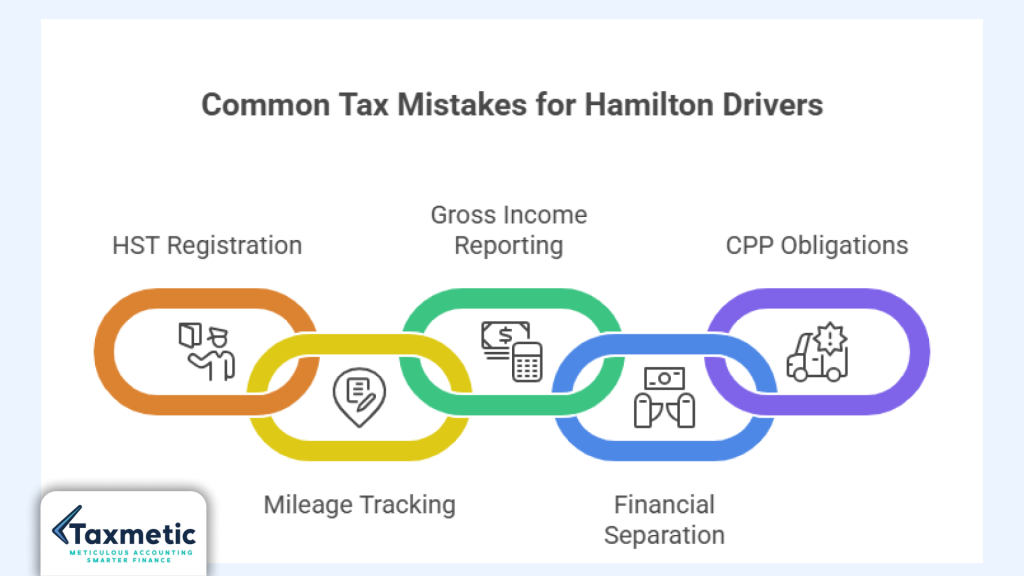
Forgetting HST Registration
The most common and expensive mistake rideshare drivers make is driving for Uber or Lyft without registering for an HST number. As discussed earlier, rideshare income triggers mandatory HST registration from the first dollar earned. Drivers who ignore this and are later flagged by the CRA can face retroactive HST remittance obligations, interest charges, and penalties. Registering is free and takes less than 30 minutes online through the CRA’s Business Registration Online portal.
Not Tracking Mileage
The second most common mistake is failing to keep a mileage log. Drivers who skip this step often discover at tax time that they cannot support their vehicle expense claims. Without a log, the CRA has every right to disallow those deductions entirely. Even if you start halfway through the year, beginning now is better than having nothing at all.
Using Bank Deposits Only
Some drivers assume that whatever lands in their bank account is their total income for CRA purposes. This is not accurate. You are required to report your gross income, meaning the total amount before platform fees, service charges, and other deductions. CRA data sharing arrangements with gig platforms are increasing, and the agency has tools to cross reference reported income with what platforms have paid out. Underreporting, even unintentionally, creates problems.
Mixing Personal and Business Finances
Using one bank account for both personal spending and gig income makes bookkeeping significantly harder and increases the chance of missing deductible expenses or accidentally claiming personal costs. A dedicated account for gig income keeps your records clean and makes filing much easier.
Ignoring CPP Obligations
Many first year gig drivers are stunned when they see the CPP line on their Notice of Assessment. They expected to owe income tax but did not factor in the self employment CPP contribution. This is a common surprise that proper planning eliminates entirely.
CRA Audit Risks for Gig Workers
The CRA has been paying increasing attention to the gig economy taxes in Ontario. As platforms like Uber and DoorDash grow in Canada, the CRA has developed better mechanisms for identifying unreported income and non compliant gig workers. Being organized and accurate is the best protection.
What Triggers CRA Reviews
Certain patterns tend to attract CRA attention for self employed individuals. Reporting significantly lower income than comparable drivers in your area can be a flag. Claiming an unusually high business use percentage for your vehicle without supporting documentation is another. Large, round number expense deductions without receipts, or a business that consistently shows losses year after year, can also prompt a review.
The CRA also receives information from third party sources. It has data sharing agreements with financial institutions and is increasingly working with digital platforms to cross reference payment data. If your bank records show substantially more deposits than your reported income, that discrepancy will likely be noticed.
Missing Receipts and Logs
If the CRA selects you for a review of your gig work deductions, the first thing they will ask for is documentation. This means mileage logs, fuel receipts, insurance records, phone bills, repair invoices, and any other paperwork supporting your expense claims. If you cannot produce these documents, the CRA can and often does disallow the deductions, which increases your taxable income and your tax owing, plus interest on any balance.
Underreporting Uber Income
Underreporting income, whether intentional or not, is one of the most serious issues a gig driver can face with the CRA. The penalties for unreported income can be significant, and repeat instances can result in gross negligence penalties of up to 50% of the understated tax. The best approach is always full, accurate reporting of all gig income from every platform you work with.
How Organized Bookkeeping Helps
The single most effective way to reduce your CRA audit risk is to maintain organized, consistent records throughout the year. This means logging your mileage every day you drive, saving digital copies of all receipts, reconciling your gig app earnings monthly, and keeping your HST records up to date. Drivers who do this have nothing to fear from a CRA review. Our blog on CRA audit red flags in Canada outlines the specific triggers that draw CRA attention and is worth reading for any self employed individual.
Tax Filing Deadlines for 2026
Missing a tax deadline as a self employed person costs money. The CRA charges interest on late amounts and late filing penalties on top of that. Knowing your key dates well in advance gives you time to organize your records, gather your documents, and avoid unnecessary fees.
Self Employed Filing Deadlines
Self employed individuals in Canada have a later filing deadline than employees. For the 2025 tax year, the filing deadline for self employed individuals and their spouses is June 16, 2026 (since June 15 falls on a Sunday, the deadline moves to the next business day). However, any balance owing is still due by April 30, 2026. This means that even though you have until mid June to file the return itself, you need to calculate what you owe and pay it by the end of April to avoid interest.
HST Filing Due Dates
Your HST filing deadline depends on the reporting period assigned to your account. Most gig drivers with annual HST revenue below a certain threshold are assigned annual filing periods, which means one HST return per year. For drivers on an annual reporting period with a December 31 fiscal year end, the HST return and payment are due by June 15 of the following year.
| Obligation | Deadline |
| 2025 T1 return (self employed) | June 16, 2026 |
| Balance owing on 2025 return | April 30, 2026 |
| Annual HST return (Dec 31 year end) | June 15, 2026 |
| Quarterly HST (if applicable) | One month after each quarter ends |
| 2026 Q1 installment | March 16, 2026 |
| 2026 Q2 installment | June 15, 2026 |
| 2026 Q3 installment | September 15, 2026 |
| 2026 Q4 installment | December 15, 2026 |
Always verify these dates directly with the CRA website or your tax professional before filing, as deadlines that fall on weekends or holidays are adjusted. Our blog on corporate tax deadlines in Ontario also covers related filing dates if you decide to incorporate down the road.
Should You Incorporate as a Gig Worker?
For most part time or casual gig drivers in Hamilton, incorporation is not necessary and adds more administrative complexity than it is worth. However, for drivers who have turned gig work into a full time income stream, who operate multiple vehicles, or who consistently earn above a certain threshold, incorporation deserves serious consideration.
Sole Proprietor vs Corporation
As a sole proprietor, which is the default structure for most gig drivers, your business income flows directly onto your personal T1 return and is taxed at your personal income tax rate. The advantage is simplicity. The disadvantage is that as your income grows, your personal tax rate grows with it.
| Factor | Sole Proprietor | Corporation |
| Setup complexity | Simple, no formal registration needed | Requires articles of incorporation and annual filings |
| Tax rate on income | Personal marginal rate (up to 53.53% in Ontario) | Small business rate of 12.2% in Ontario (federal plus provincial combined) |
| Income splitting opportunities | Limited | Available through salary and dividends to family members |
| Legal liability protection | None (personal assets at risk) | Limited liability protection |
| Administrative burden | Low | Higher, annual returns and corporate minutes required |
| Ideal for | Lower income gig workers | Higher income drivers or multi vehicle operators |
When Incorporation Makes Sense
Generally speaking, incorporation starts to make financial sense when your net gig income consistently exceeds $80,000 to $100,000 per year, or when you have reached a point where you are not spending all of your gig income personally and can leave profits inside the corporation to grow at the lower corporate tax rate. The decision depends heavily on your personal circumstances, family situation, and long term goals.
For a detailed walkthrough of what incorporation involves in Ontario and what it costs, our blog on how to incorporate a business in Hamilton Ontario covers the process from start to finish. You can also explore our comparison of salary vs dividends for business owners to understand the income distribution strategies that become available once you incorporate.
Tips to Reduce Your Uber and DoorDash Taxes Legally
Reducing your tax bill is not about bending rules. It is about being organized, thorough, and proactive. The CRA provides legal deductions for a reason, and using them fully is not just allowed but expected. The drivers who pay the most tax are usually the ones who are the least organized, not the ones who earn the most.
Keep Digital Receipts
Paper receipts fade, get lost, and are a nightmare to sort through in April. The most effective habit you can build as a gig driver is photographing or scanning every business related receipt immediately when you receive it. Several free apps allow you to store and organize receipts digitally, and the CRA accepts digital copies as valid records. Save fuel receipts, repair invoices, phone bills, insurance documents, and any other expense related paperwork in a dedicated folder organized by month.
Use Mileage Tracking Apps
As discussed earlier, your mileage log is the backbone of your vehicle expense claim. Using an automated mileage tracking app removes the risk of forgetting to log trips manually and produces clean, organized records that are easy to reference at tax time. Set it up when you start your first shift of the year and let it run throughout.
Separate Personal and Business Banking
Opening a dedicated bank account for your gig income is one of the highest impact organizational steps you can take. It simplifies your bookkeeping, makes it easy to identify all business income and expenses at a glance, and prevents the commingling of personal and business finances that causes so many problems at tax time. Some Hamilton drivers also get a dedicated credit card for business expenses to make the tracking even cleaner.
Maximize Every Eligible Deduction
Review your deduction list every few months rather than once a year. Make sure you are claiming your accountant fees, your phone plan proportionally, your platform service fees, and your full vehicle expenses with proper documentation. Many drivers forget deductions that did not occur to them as business expenses in the moment.
Plan Your HST Filing Strategically
If you are an annual HST filer, make sure you are tracking your Input Tax Credits throughout the year so you are ready to claim them fully when your return is due. Many drivers pay HST on business expenses and forget to claim the ITCs, effectively giving money back to the CRA that they did not owe.
At Taxmetic, we help Hamilton gig drivers set up the right systems from the beginning so that none of these steps feel overwhelming. Whether you need help with bookkeeping, HST filing, or a full tax return, our team understands the specific rules that apply to rideshare and delivery drivers in Ontario.
When to Hire a Tax Professional in Hamilton
There comes a point in every gig driver’s journey where doing taxes alone stops making sense. Filing a T1 with a T2125 is manageable for some people, but the complexity increases quickly as your income grows, your deductions multiply, and HST obligations enter the picture.
Signs You Need Professional Help
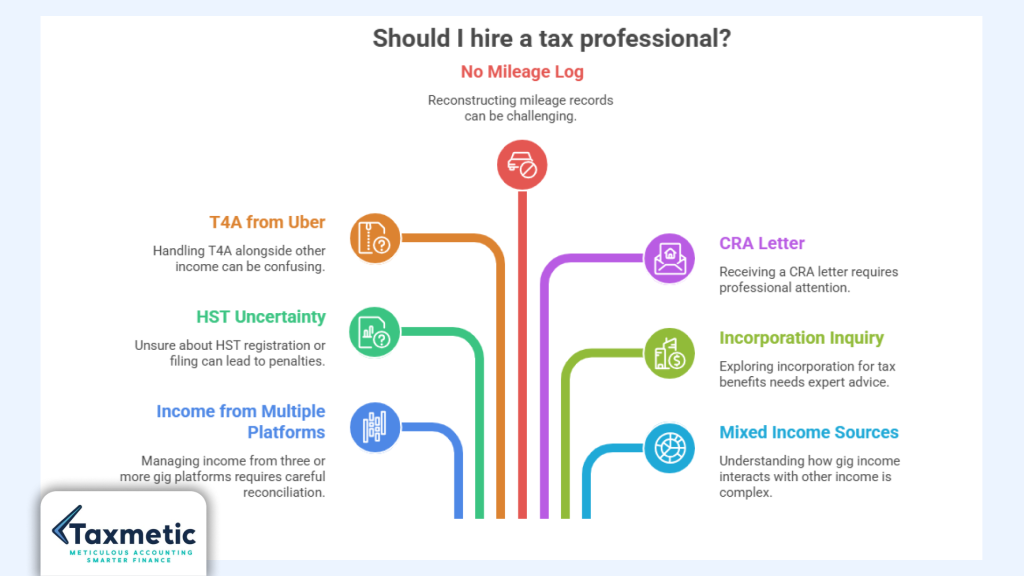
If any of the following apply to your situation, working with a tax professional in Hamilton is likely worth the cost, which is itself a deductible business expense:
You earned income from three or more gig platforms during the year. You are unsure whether you should be registered for HST or how to file your HST return. You received a T4A from Uber and do not know how to handle it alongside your other income. You have not been keeping a mileage log and need help reconstructing reasonable records. You received a letter from the CRA about your gig income. You want to understand whether incorporation could reduce your tax burden. You have both gig income and another source of income such as employment, rental income, or investments, and you are not sure how they interact.
Multiple Apps and Income Streams
The more platforms you work with, the more variables there are in your tax return. Different platforms have different reporting formats, and combining income from Uber, DoorDash, Lyft, SkipTheDishes, and potentially other sources requires careful reconciliation. A professional who understands the gig economy in Canada will ensure nothing is missed and nothing is double counted.
HST Filing Complications
If you have been driving for rideshare without an HST number, or if you are behind on your HST filings, a tax professional can help you come into compliance in the most cost effective way possible. The CRA has voluntary disclosure programs that can reduce or eliminate penalties for drivers who proactively correct past filing issues.
Work With Taxmetic for Gig Driver Taxes in Hamilton
At Taxmetic, we work specifically with self employed individuals, contractors, and gig economy workers across Hamilton and Ontario. Our services for drivers include:
Uber and DoorDash tax return preparation, HST registration and filing, T2125 preparation and optimization, CRA correspondence support, ongoing bookkeeping for gig workers, and self employed tax planning to minimize what you owe legally.
Whether you are filing for the first time or catching up on prior years, our team has the experience to handle your situation efficiently and accurately. You can also explore our self employed tax services page and our bookkeeping services to see how we support gig workers year round. For information on what professional accounting support costs and what it typically includes, our blog on how much an accountant costs in Hamilton Ontario provides a realistic breakdown.
Frequently Asked Questions
Q: Do Uber drivers pay HST in Canada?
Answer: Yes. Rideshare drivers in Canada are required to register for GST/HST regardless of their annual income. The standard $30,000 small supplier threshold does not apply to rideshare income. Delivery only drivers follow the standard threshold unless they also do rideshare.
Q: How do I file taxes as a DoorDash driver in Ontario?
Answer: DoorDash drivers file as self employed individuals. You report your gross earnings from DoorDash on Form T2125 as part of your T1 personal tax return. No taxes are deducted by DoorDash, so you are responsible for calculating and remitting what you owe.
Q: Can I claim gas and mileage for Uber driving?
Answer: Yes. You can claim your actual fuel costs and other vehicle expenses based on the percentage of your total driving that was for business purposes. You need a mileage log to support this claim.
Q: Does Uber send a T4A in Canada?
Answer: Uber may issue a T4A for certain types of payments such as incentives or bonuses. For regular trip earnings, Uber provides an annual tax summary rather than a formal T4A slip. You use this summary to complete your T2125.
Q: What expenses can gig workers deduct in Ontario?
Answer: Gig workers can deduct fuel, vehicle insurance, repairs, car washes, parking, phone and data costs, delivery equipment, dash cams, vehicle depreciation, accountant fees, platform service fees, and other costs incurred to earn business income.
Q: Do I need to register for HST as a DoorDash driver?
Answer: If you do delivery work only, you must register once your combined gross revenue from all self employment sources exceeds $30,000 in a 12 month period. If you also do rideshare driving, registration is mandatory from the start regardless of income level.
Q: What happens if I do not report Uber income to CRA?
Answer: Unreported income can result in reassessments, interest charges, late filing penalties, and in serious cases, gross negligence penalties of up to 50% of the understated tax. The CRA has increasing access to platform payment data, making underreporting a significant risk.
Final Thoughts
Driving for Uber, delivering for DoorDash, or working across multiple gig platforms in Hamilton can be a genuinely rewarding way to earn income. The flexibility is real, the earning potential is real, and for many drivers it has become far more than a side hustle. But the tax side of the business is just as real, and ignoring it leads to consequences that no amount of hustle can easily undo.
The good news is that once you understand the rules, none of this is impossibly complicated. Register for HST if your rideshare income requires it. Track your mileage from day one. Keep your receipts organized. Report your gross income accurately on your T2125. Set aside 25% to 30% of every payment for taxes and installments. And claim every deduction you are legally entitled to, because the CRA built those deductions into the system specifically for workers like you.
Proactive tax planning throughout the year is always less stressful and less expensive than reactive scrambling every April. The drivers who stay on top of their obligations, keep clean records, and plan ahead consistently pay less tax and face fewer CRA complications than those who leave everything until the last minute.
If you are ready to take the guesswork out of your gig income taxes, Taxmetic is here to help. Our team understands the specific rules that apply to Hamilton drivers in 2026, and we will make sure your return is accurate, optimized, and filed on time.
Need help filing Uber or DoorDash taxes in Hamilton? Contact Taxmetic today and let us handle the numbers while you focus on the road.